


Elon Musk Says His New Foundry Can Get Gas Turbines Online 18 Months Faster. Here's What This "Profound Game Changer" Would Mean for SpaceX and Tesla.
Key Points
SpaceX says in-house casting could accelerate turbine production by 18 months.
AI’s enormous electricity needs are driving demand for gas turbines.
Faster power deployment could accelerate SpaceX’s AI infrastructure expansion.
- 10 stocks we like better than Space Exploration Technologies ›
Elon Musk says Space Exploration Technologies (NASDAQ: SPCX) can bring natural gas turbines online up to 18 months faster by manufacturing one of its most difficult components in-house. If he's right, SpaceX could remove one of the biggest bottlenecks facing the artificial intelligence (AI) boom: electricity.
SpaceX is developing a foundry in Bastrop, Texas, that will manufacture turbine blades and vanes. These components have become a major constraint on new gas turbine production, contributing to increasingly long waits for the equipment needed to power new data centers. Musk says bringing that manufacturing in-house could shave as much as 18 months off the time required to get turbines online, calling the potential impact a "profound game changer."
Missed Nvidia in 2009? This Rare Signal Is Flashing Again. In 2009, a "Double Down" signal flashed for a little-known chipmaker called Nvidia. For the first time in years, that same "Total Conviction" signal is flashing for a company 1/100th the size of Nvidia. Continue »
For SpaceX, that could mean getting AI data centers running faster instead of waiting years for additional power generation. And for Tesla (NASDAQ: TSLA), it could make the company's rapidly expanding energy business even more relevant as Musk builds out the power infrastructure needed to support AI.
AI has a power problem
SpaceX is no longer just a rocket and satellite company. As it expands into AI infrastructure, the company needs enormous amounts of computing capacity. And all those graphics processing units (GPUs) need electricity.
Musk, the CEO of both SpaceX and Tesla, has warned that power availability could keep a significant amount of AI computing hardware from even turning on. That's why SpaceX has been scrambling to secure natural gas turbines while simultaneously building solar manufacturing capacity. SpaceX and Tesla are each working toward a goal of eventually manufacturing 100 gigawatts (GW) of solar capacity annually in the U.S. Musk has acknowledged, however, that natural gas will still be needed to supplement solar generation for several years. So instead of waiting years for suppliers to expand turbine production, SpaceX wants to manufacture one of the bottleneck components itself.
Why this matters for SpaceX stock
The immediate benefit is speed. Musk has discussed building 10 GW or more of terrestrial data centers by the end of 2027. Morgan Stanley analyst Adam Jonas estimates Musk could secure roughly 3 GW to 4 GW of power by then through various turbine purchase agreements. Producing turbine components internally could eventually remove another constraint on that expansion.
There's potentially a second benefit. The same foundry could reportedly manufacture castings for SpaceX's Raptor rocket engine turbopumps. That would allow SpaceX to spread the cost of the facility across both its space and AI operations. And of course, vertical integration gives SpaceX greater control over its expansion.
AI companies are spending tens of billions of dollars on GPUs and data centers. But those investments don't generate much value if the facilities can't get enough electricity. Every month SpaceX can eliminate from the power-development timeline potentially means expensive computing equipment starts generating revenue sooner.
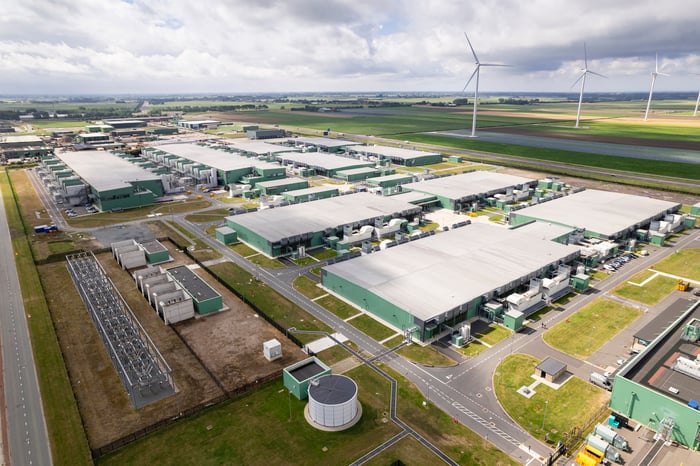
Image source: Getty Images.
What about Tesla?
The benefit to Tesla is less direct, but still important. Tesla is investing heavily in AI, autonomy, robotics, energy storage, and solar. The company is also pursuing a major expansion of U.S. solar manufacturing, including plans for a large new solar facility in Texas.
Tesla already has a substantial position in energy storage through its Megapack business. That gives it exposure to one of the other major challenges created by the AI power boom: balancing electricity supply and demand.
Gas turbines can provide reliable generation. Solar can provide enormous amounts of relatively inexpensive electricity. Batteries can store excess electricity and release it when demand rises. Tesla is already positioned in two of those three areas.
SpaceX's turbine push doesn't mean Tesla will suddenly start manufacturing gas turbines. But the broader build-out could increase demand for the solar generation and battery storage Tesla is trying to scale. And that could make Tesla Energy increasingly important to the company's valuation.
There's still plenty of execution risk
Don't assume SpaceX can simply build a foundry and immediately solve the turbine shortage. Casting turbine blades and vanes is extremely difficult. These parts must operate reliably under extraordinary temperatures and stresses. Established manufacturers have spent decades perfecting their processes. SpaceX will have to prove it can manufacture them reliably and at scale.
So I wouldn't buy SpaceX or Tesla simply because Musk says he can shorten turbine deployment by 18 months. But I would watch what happens in Bastrop. Because if SpaceX can manufacture these components at scale, it could bring new power generation online faster, accelerate its AI infrastructure build-out, and reduce its dependence on outside suppliers.
For Tesla, the impact is more indirect. But a massive expansion of AI power infrastructure creates another potentially enormous market for solar generation and battery storage. So yes, this is much bigger than just turbines, and the result could absolutely be the profound game changer Musk claims it to be.
Should you buy stock in Space Exploration Technologies right now?
Before you buy stock in Space Exploration Technologies, consider this:
The Motley Fool Stock Advisor analyst team just identified what they believe are the 10 best stocks for investors to buy now… and Space Exploration Technologies wasn’t one of them. The 10 stocks that made the cut could produce monster returns in the coming years.
Consider when Netflix made this list on December 17, 2004... if you invested $1,000 at the time of our recommendation, you’d have $421,997!* Or when Nvidia made this list on April 15, 2005... if you invested $1,000 at the time of our recommendation, you’d have $1,413,876!*
Now, it’s worth noting Stock Advisor’s total average return is 978% — a market-crushing outperformance compared to 213% for the S&P 500. Don't miss the latest top 10 list, available with Stock Advisor, and join an investing community built by individual investors for individual investors.
See the 10 stocks »
*Stock Advisor returns as of September 5, 2026.
Jeff Siegel has no position in any of the stocks mentioned. The Motley Fool has positions in and recommends Tesla. The Motley Fool has a disclosure policy.
Recommended Articles


