


AMD Q2 2026 Revenue $11.536B (+50%), Data Center $6.7B (+107%), Q3 $13B Guidance, Helios AI, Taalas Acquisition
TradingKey - AMD entered August 25th with strong Q2 momentum and strengthening Data Center fundamentals. Strong Q2 revenue of $11.536B (comprised of $6.7B Data Center revenue, or 58% of total revenue, +107% YoY) was partially attributable to the non-GAAP gross margin of 56% and GAAP gross margin of 54%. This led to non-GAAP net income of $2.76B ($1.66 EPS) and GAAP net income of $2.30B ($1.38 EPS). For Q3, the company expects revenue of $13.0B (+41% YoY, +13% seq) on a 56% gross margin. The progress of the company is evidenced by the deployments of the Helios rack-scale AI platform by a growing list of clients, including Anthropic (2GW of MI450-Series), Meta, Microsoft (Azure), OpenAI, and Oracle.
The pending Taalas acquisition, announced August 6 and awaiting regulatory approval, is expected to contribute to this accelerated growth once closed. The company also appointed Tim Ryan (Citi Group, PwC) to the Board on August 19, and acquired the AI inference specialist firm, Toronto-based Taalas on August 6. Strong unit growth of Client Ryzen (+23%) was partially offset by lower unit demand for gaming products (-31%) driven by the semi-custom console cycle. Embedded business demand increased by 19%. These metrics, coupled with a cash position of $13.11B and a debt position of $3.23B, show that AMD is well positioned for the anticipated continued growth of data center businesses.
Q2 Revenue $11.536B (+50% YoY): Data Center Dominance
For Q3 guided revenue is expected to be around $13.0B (±$300M). At the midpoint, growth is expected to be +41% YoY and +13% sequential. Non-GAAP gross margin expected to be around 56% (stable). Jean Hu, AMD's CFO, mentioned that the Data Center growth is expected to expand the revenue and increase earnings for the remaining half of 2026. This probably means that the management is more focused on the Data Center acceleration as compared to normalization (as expected in Q2). This amplifies that Q3 is going to be an important test for that this guidance is based on.
Q3 Guidance $13B: +41% YoY, +13% Sequential, Management Calls DC Acceleration
AMD Helios is a unified effort consisting of Instinct accelerators, EPYC CPUs, networking, and ROCm software for building AI systems. It is being deployed by Anthropic, Meta, Microsoft, Oracle, HUMAIN, OpenAI, TensorWave, and Vultr. Anthropic has committed to using 2GW of the MI450-series of Helios racks, and has entered into a collaboration with AMD for the optimization of ROCm. Microsoft has announced the expansion of Helios on Azure focusing on frontier-model inference. It has also added EPYC VMs and Pensando networking. This was a competitive offering from AMD against NVIDIA Blackwell/Rubin. It has also begun their endeavor of providing integrated platforms from their offerings of discrete components.
Helios Rack-Scale Platform: 2GW Anthropic Deal, Microsoft Azure Expansion
AMD Helios consolidates Instinct accelerators, EPYC CPUs, networking, and ROCm software into complete AI systems. Deployed by Anthropic, Meta, Microsoft, OpenAI, Oracle, HUMAIN, and TensorWave. Anthropic deal: up to 2GW MI450-series in Helios racks + ROCm optimization deal. Microsoft is adding Helios to Azure for frontier-model inference and is building EPYC VMs and Pensando networking. A full-system approach is more competitive against NVIDIA’s EGX Blackwell/Rubin than discrete components. AMD has begun to integrate and build systems to compete with NVIDIA.
Taalas Acquisition (August 6): AI Inference Specialization
On August 6, AMD announced plans to buy Taalas (Toronto, AI-inference silicon specialist). Taalas builds hardware designed to remove compute and memory bottlenecks found in AI-model data flows. AMD will integrate it with Instinct GPUs and Helios Systems. Price and terms were not disclosed, pending regulatory approvals. This acquisition is very important to AMD as the fastest growing segment of AI is Inference (as opposed to the slower segment of Model Training). Inference runs the models in production as opposed to building the models. This acquisition adds dataflow optimization capabilities to AMD’s arsenal.
EPYC 6th-Generation: Agentic AI, Enterprise, CPU + GPU Strategy
AMD revealed 6th-gen EPYC processors for agentic applications, enterprise, and general-purpose workloads. The key insight for this release is AI data centers will use large numbers of CPUs along with co-accelerators (applications, networking, storage, inference services). This allows AMD to participate in AI spend across both CPUs and GPUs, which reduces the reliance on Instinct accelerators.
Client Ryzen +23%, Gaming -31%, Embedded +19%
Client YoY revenues for Q2 stand at $3.1B for Ryzen (+23%), $779M for Gaming (-31%), and $977M for Embedded (+19%), with an overall uneven mix. Ryzen and Embedded are recovering, while the semi-custom cycle continues to impact. The industry leader position in Data Center revenues shows the impact.
Strong Balance Sheet: $13.11B Cash, $3.23B Debt
AMD ended Q2 at $13.11B cash, equivalents, and short-term investments with $3.23B total debt. Inventory was at $8.47B. The overall strong balance sheet positions the company to acquire, as well as fund hefty R&D and product launches with little to no concern for finance and debt.
Tim Ryan Board Appointment (August 19)
Aug 19: AMD appointed Tim Ryan (Citi Technology and Business Enablement lead, ex-PwC US Chair/Senior Partner) to board. Adds expertise in technology, enterprise operations, financial governance. Not major earnings catalyst, but latest official corporate development through Aug 25.
Technical: $456.75, Triangle Breakdown, Support $451.86, Oversold RSI 34
AMD is presently trading at $456.75 and has broken down from the lower triangle boundary. The RSI is at 34 (coming down from 38 and toward oversold). Support is at $451.86. If this holds, there is an opportunity to rally to the $467-$476 level, but this can only occur if the moving average cluster of $479-$488 is taken out.
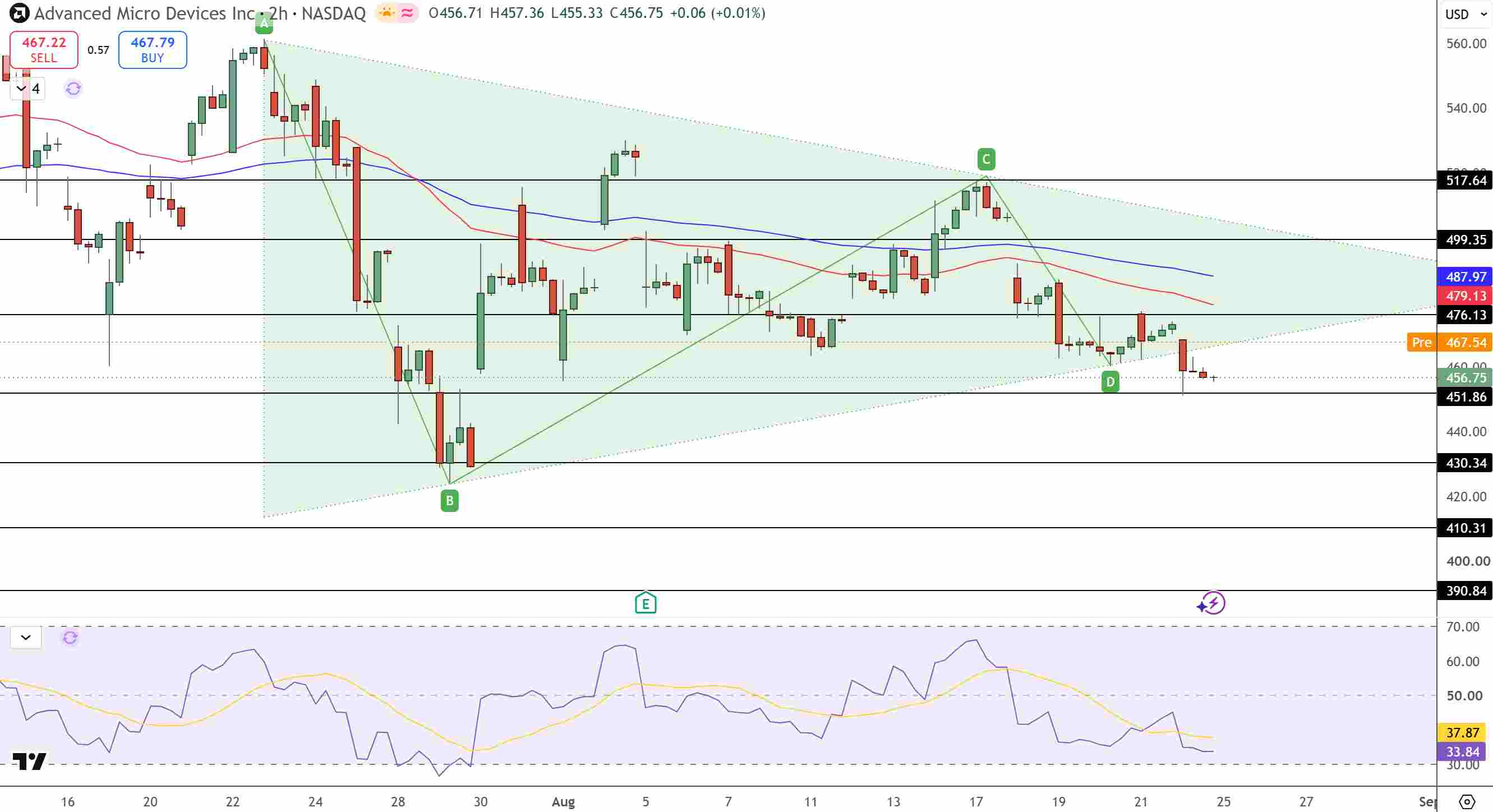
AMD Price Chart - Source: Tradingview
Resistance is at $499.35 and $517.64. A break of $451.86 puts support at $430.34 and $410.31. There is a bearish sentiment toward $476-$488.
Key Levels
- Support: $451.86 (immediate), $430.34 (major)
- Resistance: $467.54-$476.13, $499.35, $517.64
- Momentum: RSI 34 (oversold territory), bearish pressure
Bottom Line: Data Center Double, Helios Deployment, Taalas for Inference Edge
AMD Q2: $11.536B (+50%); $6.7B Data Center (+107%, 58% mix); $1.66 non-GAAP EPS. Q3 expected $13B (+41%). Achieving Helios deployments, acquisitions of Taalas and the 6th gen EPYC, deployments expected for Anthropic (2GW) & OpenAI, Microsoft. Expecting a cash balance of $13.11B.
For investors: AI infrastructure changes are favorable for AMD. Clear sight into cases of Data Center doubling (+107%), driven by large customer deployments of Helios (Anthropic 2GW, Microsoft, OpenAI), provides confidence for investment. Taalas now provides inference capability. Integration across AMD's product offerings (EPYC, Instinct, ROCm, Pensando networking), Helios, and a large potential for opportunity against NVIDIA's offerings. Long term concerns: NVIDIA domination, manufacturing and import restrictions, and slowdown in hyperscaler spend. Pressure building on support side of triangle exhibits a bearish trend; $454.86 provides key support; RSI 34 with oversell likely; stabilization expected. This is analysis, not a recommendation to invest.
Recommended Articles


