


US core PCE inflation set to keep pressure on the Federal Reserve to hike interest rates
- US core Personal Consumption Expenditures Price Index is expected to have grown at a 3.3% year-on-year rate in July.
- Headline PCE monthly inflation is seen ticking up 0.1% in July, reversing June’s 0.1% contraction.
- Traders are likely to wait for Federal Reserve’s Warsh speech at Jackson Hole to make investment decisions.
The United States (US) Bureau of Economic Analysis (BEA) is expected to publish the Personal Consumption Expenditures (PCE) Price Index data for July on Wednesday, at 12:30 GMT.
The PCE Price Index is one of the most relevant indicators for financial markets, as it is the Federal Reserve’s (Fed) gauge of choice to assess inflationary trends and, therefore, to decide its monetary policy.
On Wednesday, the US PCE Price Index release will be accompanied by the first estimate of Q2 Gross Domestic Product (GDP) and Durable Goods Orders, which might tame the Forex impact of inflationary data.
Anticipating the US PCE: Insights into the Federal Reserve's key inflation metric
In general terms, PCE inflation data for July is expected to reveal that price pressures remain high, well above the Fed’s 2% target, buoyed by high energy prices, with the Middle East conflict in a labyrinth, with no end in sight.
The core PCE Price Index – the most relevant figure from a monetary policy perspective, as it strips the seasonal influence of food and energy prices – is seen accelerating to 0.2% month-over-month (MoM) in July, from 0.1% in June, and remaining steady at 3.3% since July last year. These are still levels below May’s 3.4% YoY peak, but also well above the Fed’s target.
Investors are likely to analyse these figures carefully to get some clues about the US central bank’s monetary policy. The reaction to the data, however, is likely to be muted. The main focus will remain on the Jackson Hole central bankers' meeting on Friday, where the Fed Chairman Kevin Warsh is expected to provide further insights on the bank’s near-term policy despite his reluctance to provide forward guidance.
Strategists at DBS Bank see the Jackson Hole Symposium as an important test for the Fed’s Chairman, as, in their opinion, his rejection of forward guidance has “contributed to increased market volatility.”
They argue that Warsh now needs to spell out “how a Fed without forward guidance intends to anchor expectations, how much tightening the Fed is prepared to tolerate through long-term yields, and the policy boundary between the Fed and the Treasury,” with clarity on these points seen as critical for investors trying to assess the evolving policy mix.
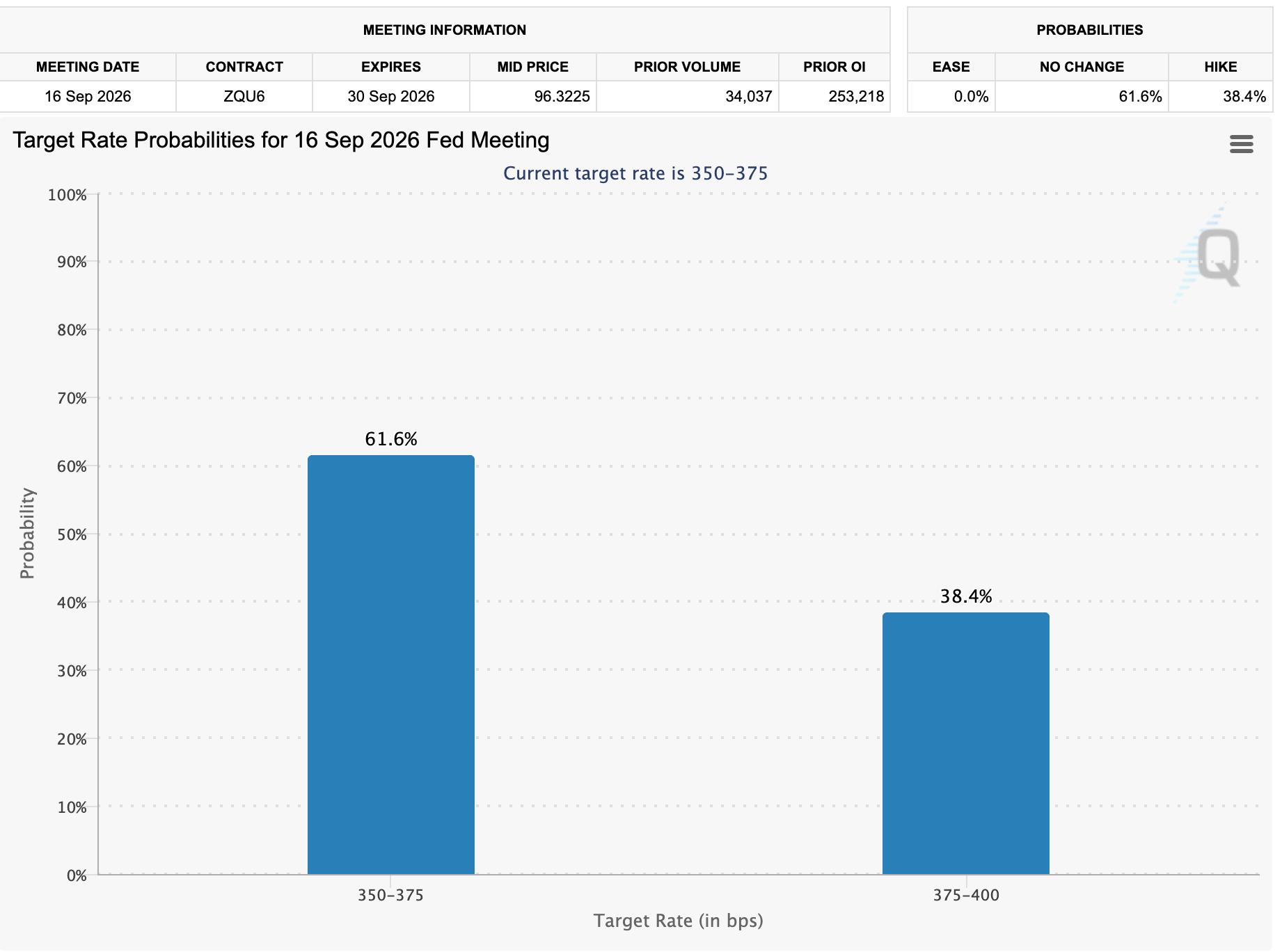
As of this writing, bets on an interest rate hike in September are declining. Futures markets are pricing a 38% chance of a quarter-point rate hike next month, down from 55% one month ago, according to data from the CME FedWatch Tool. The central bank’s lack of guidance seems to have triggered doubts about Warsh’s commitment to fight inflation. It will be interesting to see if a strong reading on Wednesday changes this view.
How will the US Personal Consumption Expenditures Price Index affect EUR/USD?
The US Dollar (USD) is struggling to regain lost ground this week, following sharp declines earlier in August, crushed by a mix of downbeat employment figures, the dovish repricing of the Fed’s monetary policy, and a plan by the US Treasury to boost repurchases of long-dated securities.
The US Dollar Index (DXY), which measures the value of the Greenback against a basket of six major currencies, is 0.75% down on the month and more than 2.5% below the late July top. Against this background, it seems rather unlikely that Wednesday’s PCE Price Index figures alone can lift the US Dollar without a clear backing from the Fed.
According to OCBC’s Analysts, the USD needs that “Warsh and other Fed officials push back against emerging debasement concerns and reinforce their commitment to returning inflation to the Fed's 2% target” to find any significant support.
Regarding EUR/USD, Guillermo Alcalá, FX Analyst at FXStreet, sees the Euro steady near three-month highs, consolidating gains after a 2.5% rally in the current month.
EUR/USD Daily Chart
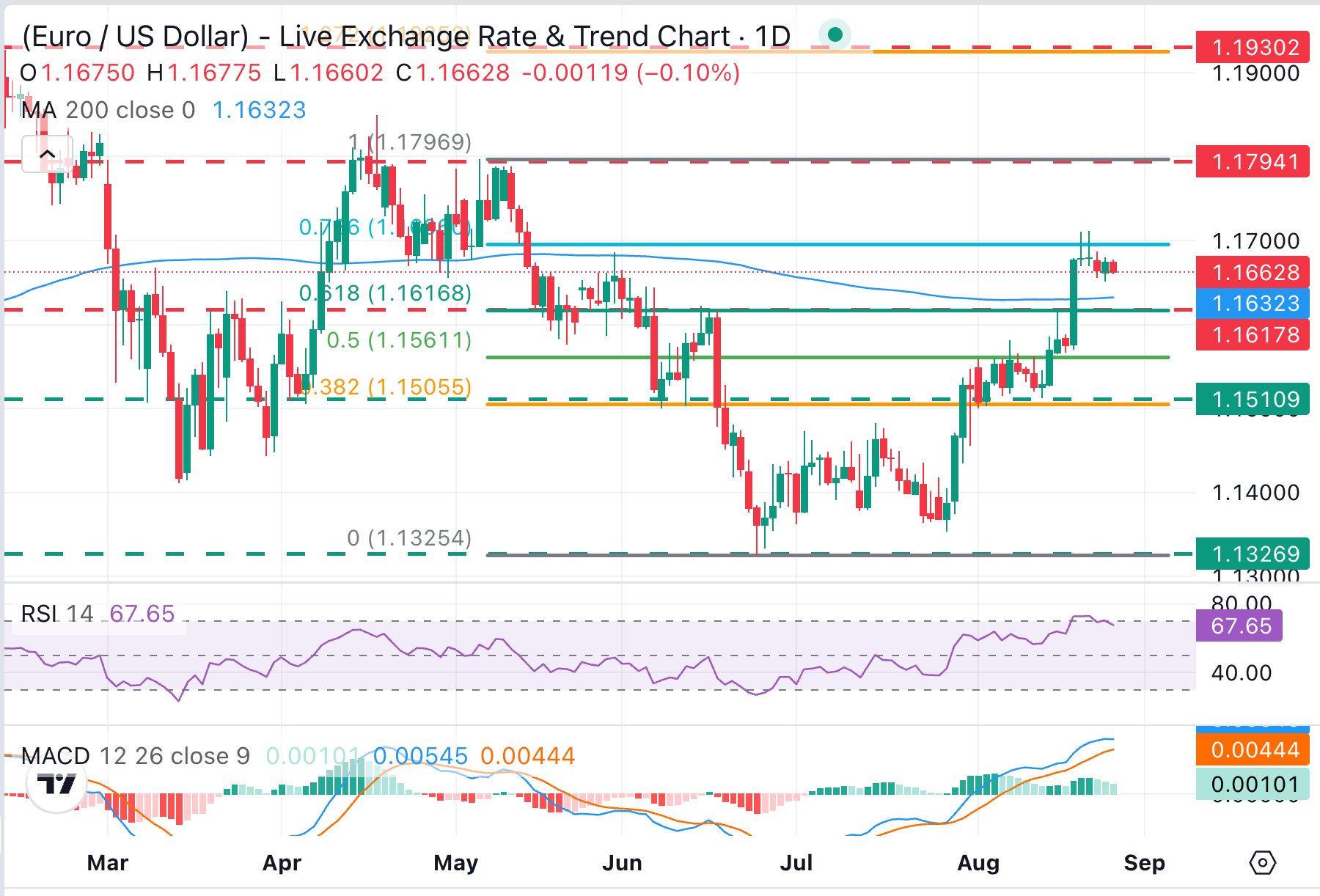
Recent price action shows a mild pullback, as the pair has reached overbought levels in most timeframes, but the near-term bias remains constructive, above the key 200-day Simple Moving Average (SMA). Momentum indicators on the daily chart endorse the bullish view, with the Relative Strength Index in the 70.00 area at the time of writing, and the Moving Average Convergence Divergence (MACD) well above the zero level.
Upside attempts have been capped below the 78.2% Fibonacci retracement of the May-June selloff, in the 1.1700 area. A bullish move above here exposes the early-May highs, near 1.1790.
On the downside, the area between the mentioned 200-day SMA, at 1.1630, and the previous resistance area around 1.1615 is likely to challenge bears. Further down, the August 19 low, at 1.1570, might provide some support ahead of the early August lows, just above 1.1500.
Economic Indicator
Personal Consumption Expenditures - Price Index (MoM)
The Personal Consumption Expenditures (PCE), released by the US Bureau of Economic Analysis on a monthly basis, measures the changes in the prices of goods and services purchased by consumers in the United States (US).. The MoM figure compares prices in the reference month to the previous month. Price changes may cause consumers to switch from buying one good to another and the PCE Deflator can account for such substitutions. This makes it the preferred measure of inflation for the Federal Reserve. Generally speaking, a high reading is bullish for the US Dollar (USD), while a low reading is bearish.
Read more.Next release: Wed Aug 26, 2026 12:30
Frequency: Monthly
Consensus: 0.1%
Previous: -0.1%
Source: US Bureau of Economic Analysis
Inflation FAQs
Inflation measures the rise in the price of a representative basket of goods and services. Headline inflation is usually expressed as a percentage change on a month-on-month (MoM) and year-on-year (YoY) basis. Core inflation excludes more volatile elements such as food and fuel which can fluctuate because of geopolitical and seasonal factors. Core inflation is the figure economists focus on and is the level targeted by central banks, which are mandated to keep inflation at a manageable level, usually around 2%.
The Consumer Price Index (CPI) measures the change in prices of a basket of goods and services over a period of time. It is usually expressed as a percentage change on a month-on-month (MoM) and year-on-year (YoY) basis. Core CPI is the figure targeted by central banks as it excludes volatile food and fuel inputs. When Core CPI rises above 2% it usually results in higher interest rates and vice versa when it falls below 2%. Since higher interest rates are positive for a currency, higher inflation usually results in a stronger currency. The opposite is true when inflation falls.
Although it may seem counter-intuitive, high inflation in a country pushes up the value of its currency and vice versa for lower inflation. This is because the central bank will normally raise interest rates to combat the higher inflation, which attract more global capital inflows from investors looking for a lucrative place to park their money.
Formerly, Gold was the asset investors turned to in times of high inflation because it preserved its value, and whilst investors will often still buy Gold for its safe-haven properties in times of extreme market turmoil, this is not the case most of the time. This is because when inflation is high, central banks will put up interest rates to combat it. Higher interest rates are negative for Gold because they increase the opportunity-cost of holding Gold vis-a-vis an interest-bearing asset or placing the money in a cash deposit account. On the flipside, lower inflation tends to be positive for Gold as it brings interest rates down, making the bright metal a more viable investment alternative.
Recommended Articles


