


Walmart Earnings Preview: Can Q2 Results Continue to Drive the Stock Price Up?
TradingKey - Walmart (WMT) will report its second-quarter fiscal 2027 financial results before the US market open on August 20 ET. The market currently expects Walmart's second-quarter revenue to be approximately $186.3 billion to $186.9 billion, up about 5% to 6% year-over-year, with adjusted earnings per share (EPS) of around $0.73 to $0.74. Walmart's previous quarterly guidance called for net sales growth of 3.5% to 4.5% and adjusted EPS of $0.72 to $0.74.
For this earnings report, investors need to pay attention to three key aspects: whether Walmart can maintain same-store sales growth; whether its e-commerce and advertising businesses can continue to accelerate growth; and whether Walmart will raise its full-year guidance.
Can Walmart Maintain Same-Store Sales Growth?
One of the key metrics to watch in this earnings report is Walmart U.S. same-store sales and customer traffic.
In the previous quarter, Walmart U.S. same-store sales grew 4.1% as the company continued to gain market share. Management stated during the earnings conference call that both transaction counts and market share kept growing. Meanwhile, global e-commerce sales rose 26% year-over-year, reflecting consumers' ongoing shift toward online and omnichannel shopping.
However, Wall Street has recently begun lowering its expectations for second-quarter same-store sales. According to a report by Talk Business, Bank of America, RBC Capital, Deutsche Bank, and Oppenheimer have all recently made cautious adjustments to their Walmart same-store sales growth forecasts, with some institutions lowering their projections from around 4% previously to the 2.5%–3.5% range, mainly due to more cautious consumer spending and price changes in the pharmacy business.
Consumer pressure is also a key focus area for this earnings call. U.S. gasoline prices were recently about $0.92 per gallon higher than the same period last year, while MarketWatch noted that multiple companies, including consumer staples firms, continue to observe price-sensitive consumers curbing their spending.
However, this is not entirely bad news for Walmart. As cost-of-living pressures rise, consumers may cut back on discretionary spending such as apparel and home goods while prioritizing prices on food and daily necessities. Because Walmart derives a high proportion of sales from grocery and consumer staples, the market will pay close attention to whether the company continues to gain market share from other retailers and whether middle- to high-income consumers continue to spend more at Walmart.
For Walmart's stock price, if U.S. same-store sales growth reaches or exceeds 3.5%–4% alongside continued traffic growth, it will help demonstrate that Walmart is still gaining market share and could serve as a positive post-earnings catalyst. Conversely, if same-store sales growth slows to around 2.5% or lower, the market may again revise down revenue growth expectations for the second half of the year.
Can Walmart's E-Commerce and Advertising Businesses Still Accelerate Growth?
The second focus of this earnings report is whether Walmart can continue to reduce its reliance on traditional merchandise retail profits.
Last quarter, Walmart's global e-commerce sales grew by 26% year-over-year, while advertising revenue rose 37%. Compared with traditional retail operations, businesses such as advertising, Marketplace, and memberships typically command higher profit margins, and e-commerce and advertising have become key drivers of incremental profit growth for Walmart.
If consumers shop more frequently on Walmart's website and app, it will attract more brands to purchase ads; an increase in Marketplace merchants can expand merchandise selection and commission revenue, while growth in Walmart+ memberships can boost recurring revenue. These businesses can generate synergies with one another rather than relying entirely on opening new physical stores to drive growth.
Jefferies analyst Corey Tarlowe believes that Walmart's upcoming earnings report may continue to benefit from e-commerce and advertising revenue growth. However, the company's reinvestment of a portion of its tariff refunds into pricing and consumer value could mean it will take longer for margin improvements to fully materialize.
Therefore, for this earnings report, the market will not only look at the revenue scale of over $186 billion, but will also focus on whether operating profit growth can continue to outpace sales growth.
For WMT's stock price, if second-quarter e-commerce growth remains above 20% and advertising maintains a growth rate of around 30% or higher, while operating profit growth outpaces revenue growth, it will help reinforce market expectations for an improvement in Walmart's profit structure, thereby driving the stock price higher. Conversely, if e-commerce continues to grow rapidly but delivery, price investments, and labor costs lead to a margin decline, the stock price may come under pressure and pull back.
Will Walmart Raise Full-Year Guidance?
In this earnings report, full-year guidance will likely be the primary determinant of stock price movement.
Walmart previously projected fiscal 2027 net sales growth of 3.5% to 4.5% on a constant-currency basis, adjusted operating income growth of 6% to 8%, and adjusted earnings per share of $2.75 to $2.85. The figures indicate that the company currently expects profit growth to outpace sales growth.
For this earnings report, Wall Street lacks a consensus expectation of a "guidance raise." Jefferies analyst Corey Tarlowe expects Walmart's Q2 U.S. same-store sales to grow by approximately 3.6% and believes the company is capable of maintaining its full-year performance targets; meanwhile, Oppenheimer recently lowered its U.S. same-store sales growth forecast from 4.0% to 3.5%, primarily reflecting consumer spending and price changes for certain items. Therefore, the market is currently more focused on whether management still considers the previous full-year growth targets achievable, rather than simply whether they outright raise the numbers.
From a stock price perspective, if Walmart raises its full-year sales or EPS forecast while attributing the move to better-than-expected performance in same-store sales, customer traffic, e-commerce, and advertising, analysts may need to revise earnings forecasts upward for coming quarters, creating a positive impact on Walmart's valuation.
If the company maintains its current guidance, it will need to be evaluated alongside actual second-quarter results. If same-store sales and margins meet or exceed expectations, but management remains cautious due to macroeconomic uncertainty, this signal differs from an actual deterioration in the core business, and the stock price reaction may be relatively muted.
Conversely, if Walmart lowers its full-year guidance and explicitly points to weakening consumer demand, declining gross margins, or rising cost pressures, the market will likely cut future EPS forecasts, placing downward pressure on Walmart's stock price.
Walmart Stock Technical Analysis
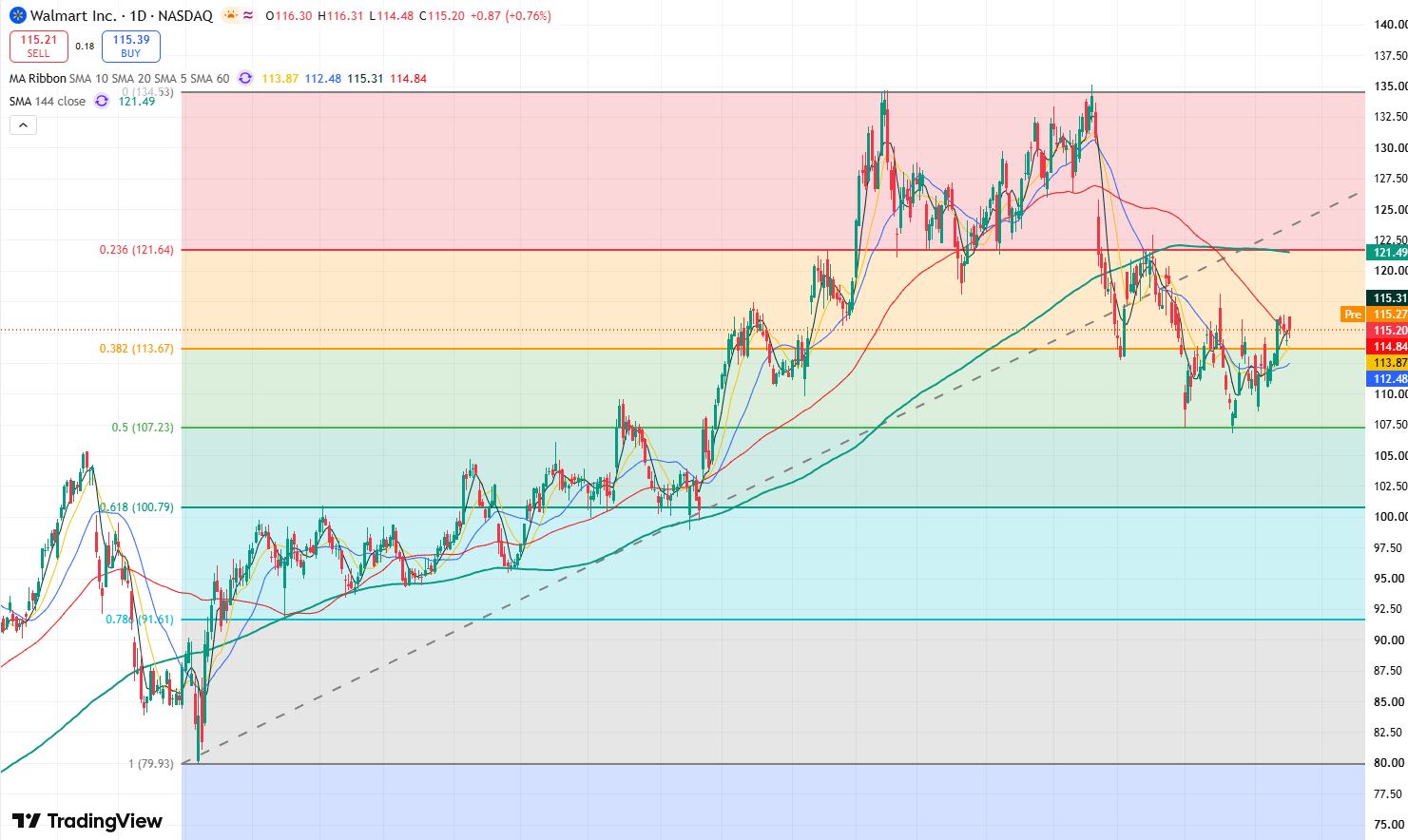
Walmart daily stock price chart, Source: TradingView
Looking at the daily chart of Walmart's stock price, the stock price tested the $135 resistance level twice in February and May, failing to break through both times. The candlestick structure formed a double bottom pattern, which led to a recent sustained pullback. Currently, the stock price has found support near $107 and begun to rebound, but candlestick action remains suppressed by the 60-day moving average, indicating weakened bullish momentum in the market.
On the upside, the primary resistance level above to watch is $118. If it breaks above this level, the stock price will test the resistance level near $123. If it continues to rise, the stock price may move up to fill the $125–$130 gap, and may even test the $135 resistance level.
On the downside, the first support level below to watch is $114. If it falls below this level, the stock price may continue to test $107. If this level fails to hold, the stock price will further test the $100 mark.
Recommended Articles


