


Here's Where the Fed May Take Interest Rates Under Chairman Kevin Warsh
Key Points
The Federal Reserve (Fed) has maintained interest rates since Kevin Warsh took over as chairman.
The current interest rate has consistently been above the Fed's 2% target rate.
The U.S. unemployment rate went down, but that's largely due to 264,000 people leaving the workforce.
- These 10 stocks could mint the next wave of millionaires ›
Federal Reserve Chairman Kevin Warsh began leading the U.S.'s central bank in March, and since then, the Fed has kept interest rates unchanged at both of its meetings. This past meeting, however, presented the largest Fed dissent in a decade, with nine policymakers voting to keep interest rates steady and three voting to raise them.
The Fed will hold its next meeting in September, and people are torn on which way the committee will rule. A couple of different factors at play make the decision not so clear-cut. However, signs are pointing to another meeting without an increase.
Missed Nvidia in 2009? This Rare Signal Is Flashing Again. In 2009, a "Double Down" signal flashed for a little-known chipmaker called Nvidia. For the first time in years, that same "Total Conviction" signal is flashing for a company 1/100th the size of Nvidia. Continue »

Image source: The Federal Reserve.
The role interest rates play
The Fed's main job is to keep prices stable and maintain healthy employment, and one of the ways it does so is by adjusting the federal interest rate. That's why, when inflation reached its highest levels in 40 years in 2022, the Fed raised the interest rate range from 0%, to 0.25%, to 5.25%, to 5.50% by mid-2023.
Since the end of last year, though, the Fed interest rate has stayed in the 3.50% to 3.75% range. So, what's next? Well, with Warsh, don't expect forward guidance, as he has been clear that he doesn't plan to provide insight on what the Fed might do. During a July Congressional testimony, Warsh said the following:
We want to get policy right, and I think being somewhat more circumspect in our communications, at least for me, is a better way of calling balls and strikes.
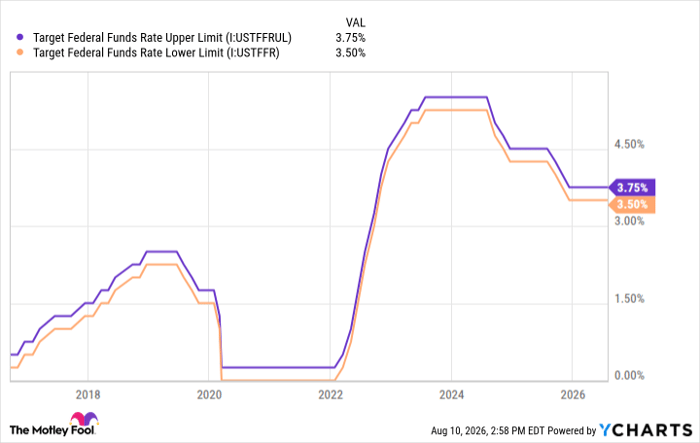
Target Federal Funds Rate Upper Limit data by YCharts.
Where could interest rates be headed?
Inflation cooled from June to July, but it's still up 3.5% year over year, according to the latest Consumer Price Index for All Urban Consumers (CPI-U) data. The Fed's target goal for inflation is 2%, so we're still hovering above that, which is why there have been calls for an interest rate hike.
In many people's eyes, inflation remaining above the target goal is all the justification needed to warrant an interest rate hike. However, another factor has been thrown into the equation, making the choice not so obvious: job losses.
In July, the U.S. lost 23,000 jobs, which was completely unexpected. The consensus was that the U.S. would add between 80,000 and 85,000 jobs, resulting in a 113,000- to 118,000-job deficit compared to expectations. The actual unemployment rate decreased to 4.1% (down from 4.2% in June and 4.6% in July 2025), but that's mainly because 264,000 people left the workforce.
The job report matters because lowering interest rates is usually used to encourage hiring. However, doing so while fighting inflation is difficult. This puts the Fed between a rock and a hard place. That said, I expect Warsh and the Fed to hold rates steady again during their next meeting in September.
Where to invest $1,000 right now
When our analyst team has a stock tip, it can pay to listen. After all, Stock Advisor’s total average return is 964%* — a market-crushing outperformance compared to 215% for the S&P 500.
They just revealed what they believe are the 10 best stocks for investors to buy right now, available when you join Stock Advisor.
See the stocks »
*Stock Advisor returns as of August 13, 2026.
The Motley Fool has a disclosure policy.
Recommended Articles


