


SpaceX vs. Rocket Lab: Which Space Stock Looks Like the Better Buy Right Now?
Key Points
SpaceX's Starlink satellite broadband unit has become a massive subscription business that generates recurring cash flow.
Rocket Lab has impressive momentum, but it still has a lot to prove.
As a newly public company that has attracted enormous attention, SpaceX benefits from greater analyst coverage, liquidity, and financial transparency.
- 10 stocks we like better than Space Exploration Technologies ›
If you're trying to pick one pure-play space stock right now, I would lean toward Space Exploration Technologies (NASDAQ: SPCX) over Rocket Lab (NASDAQ: RKLB). Both are doing real work in orbit, but only one has turned that work into a massive, increasingly profitable business with millions of paying customers and global attention.
On paper, Rocket Lab looks like the kind of company growth investors love. In the first quarter of 2026, it reported record revenue of $200.3 million, up 63.5% year over year, with a GAAP gross margin of 38.2% and a backlog that climbed to $2.2 billion. It now has more than 70 missions on its manifest, and is selling not just launches on its Electron rocket but also satellite buses, components, and future capacity on its larger Neutron rocket.
Missed Nvidia in 2009? This Rare Signal Is Flashing Again. In 2009, a "Double Down" signal flashed for a little-known chipmaker called Nvidia. For the first time in years, that same "Total Conviction" signal is flashing for a company 1/100th the size of Nvidia. Continue »
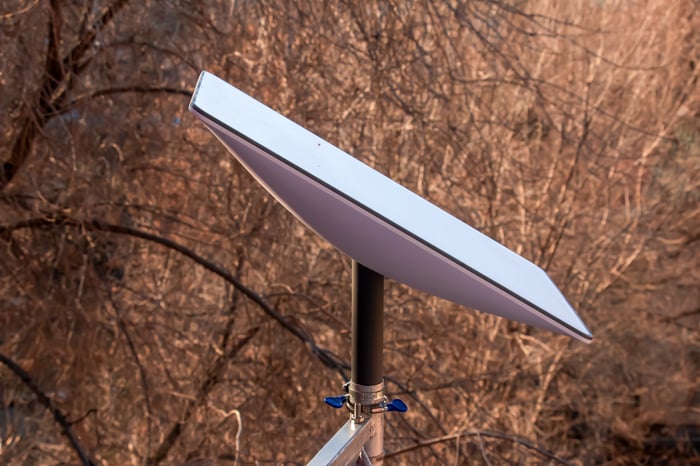
Image source: Getty Images.
The catch is that Rocket Lab is still losing money. In Q1, it booked a GAAP net loss of $45 million and an adjusted EBITDA loss of $11.8 million, despite the revenue surge. Its strategy is sensible for an emerging player: Build backlog, expand into space systems, and use equity offerings to fund its climb. But that will leave shareholders exposed to execution risk and capital market swings for years.
Next week, Rocket Lab reports its second-quarter earnings, so it's important to see whether the company can continue to grow revenue while narrowing its losses. Investors will be watching for updates on Electron launch cadence, Neutron's development timeline, and backlog growth.
SpaceX: scale, Starlink, and Starship
SpaceX, by contrast, is starting to look like an operating machine rather than just a launch start-up. After its June IPO, the company's first reported quarter showed revenue of $7.8 billion, up 92% from $4.1 billion a year earlier, driven by strong growth in its Starlink satellite internet and AI businesses.
Starlink is the engine here. In 2025, Starlink generated about $11.4 billion in revenue, roughly 61% of SpaceX's total, and by the first quarter of 2026, that share had risen to 69%. SpaceX now reports more than 10.3 million Starlink subscribers across 155 countries, with analysts expecting that number to grow to roughly 16 million by year's end. That is recurring, subscription‑like cash flow layered on top of launch contracts and NASA work, which makes the business feel very different from a purely project-based model.
At the same time, SpaceX keeps pushing the hardware frontier. Its Starship craft has already flown multiple large test missions this year, including the 12th and 13th flights that attempted full reusability profiles while carrying next-generation Starlink V3 satellites. ItsFalcon 9 and Falcon Heavy rockets continue to dominate the commercial launch market, with some estimates putting SpaceX's global launch share north of 80% in 2025 and 2026.
Why more eyes on SpaceX actually matter
The title of "better buy" is not just about fundamentals, though. SpaceX's IPO at a market cap of around $1.7 trillion instantly made it one of the most closely watched companies on the planet. All that brings more analyst coverage, better liquidity, fairer pricing, and clearer financial reporting for investors. More eyes on a company don't guarantee better returns, but they do make it harder for major problems to remain hidden.
Rocket Lab, as a smaller name, can still swing in price sharply on headlines about new contracts or technical setbacks, with fewer people reading every footnote. Rocket Lab offers potentially higher percentage upside if the Neutron rocket works and its space systems business scales up. It also carries a higher risk, because the company is still in the "prove it" phase and funding its expansion by issuing new equity.
SpaceX, on the other hand, is already demonstrating enormous revenue growth, holds a dominant position in launches, and operates a rapidly expanding, cash-generative Starlink franchise. For most investors seeking exposure to the commercial space economy and preferring a business with proven demand and global attention, SpaceX looks like the more compelling buy right now. It has the hype; it has the name recognition.
Should you buy stock in Space Exploration Technologies right now?
Before you buy stock in Space Exploration Technologies, consider this:
The Motley Fool Stock Advisor analyst team just identified what they believe are the 10 best stocks for investors to buy now… and Space Exploration Technologies wasn’t one of them. The 10 stocks that made the cut could produce monster returns in the coming years.
Consider when Netflix made this list on December 17, 2004... if you invested $1,000 at the time of our recommendation, you’d have $411,427!* Or when Nvidia made this list on April 15, 2005... if you invested $1,000 at the time of our recommendation, you’d have $1,335,252!*
Now, it’s worth noting Stock Advisor’s total average return is 965% — a market-crushing outperformance compared to 215% for the S&P 500. Don't miss the latest top 10 list, available with Stock Advisor, and join an investing community built by individual investors for individual investors.
See the 10 stocks »
*Stock Advisor returns as of August 11, 2026.
Micah Zimmerman has no position in any of the stocks mentioned. The Motley Fool has positions in and recommends Rocket Lab. The Motley Fool has a disclosure policy.
Recommended Articles


