


Intel Stock Price Forecast: Share Placement Attracts Over $100 Billion in Demand, Can the Stock Price See a Trend Recovery?
TradingKey - Intel (INTC) officially finalized a $20 billion common stock offering plan on August 11, Eastern Time, up one-third from the previously announced $15 billion size.
According to company announcements, the company will issue approximately 211 million shares of common stock at $95 per share, with expected net proceeds of approximately $19.7 billion from the offering. The transaction is scheduled to close on August 12, and the underwriters have an option to purchase up to an additional 31.58 million shares. Intel's offering is led by JPMorgan, Goldman Sachs, Morgan Stanley, and Citigroup as joint book-running managers.
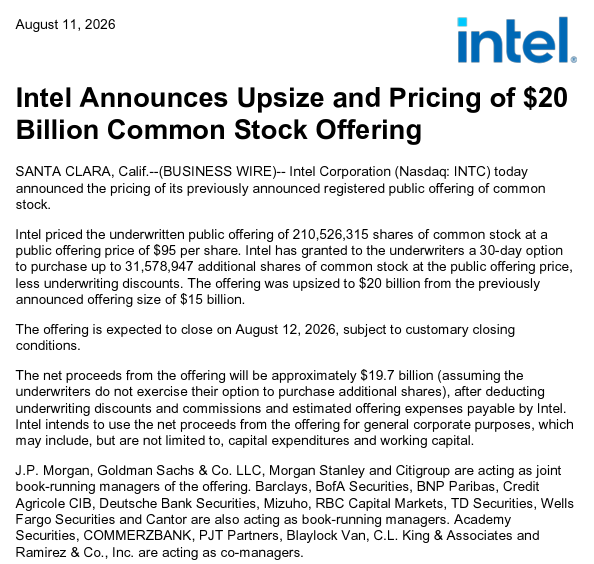
Source: Intel news events
It is reported that the deal attracted over $100 billion in subscription demand, demonstrating that the capital market's enthusiasm for the AI supply chain remains intact. Intel stated that the funds will be used for general corporate purposes, including capital expenditures and working capital, providing additional firepower for the expansion of its AI chip, advanced packaging, and foundry businesses.
Over the past year, the accelerated expansion of global data centers has driven a recovery in demand for general-purpose processors, and Intel hopes to take this opportunity to return to the core AI arena. However, compared with Nvidia and AMD, Intel remains in a catch-up position in the AI accelerator market; meanwhile, its foundry business also requires continuous investment to attract more external customers.
Recently, semiconductor research firm SemiAnalysis pointed out that Intel needs to replenish capital through equity financing, and equity is the largest and lowest-cost viable financing method under current conditions.
During its earnings call, Intel raised its 2026 capital expenditure guidance to over $20 billion and stated that this figure will be significantly higher in 2027. The continuously rising capital expenditure requirements are one of the direct drivers behind this large-scale equity financing. Upon completion of this offering, Intel will secure ample capital reserves to support a multi-year, capital-intensive investment cycle.
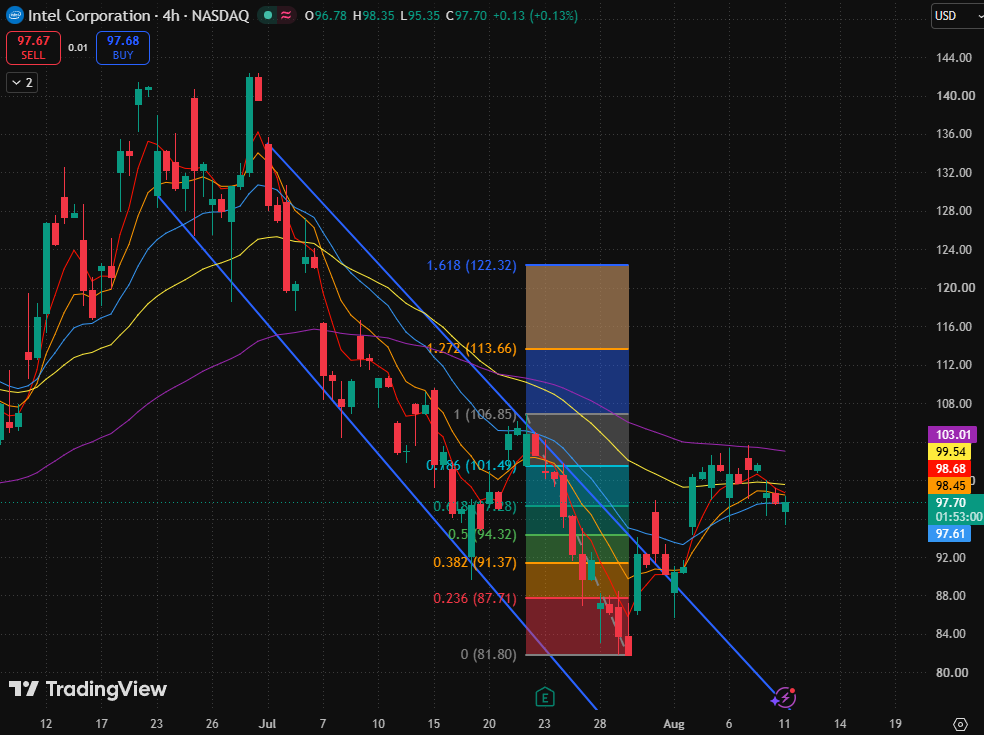
Intel four-hour stock chart, Source: TradingView
Intel's stock price rebounded after touching around $81.80, but upward momentum has slowed in recent trading sessions, with the price dropping back below short-term moving averages. Overall, INTC remains in a low-level consolidation phase following a sharp decline from previous highs: the rebound has not yet reversed the medium-term weakness, and the stock faces a directional choice in the short term.
From a market context perspective, Intel recently completed a $20 billion offering. While the financing for expansion logic gained market attention, equity dilution has also further amplified its high-volatility characteristics.
The primary current risk is that INTC is still trading below major moving averages, with the $99.50–$103.00 region combining resistance from the 20-day, 40-day, and 80-day moving averages as well as the 0.786 Fibonacci retracement level ($101.49). If a short-term rebound lacks volume support, it could easily turn into a retreat after encountering resistance.
If the stock price falls back below the 0.618 Fibonacci retracement level ($94.31), it would indicate that this round of low-level recovery has weakened significantly, increasing the risk of retesting the $91–$92 region.
Only if the stock price consistently holds above $101.49 and further reclaims $106.85 can it more strongly confirm a shift from low-level consolidation to trend recovery. At the market level, attention should also be paid to equity dilution from the offering, the execution pace of AI and foundry expansion, and changes in overall risk appetite across the semiconductor sector.
Recommended Articles


