


NVIDIA (NVDA): Q1 FY2027 $81.6B Revenue, 85% Growth, Breakout to $224, $229.49 Resistance Next
TradingKey - NVIDIA (NVDA)'s fiscal 2027 Q1 results published on May 20 shuttered a new record with a revenue increase to $81.6 billion, an 85% increase YoY and 20% increase QoQ. Revenue from the Data Center grew 92% to $75.2 billion. NVIDIA returned $20 billion to its shareholders, and the board authorized another $80 billion in Shareholder buybacks.
By August 10, NVIDIA's stock moved above the descending trendline since May, to around $224. With the RSI around 64 (bullish, but not overbought), the first resistance is identified at $229.49 with the 1.618 Fibonacci extension. If the price breaks that resistance, it is expected to reach $234.51 and $238.81. The price action has a bullish sentiment prior to the earnings on August 26. NVIDIA has guided Q2 revenues to $91 billion, while limited, yet progressively more, exports to China are expected to provide additional revenues.
NVIDIA’s Growth Remains Concentrated in Data Centers
NVIDIA's Q1 FY2027 results surpassed all estimates and expectations. Revenue of $81.6 billion beat the forecast of $79.2 billion and represented an 85% increase YoY. GAAP net income was reported at $58.3 billion which included revenues from the sales of equity securities. Non-GAAP net income was $45.5 billion (an increase of 139%), with adjusted diluted earnings of $1.87 per share beating the estimate of $1.77.
The combination of revenue streams also matters. Data Centers racked up $75.2 billion, or about 92% of all revenue. Compute revenue increased to $60.4 billion, a yearly increase of 77%, while networking revenue increased to $14.8 billion, an increase of 199%.
The rapid increase in networking revenue illustrates NVIDIA's transition out of selling only standalone accelerators. NVIDIA's offerings now include GPUs, CPUs, interconnects, networking, storage, and software. As customers deploy all of these, they become more integrated to NVIDIA's architecture, making it more difficult and expensive to move to other competitor systems.
Profitability Remains Strong Despite Heavy Investment
Despite rising 85% in revenues, NVIDIA maintained a 74.9% GAAP gross margin. This shows customers have strong demand and a willingness to pay for NVIDIA’s most valuable products.
Year-over-year operating income rose 147% to $53.5 billion. Operating expenses grew by $7.6 billion, a 52% increase, as NVIDIA continued investing in the development of new products and research on the next generation of computing systems. Revenue continued to grow well above the level of operating expenses, which led to a greater than 100% increase in operating profit.
During the quarter, NVIDIA improved its cash dividend from $0.01 to $0.25 per share and also approved an $80 billion stock buyback. Cash generation from NVIDIA's Data Center business supported a $20 billion return to shareholders.
Blackwell Expands as Rubin Approaches Commercial Deployment
Blackwell is NVIDIA’s most important sales product to date and explains most of the $60.4 billion in revenue for the Data Center compute products. At the same time, the new Vera Rubin platform of NVIDIA is being prepared for next generation computing of agentic AI and advanced reasoning, serving large and complex inference workloads.
Rubin has a new architecture which integrates GPUs, Vera CPUs, and new networking and storage systems from NVIDIA and their partners. Systems should be available in the second half of 2026.
NVIDIA’s specific annual product cycle grants competitors less time to develop a competing product for each new generation of NVIDIA chips. NVIDIA’s competitive advantage functions beyond the speed of their chips. CUDA, high speed networking, rack scale systems, and developer tools build an interconnected platform that create a bind for competing suppliers to address (across the hardware and software) the gaps left by NVIDIA, and more than simply offer a faster chip.
China Is a Measured Upside to Q2 Guidance
The biggest unknown before the August 26 earnings is China. In July, United States officials confirmed NVIDIA started shipping H200 AI chips to China, although shipments were described as "very few." Around 10 companies in China, including Ali Baba, Tencent, and ByteDance, received licenses to sell the chips, among others.
NVIDIA's Q2 guidance of $91 billion assumed no Data Center compute revenue would be received from China. In the first quarter of FY2026, China contributed about $4.6 billion to Data Center compute revenue before restrictions on exports increased. If H200 shipments to China increase significantly during the second quarter, it would be an increase to the $91 billion guidance.
However, because of export restrictions concerning NVIDIA hardware and the Commerce Department confirming that more exports will be controlled, China remains a risk as well as an opportunity.
NVIDIA Breakout Targets $229.49 as Momentum Strengthens
NVIDIA reported a strong breakout after the descending trendline, which blocked strong moves for the stock since May, was broken. The stock also breached the previous resistance of $214.41 and the Fibonacci extension of $221.05, forming a high and low pattern. The stock was trading near the $224 mark on the 10th of August. The immediate resistance lies at $229.49, which coincides with the Fibonacci extension.
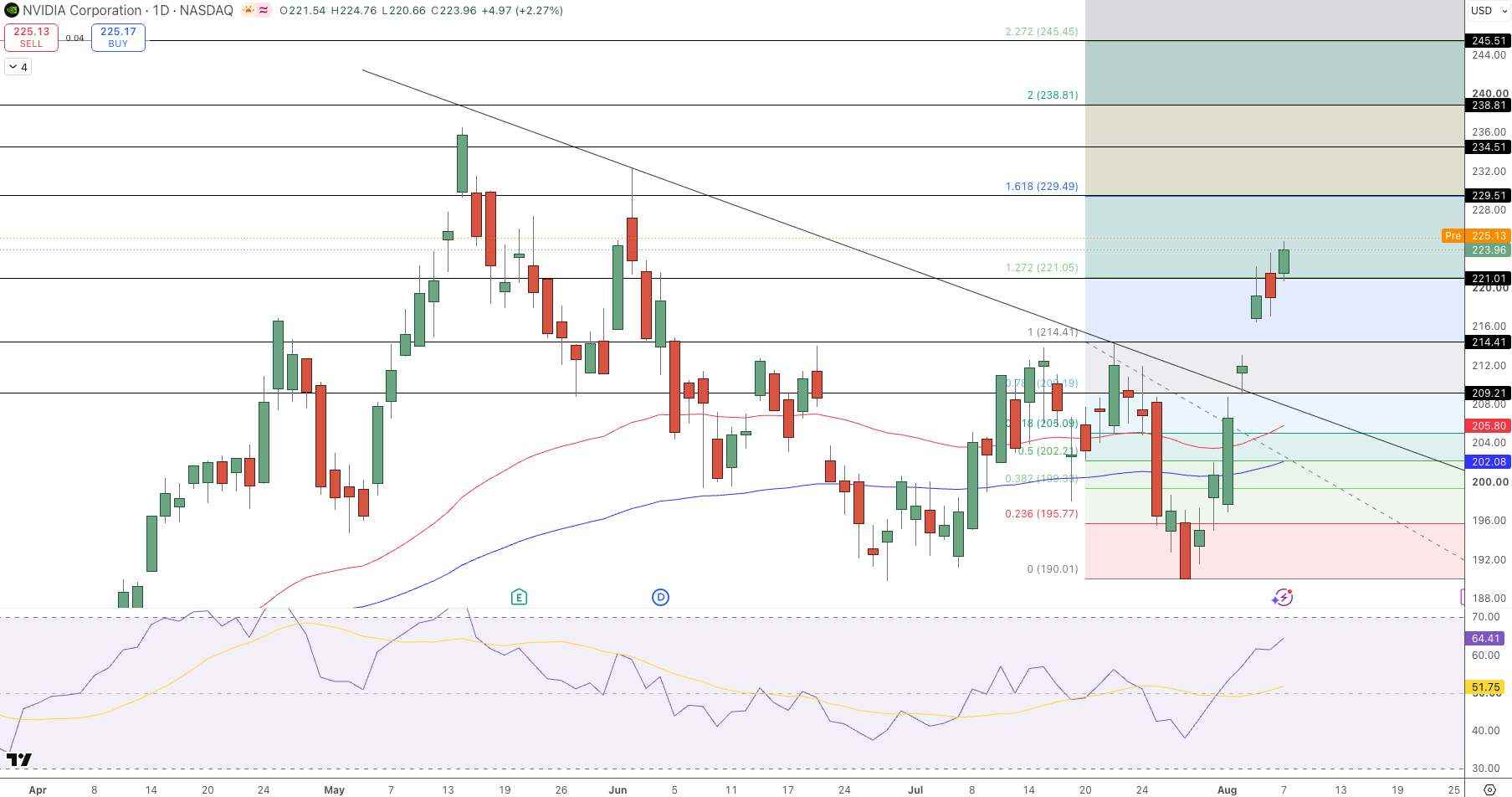
NVIDIA Price Chart - Source: Tradingview
A daily close above this will confirm the breakout and target $234.51, $238.81 and $245.51. The RSI is at a value of 64, which indicates the momentum is positive and there is still a lot of room to grow before the stock is in the overbought territory. The first line of support is set to be $221.01 with the second at $214.41. Both of these would maintain the bullish framework for NVIDIA.
A breach of $214.41 would shift the focus to $209.21 and $205.80 (the 100-day EMA). $221.01 will be the line of defense for bullish buyers. The focus for bullish buyers is on $229.49.
What to Watch for Aug 26 Earnings
The Q2 FY2027 results to be released on the 26th will be the next big influence on stock price. Key focuses will be: 1) Will NVIDIA meet the $91 billion in expected Q2 revenue? 2) Will gross margins be at or near 75% and above? 3) Will there be any new revenue from the H200 shipments to China? 4) What will be the guidance for Q3? 5) Will the predicted guidance for the full year be improved? If NVIDIA exceeds guidance and predictions are positive, the stock will likely break the $229.49 price target and head to the $234-$238 mark. If it only meets guidance, the stock will likely remain in a consolidation phase.
Bottom Line
NVIDIA's recently released Q1 FY2027 results are nothing short of remarkable. $81.6 billion in quarterly revenue is a staggering 85% year over year growth. $75.2 billion came from the Data Center business segment, which is an impressive 92% year over year growth, while gross margins expanded to 74.9%. Such results caused a 147% increase in operating income, coupled with a generous $80 billion new buyback authorization. NVIDIA has full confidence in the robust spending of AI infrastructures, as the company is making heavy investments on Blackwell and Rubin.
Recommended Articles


