


Morgan Stanley Bear Shawn Kim Turns Bullish as Memory Market Correction Nears End; SK Hynix EPS Raised 13%
TradingKey - On August 7, Asia-Pacific time, Morgan Stanley ( MS) analyst Shawn Kim, in his latest memory industry research report, turned bullish on SK Hynix ( SKHY) and Samsung Electronics.
Kim believes that the most severe adjustment in the memory market this round is nearing its end, and current valuations offer an "appealing tactical entry" opportunity. He maintained the target prices for SK Hynix and Samsung Electronics unchanged at 2.6 million Korean won (equivalent to approximately $1,834) and 375,000 Korean won, respectively.
Based on the closing prices on August 7, SK Hynix closed at 1.422 million Korean won and Samsung Electronics at 231,000 Korean won, representing an upside potential of over 60% for both companies compared to their target prices.
Although target prices were not adjusted, earnings forecasts changed. Morgan Stanley raised its fiscal year 2026 earnings per share (EPS) estimate for SK Hynix by 13%, while that for Samsung Electronics was cut by 10% due to weakness in its consumer electronics business.
Looking back at July, the memory sector experienced a period of severe volatility. Morgan Stanley had warned at the beginning of the month that the rally in DRAM prices was nearing its peak, which, coupled with overly concentrated market positioning, could trigger a short-term correction.
This assessment was subsequently validated as the Korea Composite Stock Price Index (KOSPI) and the two memory giants all suffered irrational sell-offs. For the entire month of July, the KOSPI Index plummeted by over 20%, SK Hynix plunged by nearly 33%, and Samsung Electronics also dropped by about 16.5%.
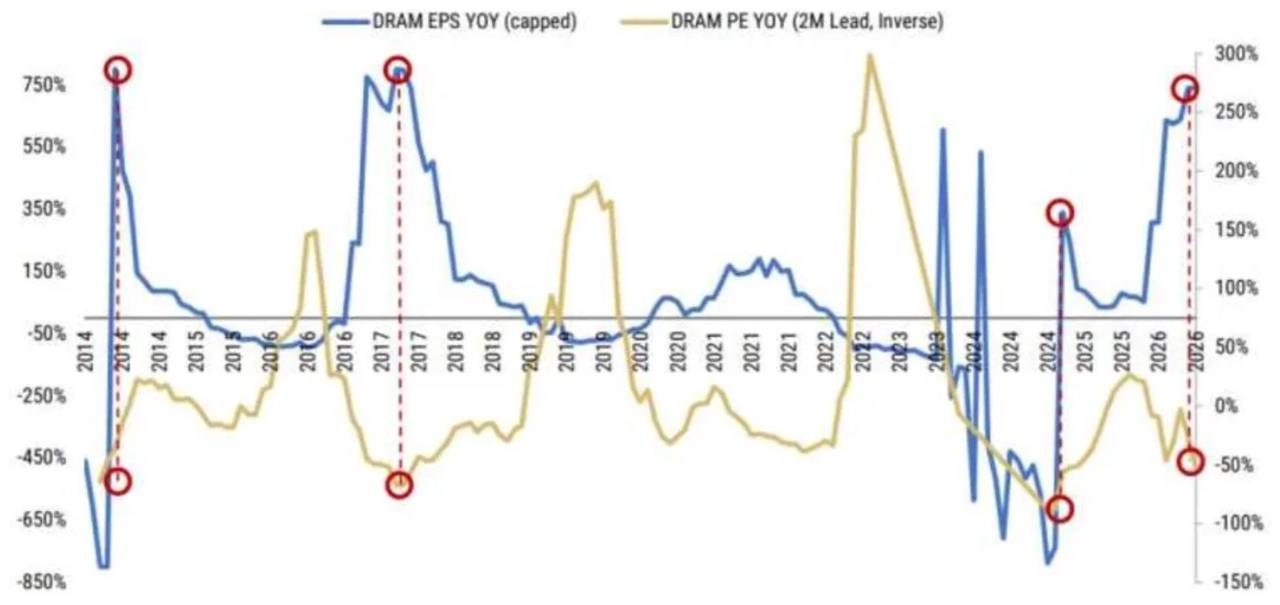
However, Kim now believes that the most pessimistic period may have passed. The report pointed out that current valuations of memory stocks are around 3 times forward 12-month earnings, pricing in almost no long-term growth premium. He described this adjustment as a "minor ripple in the AI supercycle" and expects earnings growth for both companies to reach 25% to 50% by 2027.
[Source: Morgan Stanley, Wall Street CN]
Morgan Stanley believes that the current AI-driven memory demand is distinctly different from traditional cycles. The report noted that the year-on-year increase in DRAM prices reached 700% at one point during this round, which is not only far higher than in several historical memory upcycles but has also lasted longer, reflecting that the demand driven by AI server construction possesses stronger structural characteristics. As HBM becomes an essential component of AI computing infrastructure, DRAM supply is also gradually becoming a key bottleneck in the industry chain.
In addition, the market's focus is also shifting. The report pointed out that in the next phase, share buybacks, free cash flow, and long-term supply agreements are expected to become share price drivers, rather than focusing solely on DRAM price trends.
Although the market remains divided on the outlook for the memory industry, several Wall Street institutions have recently begun to release positive signals. Among them, JPMorgan ( JPM) firmly maintained its optimistic view, calling the recent share price correction an excellent opportunity to buy the dip; Bank of America continued to characterize the industry's development as an "AI supercycle" and likewise held a strongly bullish stance.
For investors, the core message of Shawn Kim's report is that the most severe adjustment in the memory industry is nearing its end, and the changes in performance and sentiment over the next few weeks will be a critical window to validate this judgment.
Recommended Articles


