


Today’s Market Recap:ADP Misses, Stagflation Fears Rise; SanDisk & WDC Plunge After-Hours; Gold Back Above $4200
Tracking the Market Trend
TradingKey - On August 5, Eastern Time, U.S. stocks closed mixed at the close of trading, with the Dow Jones Industrial Average rising while the Nasdaq and S&P 500 closed lower. The Dow Jones Industrial Average rose 0.49% to 54,349.12; the Nasdaq Composite fell 0.83% to 26,363.44; and the S&P 500 fell 0.17% to 7,723.55.
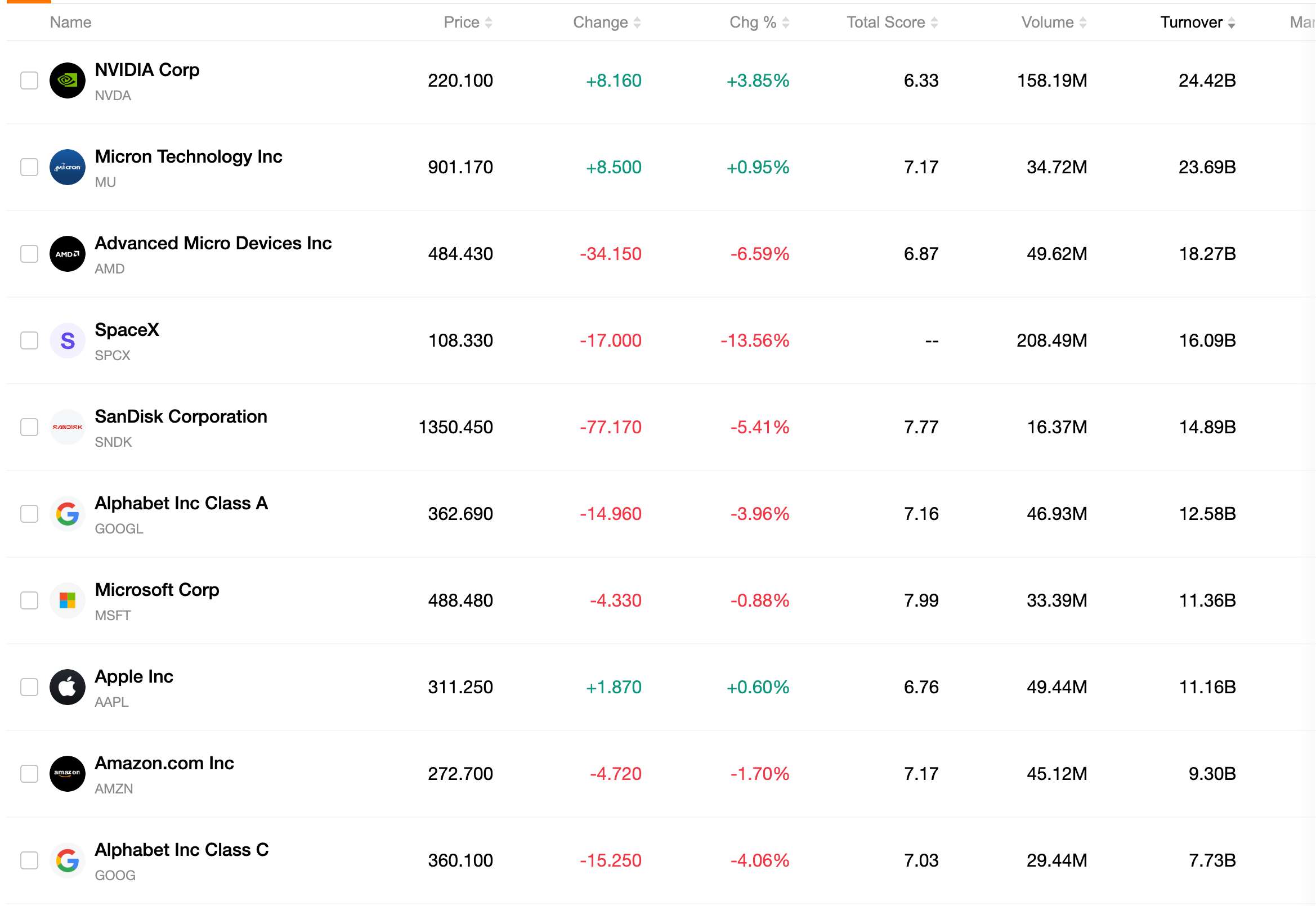
At the individual stock level, SpaceX(SPCX) plummeted more than 13%, and AMD(AMD) fell over 7%; Google (GOOGL) dropped 4.05%, while Nvidia (NVDA) bucked the trend, rising more than 3%. SanDisk(SNDK) and Western Digital (WDC) both closed down about 5.4%, having fallen as much as 8% and 10%, respectively, during the session, continuing their downward trend following their recent earnings reports.
On the macro front, U.S. ADP employment data showed a slowdown, but the ISM Services Cost sub-index remained high, reigniting market concerns about “stagflation.” The 10-year U.S. Treasury yield closed at 4.6188%, virtually unchanged.
In the foreign exchange and precious metals markets, the U.S. Dollar Index edged down 0.2%, while Bitcoin continued its recent rally. Driven by safe-haven demand, spot gold surged 4.11%, returning above the $4,200 level, while spot silver rose 4.12%.
In the energy market, crude oil prices spiked intraday amid escalating threats from Houthi militants but quickly retreated following news that the Strait of Hormuz was expected to reopen. WTI crude ultimately closed down 0.8% at $75.13 per barrel.
Market Headline
U.S. ADP Employment Grows by Only 44,000 in July, Hitting a New Low for the Year; Stagflation Fears Mount, with Nonfarm Payrolls Data Becoming Key. U.S. private-sector employment rose by only 44,000 in July, far below expectations and marking the lowest level of the year. The goods-producing sector came under significant pressure, indicating that the labor market continues to cool. However, wages for employees who changed jobs rose by a robust 7% year-over-year, suggesting that structural labor shortages persist. The market is now focused on Friday’s nonfarm payrolls data; if employment trends stabilize, it could confirm the economy’s resilience and provide support for the Federal Reserve to continue prioritizing the fight against inflation.
Driven by strong demand for AI, SanDisk’s revenue for the previous quarter surged nearly fourfold, exceeding expectations, but its guidance for the current quarter was disappointing, causing its stock to drop as much as 8% in after-hours trading. In the fourth fiscal quarter, SanDisk’s revenue, EPS, and gross margin all hit record highs for a single quarter. EPS exceeded analyst expectations by more than 10%, and the gross margin rose beyond expectations to 84.6%, more than triple the level from the same period last year. Data center revenue surged nearly 13-fold year-over-year and doubled quarter-over-quarter, while the edge computing business—the largest revenue source—grew nearly fourfold year-over-year, and the consumer business declined 5% year-over-year. Full-fiscal-year revenue increased 175% compared to the previous year. However, although the median revenue guidance for the first fiscal quarter represented a 359% year-over-year increase, it was still 5.5% below analysts’ expectations. The median EPS guidance was slightly below expectations, and the gross margin guidance was roughly flat compared to the previous quarter, triggering an after-hours drop in the stock price of up to 8%.
Western Digital’s fourth-quarter revenue and profits exceeded expectations, but its guidance fell short of the market’s high expectations, leading to a 10% plunge in after-hours trading. In the fourth quarter, Western Digital reported revenue of $3.747 billion, up 44% year-over-year and higher than the expected $3.68 billion; net income surged more than 12-fold, and adjusted EPS reached $3.56, exceeding the expected $3.31. The company forecasts revenue of $4.0–4.2 billion for the first quarter of fiscal 2027, with a midpoint of $4.1 billion, which is also higher than the market’s expectation of $4.06 billion. However, after several consecutive quarters of beating expectations and a significant rise in its stock price, investors were clearly hoping for an even bigger “surprise,” and this disappointment dragged the stock down 10% in after-hours trading.
Anthropic confirmed the formation of an in-house AI chip development team but emphasized that it will continue to adopt a “multi-chip” strategy. Anthropic is establishing an internal silicon team to design custom chips for Claude, using a co-design approach that integrates hardware and models to improve speed and efficiency and better meet customers’ needs for large-scale deployment. However, the company emphasized that developing its own chips does not mean abandoning existing suppliers; hardware from AWS, Google, NVIDIA, and AMD will remain a key component of its computing power expansion.
Meta launched its first AI programming agent, Muse Code, directly challenging Anthropic and OpenAI with a low-price strategy. Meta’s Muse Code runs on the latest Muse Spark 1.2 model and supports a full range of tasks, including planning, writing, and verifying code. Developers can access Muse Code through a pay-as-you-go model, which uses API pricing similar to that of Muse Spark 1.1: $1.25 per million input tokens and $4.25 per million output tokens.
The departure of Jeff Dean, a key figure in Google’s AI division, to start his own company has exacerbated the trend of AI talent flight at the company. Jeff Dean, one of Google’s earliest employees and a key figure who has led the company’s AI strategy for the past 15 years, is leaving Google to become CEO of Discovery Loop, a newly established nonprofit focused on AI-driven scientific discovery. Joining him in this venture are Google senior researchers Oriol Vinyals, Quoc Le, and Sanjay Ghemawat. Together, the four have driven numerous significant advancements in mathematics and protein structure and are among the world’s most-cited researchers. The departure of this group of top talent has further intensified the pressure on Google regarding its recent AI talent exodus.
More than half of Microsoft’s AI revenue comes from OpenAI, highlighting the deep interdependence between the two companies. According to Microsoft’s latest disclosures, the company generated $24.1 billion in sales from OpenAI during the fiscal year ending in late June. Microsoft CEO Satya Nadella previously stated that by the end of the March quarter, the company’s annual AI revenue was expected to reach $37 billion. Based on these figures, OpenAI contributed more than half of Microsoft’s actual AI sales, accounting for as much as approximately 70 percent. Under the agreement, OpenAI pays Microsoft for computing power, costs related to AI model development, and a portion of its revenue, creating a deep alignment of commercial interests between the two companies.
Top 10 Most Traded Stocks
The table below lists the ten most actively traded stocks in the market recently. Backed by massive trading volumes and excellent liquidity, these assets have become key benchmarks for tracking global market dynamics.
Recommended Articles


