


Fed Chair Kevin Warsh Is Considering Fewer Annual FOMC Meetings, Which Would Be Disastrous for Wall Street
Key Points
Fed Chair Kevin Warsh has vowed to lead a reform-oriented Fed, and has started his tenure by removing forward-looking guidance from Federal Open Market Committee (FOMC) meeting statements.
Removing transparency (i.e., forward-looking guidance) has resulted in a sizable move in long-term Treasury bond yields.
The new Fed chair is tinkering with the idea of fewer annual FOMC meetings, but sacrificing further transparency could be detrimental to the stock and bond markets.
- 10 stocks we like better than S&P 500 Index ›
This has been a history-packed year for financial markets. The Dow Jones Industrial Average (DJINDICES: ^DJI), S&P 500 (SNPINDEX: ^GSPC), and Nasdaq Composite (NASDAQINDEX: ^IXIC) all blasted to record highs, and America's premier financial institution, the Federal Reserve, saw a changing of the guard at its most important position.
When Kevin Warsh was sworn in as Fed chair on May 22, he promised to lead a reform-oriented Fed and repair perceived mistakes made since the financial crisis.
Where to invest $1,000 right now? Our analyst team just revealed what they believe are the 10 best stocks to buy right now, when you join Stock Advisor. See the stocks »
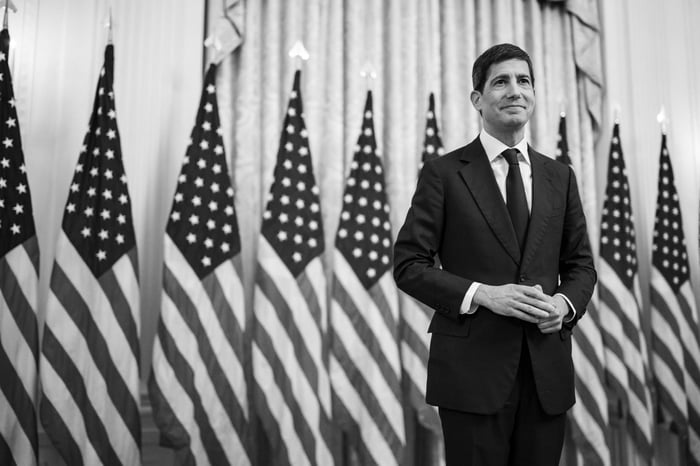
Fed Chair Kevin Warsh has proposed major changes to America's foremost financial institution.
In no particular order, Warsh:
- Has argued that the Federal Reserve's $6.74 trillion balance sheet should be deleveraged.
- Removed forward-looking guidance from Federal Open Market Committee (FOMC) meeting statements (a break of a more-than two-decade tradition).
- Wants to alter how policymakers think about inflation.
- Established five independent task forces to reshape how the central bank operates.
And the head of the Fed is far from finished. According to a July 31 New York Times report, Warsh has hinted at the possibility of conducting fewer FOMC meetings. While the body that sets our nation's monetary policy currently meets for two days every six weeks (about eight times per year), Warsh apparently wants to widen that gap. However, doing so would likely prove disastrous for Wall Street.
BREAKING: Fed Chair Warsh is considering reducing the amount of times that the Fed meets in a year, per NYT.
-- The Kobeissi Letter (@KobeissiLetter) July 31, 2026
Details include:
1. The FOMC has met eight times annually since 1981, with Federal law requiring at least four meetings per year
2. Fed Chair Warsh has reportedly not...
Reducing transparency has its limits
Arguably, the most fundamental change to Warsh's early tenure was his removal of forward-looking guidance. The Fed's new chair strongly believes that markets should react to facts and not the whims of policymakers. He also believes that the lack of forward-looking guidance gives policymakers more freedom to act, rather than being confined to previously outlined projections.
But it's this removal of forward guidance that's helped precipitate a significant move upward in Treasury bond yields at the long end of the yield curve.
Under former Fed Chair Jerome Powell and several of his predecessors, the transparency of forward-looking guidance resulted in orderly trading in the bond market (most of the time).
Since Warsh axed this guidance, bond traders have been selling 10-year and 30-year Treasury bonds, thereby pushing up yields and borrowing costs. Even though the FOMC hasn't altered its monetary policy, Warsh providing the financial market with less information has resulted in bond traders erring on the side of caution amid above-average inflation, leading to notably higher Treasury yields.
U.S. 30-year yield soaring to highest level since 2007 pic.twitter.com/lUgbjEmzDF
-- Hedgeye (@Hedgeye) July 31, 2026
If the new Fed chair is successful in lowering the number of required annual meetings, the equity and bond markets will receive even less data, heightening the likelihood of increased volatility.
The stock market looks to the central bank as a foundational source of credibility. With less transparency and guidance, wild swings in the Dow, S&P 500, and Nasdaq Composite may be more commonplace.
Likewise, the bond market will be even more apt to err on the side of caution when inflation is well above or below the Federal Reserve's long-term target of 2%.
Arguments can be made that deleveraging the Fed's balance sheet makes sense, or that task forces will help policymakers better do their job and avoid falling behind the curve. But reducing the number of annual FOMC meetings and further inhibiting transparency would, I believe, backfire on Wall Street.
Should you buy stock in S&P 500 Index right now?
Before you buy stock in S&P 500 Index, consider this:
The Motley Fool Stock Advisor analyst team just identified what they believe are the 10 best stocks for investors to buy now… and S&P 500 Index wasn’t one of them. The 10 stocks that made the cut could produce monster returns in the coming years.
Consider when Netflix made this list on December 17, 2004... if you invested $1,000 at the time of our recommendation, you’d have $395,463!* Or when Nvidia made this list on April 15, 2005... if you invested $1,000 at the time of our recommendation, you’d have $1,268,290!*
Now, it’s worth noting Stock Advisor’s total average return is 927% — a market-crushing outperformance compared to 211% for the S&P 500. Don't miss the latest top 10 list, available with Stock Advisor, and join an investing community built by individual investors for individual investors.
See the 10 stocks »
*Stock Advisor returns as of August 5, 2026.
Sean Williams has no position in any of the stocks mentioned. The Motley Fool has no position in any of the stocks mentioned. The Motley Fool has a disclosure policy.
Recommended Articles


