


AMD Shares Slump 9% Despite Q2 Beat; Why Challenging Nvidia Still Has Not Swayed Market?
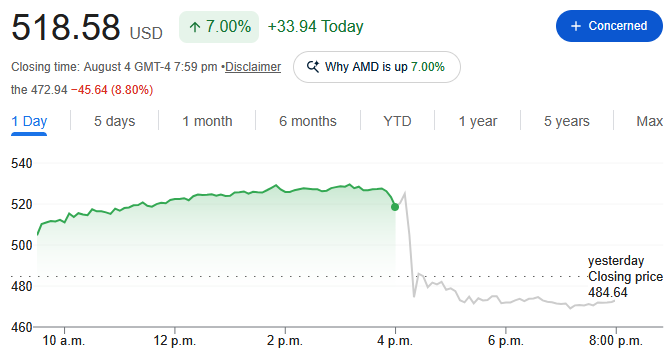
TradingKey - AMD ( AMD) reported second-quarter fiscal 2026 financial results that overall exceeded market expectations. However, because investors had already placed extremely high expectations on its AI business, and its third-quarter revenue guidance failed to fully satisfy the most optimistic forecasts, the company's stock fell 9% in after-hours trading.
Source: Google Finance
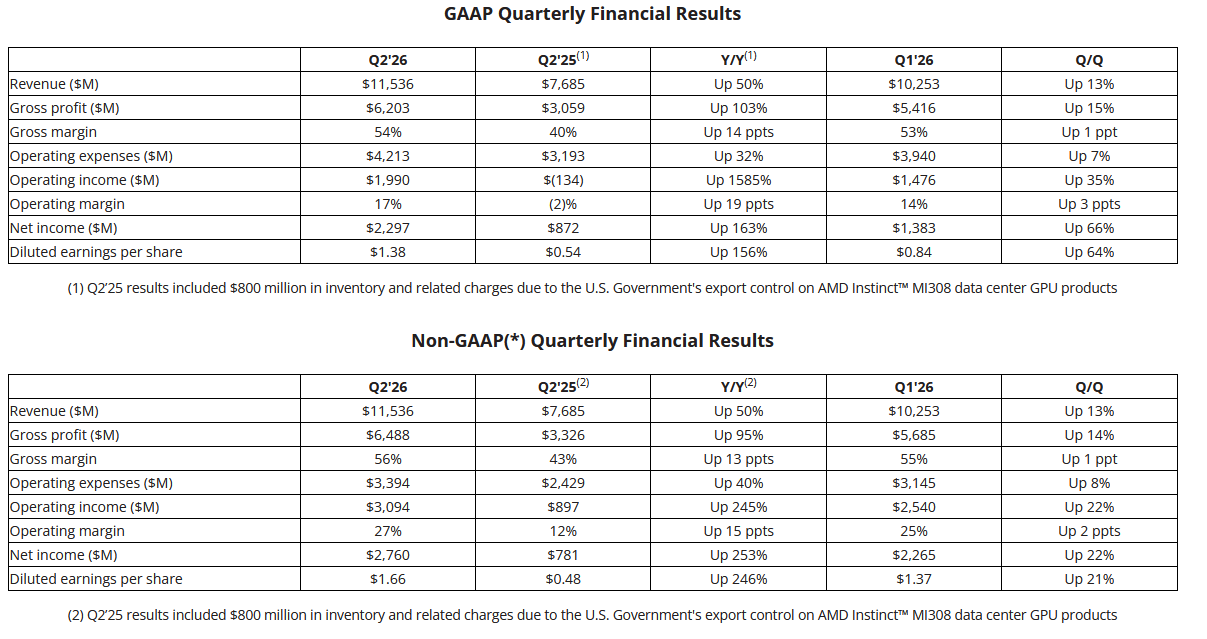
According to the earnings report, for the second quarter ended June 27, AMD achieved revenue of $11.54 billion, up 50% year-on-year, higher than the market expectation of $11.28 billion. Adjusted earnings per share were $1.66, also exceeding the $1.62 expected by analysts. Net income increased to $2.3 billion, a substantial rise from $872 million in the same period last year, as profitability continued to improve.
Source: AMD
So far this year, AMD's stock price has gained more than 100% cumulatively, far outperforming the broader market, as a large amount of AI growth expectations have already been reflected in its valuation. Consequently, even though the company provided a third-quarter outlook that exceeded average market estimates, it was still difficult to satisfy some investors' expectations for a continued explosion in its AI business.
Data Centers Become Largest Growth Driver
The data center segment remained the brightest spot this quarter.
AMD's second-quarter data center revenue reached $6.7 billion, up 107% year-over-year, accounting for nearly 60% of the company's total revenue and continuing to serve as the core driver of its performance growth. The company stated that sustained strong demand for EPYC server processors and Instinct AI GPUs was the primary driver behind the doubling of revenue.
As global cloud computing providers continue to expand their investments in AI infrastructure, demand for server CPUs and GPUs has risen in tandem, further driving AMD's market share expansion.
During the earnings call, Lisa Su stated that major cloud service providers, including AWS, Microsoft, Google, and Oracle, are further expanding their deployment of EPYC processors across internal data centers and public cloud platforms, as the company's CPU products continue to win market share from competitor Intel.
Management expects this trend to strengthen further in the coming quarters. AMD projects that the growth rate of its data center business will continue to accelerate in the second half of the year, driving concurrent improvements in overall revenue and profitability.
Lisa Su even projected that by 2027, the scale of the company's data center business is poised to double from current levels, with the server business expected to achieve a year-over-year growth rate exceeding 80% in the second half of fiscal year 2026, while demand for both accelerators and server CPUs has significantly exceeded previous internal expectations.
AMD Challenges Nvidia Across the Board in Shift From Selling Chips to Systems
Compared to past practices of simply selling GPU products, AMD is accelerating its transition toward becoming a complete AI infrastructure solution provider.
The company announced that it will begin delivering to Meta ( META ), OpenAI, Oracle ( ORCL) and other customers its first rack-scale AI system, Helios. For the first time, this system integrates AMD's own EPYC CPU, Instinct GPU, and networking chips into a unified platform, taking the competition with Nvidia ( NVDA )'s currently promoted integrated AI systems, rather than being limited to competition at the single-chip level.
AMD expects Helios to enter a larger-scale delivery phase in the fourth quarter, serving as an important driver for future AI server growth.
Meanwhile, the company is also continuously expanding its AI ecosystem footprint, including deepening collaboration with customers such as Anthropic and Microsoft Azure. AMD aims to replicate Nvidia's integrated model of 'GPU+CPU+networking+software' to further enhance its influence in the AI infrastructure market.
However, Nvidia currently still firmly dominates the AI accelerator market. On the same day AMD released its earnings, Elon Musk also announced during a SpaceX ( SPCX) conference call that the company's future AI data centers will be built entirely using Nvidia GPUs and the Rubin platform, with plans to launch Starmind AI satellites equipped with Nvidia Vera CPUs and Rubin GPUs next year. This news further solidifies Nvidia's leadership in the AI computing power sector while also putting pressure on AMD's after-hours stock price performance to some extent.
Guidance Above Market Average
AMD expects third-quarter revenue of approximately $13 billion, plus or minus $300 million, with the midpoint representing year-over-year growth of about 41%, higher than the market consensus of approximately $12.5 billion; adjusted gross margin is expected to be around 56%, which is generally in line with market forecasts.
However, against the backdrop of a red-hot AI industry, some institutions had previously expected AMD's quarterly revenue to approach $14 billion. Therefore, although the $13 billion revenue guidance exceeded consensus expectations, it failed to meet the market's most aggressive, optimistic estimates.
Overall, this earnings report once again proves that AMD is in a new high-growth cycle driven by AI. The continuous rapid expansion of the data center business, the commercialization phase of system-level products like Helios, and the growing market share in server CPUs all demonstrate the company's strengthening competitiveness.
Meanwhile, as valuations continue to rise, the capital markets are placing increasingly high demands on the speed of earnings delivery, AI ecosystem construction, and future profitability. Whether AMD's stock price can sustain its strength in the future will depend more on the ramp-up speed of AI products, the market penetration rate of its system solutions, and whether it can continue to expand the scale of cooperation with major global cloud service providers, rather than just whether quarterly results slightly exceed expectations.
Recommended Articles


