


Boeing (BA) Stock Forecast: BNP Paribas Upgrades, JPMorgan Raises to $290, Double-Top at $234 in Focus
TradingKey - Boeing (NYSE: BA) is trading at $226.51 on Monday August 4, up by 4.80% from its Friday closing price at $216.14. The upgrade was announced by BNP Paribas from Underperform to Outperform and JPMorgan upped its price target from $270 to 290. Goldman Sachs remained Bullish with a $260 price target. Over the last year, Boeing has traded in a range of $176.77 to $254.35. Q2 reported Boeing's largest number of deliveries since 2018, delivering 171 total aircraft. Additionally, Q2 reported $631 million in FCF and a new record total backlog of $715 billion. The RSI has reached 75 and is now approaching the double top resistance at $234.06. For the year, FCF is expected to be in the $1 to $3 billion range.
What Changed to Drive Today's Upgrade and Analyst Moves
BNP Paribas changed its stance on Boeing from Underperform to Outperform. This subsequent bullish call follows positive Q2 operational results from Boeing. Q2 reported a total backlog of $715 billion and a delivery count of 171 (the highest since 2018) alongside positive FCF of $631 million. Prior to the bullish call, Boeing received a positive report from the FAA, stating Boeing had the authority to self-certify all new 737 MAX and 787 models.
Now, Kelly Ortberg’s published turnaround plans, focusing on the improvement of the 737 MAX and the scale of the production ramp, are already beginning to align within the trajectory Jim Cramer mentioned during his upgrade of Boeing on the CNBC Investing Club on July 28.
At the same time, JPMorgan increased its target to $290 from $270 based on improving FCF expectations and Boeing's guidance for FY2022 FCF of $1 billion to $3 billion. This target price considers more rapid cash generation with the summer production of the 737 at 47 units/month and expected to go to 52 units/month with the opening of the North Everett production line.
Elsewhere, RBC lowered its target to $265 from $275 due to more conservative expectations for the 777X certification, the most significant near-term catalyst, but maintains its Buy rating on the stock.
The Q2 Numbers and What They Prove About the Turnaround
Boeing reported results for Q2 2026 on July 28, and with revenue up 8% to $24.6 billion, the GAAP net loss improved to $428 million ($0.67) vs. $612 million ($0.92) in the prior year. The Commercial Airplanes business delivered 171 aircraft, the most since 2018, and the operating margin improved to -2.7% from -5.1%. Revenue for the Defense, Space and Security business increased 13% to $7.5 billion, and Global Services did even better, achieving an operating margin of 18.1%.
Free Cash Flow of $631 million was a pivotal improvement after four consecutive quarters of Cash Burn. Backlog hit a record high of $715 billion ($481 billion at list prices) and provides an estimated 29 annual revenue fleet replacement, or an average of nine years of revenue. Backlog at the targeted production levels of 8 787s and 47 737s is expected to turn cash flow positive via increased delivery and payment by customers. Ramping up deliveries to 500 737s in 2026 will require an average of 186 737s in the second half of the year, on top of the prior 314 deliveries.
The 777X and What Analysts Are Watching
The only large catalyst for Boeing at this point is the 777X obtaining its certification. As the FAA advances in its approvals for the 737 7, 737 10, and the 777X flight tests, they are also targeting 2027 for the first delivery of multiple variants. UBS mentioned last week that the 777X certification was the biggest remaining catalyst when they maintained their Buy at $285.
The 777X matters because the opening of this wide-body delivery revenue stream for airlines is greatly awaited and creates an opportunity for Boeing to deliver a new aircraft that demonstrates they can navigate new FAA certification standards after the 737 MAX and the subsequent enhanced regulatory procedures.
The negotiations for the SPEEA engineering union remain another variable that could influence workforce stability during the certification and production of aircraft.
BA Technical Setup
Boeing is currently sitting at $226.51, not far from the $234.06 resistance zone. The 50 and 100period EMAs ($219.69) and ($217.74) respectively, are all sitting below the current price, and are indicating a bullish trend. RSI (75) and the sharp rally from the $204.90 post earnings level indicate an overbought condition.
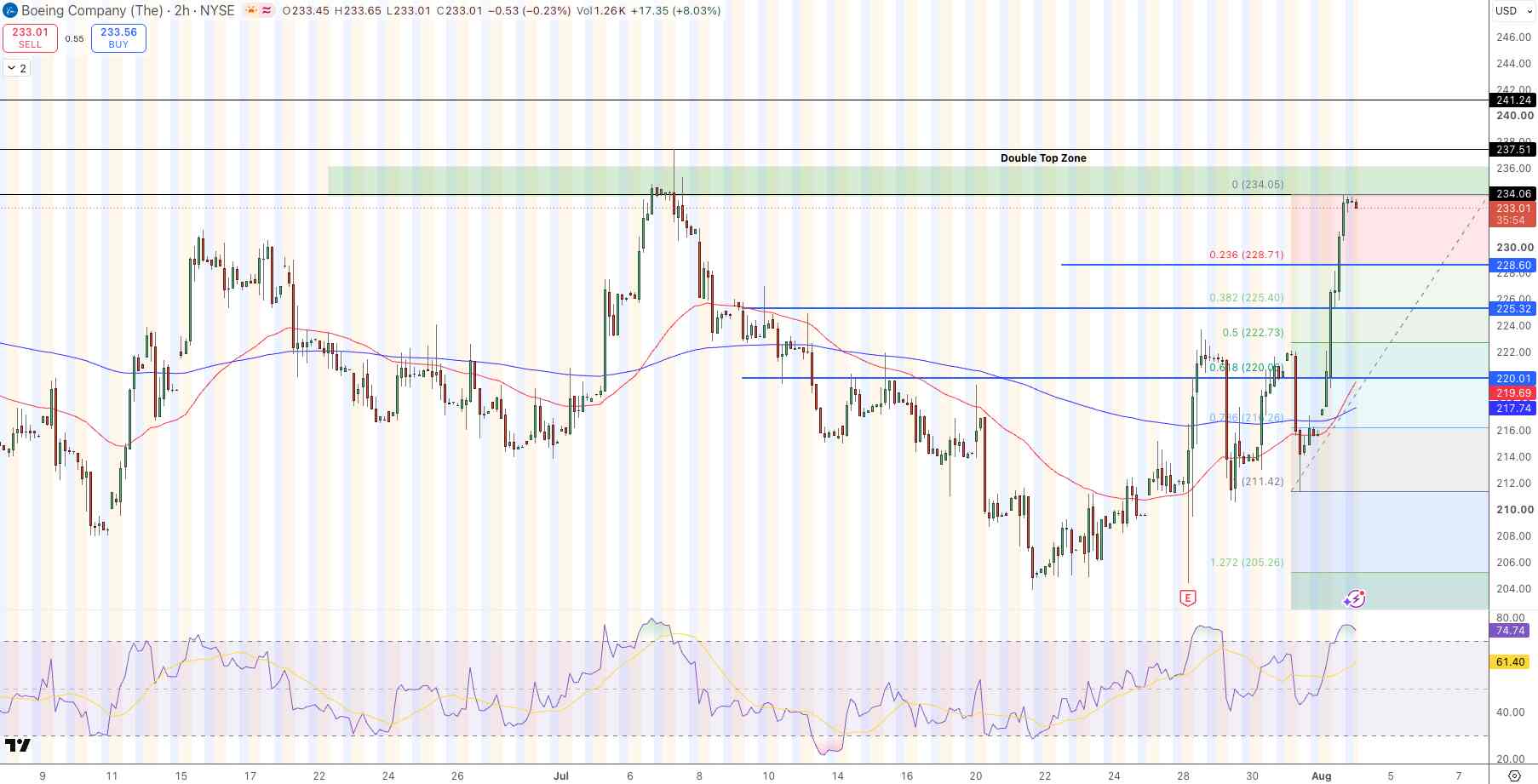
Boeing (BA) Stock Price Chart - Source: Tradingview
A close beyond $234.06 would cancel the double top, and expose the targets at $237.51 and $241.24. $228.60 (first Fibonacci retracement) is the key support level, with $225.32 being critical support. In order to maintain the bullish trend, the stock must not fall under $225.32
Key Levels
- Today: $226.51 (+4.80%). Range: $219.21 - $228.22. Yesterday's Close: $216.14
- 52 Week Range: $176.77 to $254.35. Today's RSI: 75 (overbought)
- Q2 Confirmed: Revenue $24.6B (+8%). 171 deliveries (highest since 2018). FCF $631M. Backlog $715B record
- Analyst Updates: BNP Paribas upgraded to Outperform. JPMorgan reiterated Outperform and raised target to $290. Goldman reiterated Buy and raised target to $260. RBC reiterated Buy and raised target to $265.
- FCF Guidance: $1B - $3B expected FCF for Full Year 2026. $1.4B Operating Cash Flow for Q2.
- 777X: The FAA continues to evaluate the next steps for certification. Conduct the first deliveries, expected to be in 2027. Key catalyst going forward.
- Resistance: $234.06 (double top), $237.51, $241.24
- Support: $228.60, $225.32, $220.01, $217.74 (100 EMA)
Why Did BNP Paribas Upgrade Boeing from Underperform to Outperform Today?
BNP Paribas upgraded its assessment of the operational pathway for Boeing after the positive news in Q2. We have a number of positive data points. Boeing generated positive free cash flow of $631 million, the highest it has ever been since 2018. Boeing delivered 171 planes, the highest it has been since 2018. There was a positive development for Boeing when the FAA restored the 737 MAX and 787 self-certification authority in July.
The delivery backlog on both the models was eliminated. In addition, setting a positive tone on the outlook for the production of Boeing planes, Ortberg also delivered positive news in two consecutive quarters, which further erased customers' concerns. The fund was highly bearish around the 2024-2025 crisis. Now the fund is positive on Boeing due to the 715 billion dollar backlog and positive FCF for the year in the range of $1 billion to $3 billion.
What Is the 777X and Why Does It Matter for Boeing's Stock?
As Boeing’s next-generation wide-body airliner, the 777X is an important development. Here are three reasons why it matters for Boeing’s stock.
First, the 777X will allow Boeing to capture delivery revenue from airlines who have patiently awaited its delivery. Each aircraft delivered provides cash that Boeing currently cannot capture.
Second, if the FAA certifies the 777X under enhanced scrutiny, it will allow Boeing to showcase their ability to successfully navigate an important regulatory pathway and provide confidence for the entire company.
Third, it will allow Boeing to lessen its reliance on the 737 MAX for its recovery. The company expects its Free Cash Flow to be in the range of $1 billion to $3 billion for 2026; however, 2027 and beyond could bring even greater FCF from the 777X.
Bottom Line
Boeing increased by 4.80% to $226.51. This was especially due to the BNP Paribas upgrade from Underperform to Outperform and JPMorgan increase on target from $250 to $290. $234.06 double-top is immediate resistance. Q2 shows the operational inflection point. This inflection was done with the record of 171 deliveries with $631 million in FCF, leading to a new company record of $715 billion in backlog.
The 777X certification, and the NFP Data on Friday are the key market mover events for the week. With the RSI of 75, it is overbought after the sharp move up from $205. The $225.32 support will have to hold for the bullish outlook to be valid. Strong buy recommendations are at $290 from JPMorgan, $260 from Goldman, and $265 from RBC.
Recommended Articles


