


1 Glorious Growth Stock That Could 10X by 2034
Key Points
Lemonade is overhauling the insurance industry by using artificial intelligence (AI) to write quotes, pay claims, and calculate premiums.
The company's revenue rocketed 79% higher during the second quarter of 2026.
Lemonade stock trades at an attractive valuation, and it could deliver a tenfold return over the next eight years or so.
- 10 stocks we like better than Lemonade ›
Nobody really likes dealing with their insurance company, especially when it's time to make a claim. Receiving a payout can involve several phone calls and a lengthy waiting period, during a time when stress levels are already running high. Lemonade (NYSE: LMND) is improving the customer experience by using artificial intelligence (AI) to automate the quotes and claims processes, and it's having a tremendous amount of success.
The company operates in the homeowners, renters, life, pet, and car insurance markets, and as of June 30, it had $1.4 billion worth of in-force premium (IFP), which is the value of premiums from all active policies. In late 2024, management outlined a 10-year plan to grow that figure to $10 billion, and here's why it could translate to a tenfold return for shareholders by the year 2034.
Where to invest $1,000 right now? Our analyst team just revealed what they believe are the 10 best stocks to buy right now, when you join Stock Advisor. See the stocks »

Image source: The Motley Fool.
Consumers are flocking to Lemonade
A prospective Lemonade customer starts their journey on the company's website, where a chatbot named Maya can write an insurance quote in under 90 seconds. When it's time to make a claim, another AI assistant named Jim can pay them out in just a few seconds with no human intervention.
But an attractive customer experience isn't the only thing Lemonade offers. The company also uses AI to calculate premiums, analyze risk, and run its operations, resulting in a high degree of efficiency that ultimately reduces prices. In fact, during the second quarter of 2026, Lemonade's loss adjustment expense (LAE) ratio declined to a record low of just 5%, which is nearly half the industry average of 9%. The LAE ratio measures the percentage of premiums that an insurer spends on handling claims, and 5% is extremely efficient.
As a result, it's no surprise that Lemonade had a record 3.3 million policyholders as of June 30, up 23% from the same time last year. IFP, which was $1.4 billion as I highlighted earlier, soared at an even faster rate of 32%.
Lemonade's revenue is surging
The gross loss ratio is an important metric in the insurance industry because it measures the proportion of premiums paid out as claims. In the past, Lemonade said a gross loss ratio of 75% was the key to a thriving insurance business, but the lower the better, and it came in at a record low of 60% in the second quarter.
When IFP grows and the gross loss ratio declines, the net result is more money in Lemonade's pocket. That explains why the company's second-quarter revenue soared by 79% year over year to $294.4 million. The result was so strong that management increased its full-year revenue forecast for 2026 to $1.217 billion (at the midpoint of the respective guidance ranges) from $1.2 billion.
As an early-stage technology company, Lemonade is squarely focused on acquiring customers and growing its business, even if it results in short-term losses. But it did make some progress at the bottom line during the second quarter; its net loss of $43 million roughly matched its net loss from the year-ago period, but its loss on an adjusted earnings before interest, taxes, depreciation, and amortization (EBITDA) basis more than halved to $18.7 million.
The path to a 10x return
Based on Lemonade's trailing-12-month revenue of $975 million, its stock is trading at a price-to-sales (P/S) ratio of 4.2. That is below its three-year average of 5.3 and way below its recent peak of almost 12, so the stock looks attractively valued right now.
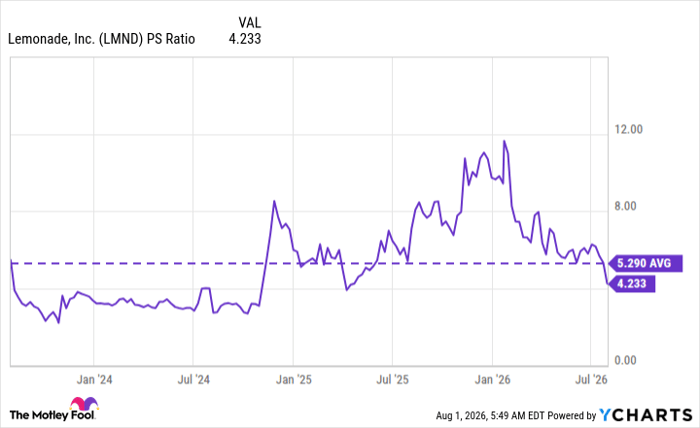
LMND PS Ratio data by YCharts. PS Ratio = price-to-sales ratio.
Management believes Lemonade can grow its IFP to $10 billion by 2034 by doubling down on its excellent customer experience and leaning into valuable markets like car insurance. It would represent a 600% increase from where IFP is today, and revenue can be expected to grow by roughly the same amount. Therefore, even if Lemonade's P/S ratio remains exactly where it is today, its stock could be headed for a 600% return over the next eight years.
However, we know the company's revenue is currently growing at more than twice the pace of its IFP because of its declining gross loss ratio and ultra-low LAE ratio. If both metrics remain where they are today, a sixfold increase in IFP by 2034 could easily lead to a tenfold increase in revenue and, thus, a tenfold return in Lemonade stock.
But it won't be easy for Lemonade to continue improving its gross loss ratio or LAE, even with the help of AI, because both metrics are already below industry averages. That is a risk investors should keep in mind, but I think Lemonade stock has plenty of upside potential over the long term nonetheless.
Should you buy stock in Lemonade right now?
Before you buy stock in Lemonade, consider this:
The Motley Fool Stock Advisor analyst team just identified what they believe are the 10 best stocks for investors to buy now… and Lemonade wasn’t one of them. The 10 stocks that made the cut could produce monster returns in the coming years.
Consider when Netflix made this list on December 17, 2004... if you invested $1,000 at the time of our recommendation, you’d have $386,727!* Or when Nvidia made this list on April 15, 2005... if you invested $1,000 at the time of our recommendation, you’d have $1,232,139!*
Now, it’s worth noting Stock Advisor’s total average return is 906% — a market-crushing outperformance compared to 208% for the S&P 500. Don't miss the latest top 10 list, available with Stock Advisor, and join an investing community built by individual investors for individual investors.
See the 10 stocks »
*Stock Advisor returns as of August 4, 2026.
Anthony Di Pizio has no position in any of the stocks mentioned. The Motley Fool has positions in and recommends Lemonade. The Motley Fool has a disclosure policy.
Recommended Articles


