


One Word Repeated 10 Times by Fed Chair Kevin Warsh Has Effectively Reshaped the Central Bank's Monetary Policy Approach
Key Points
The Dow Jones Industrial Average, S&P 500, and Nasdaq Composite sank like a stone after Fed Chair Kevin Warsh and the Federal Open Market Committee (FOMC) left interest rates unchanged.
The head of the Fed just recharacterized America's sources of inflation, and it has significant implications for monetary policy and Wall Street.
Warsh's calculated use of this word, coupled with rising long-dated Treasury bond yields, suggests that rate hikes are likely.
- 10 stocks we like better than S&P 500 Index ›
This has been a transformational year for America's foremost financial institution, the Federal Reserve, as well as the Dow Jones Industrial Average (DJINDICES: ^DJI), S&P 500 (SNPINDEX: ^GSPC), and Nasdaq Composite (NASDAQINDEX: ^IXIC), given that the Fed has always been viewed as a stabilizing force by Wall Street.
On May 22, President Donald Trump's handpicked successor to Jerome Powell, Kevin Warsh, was officially sworn in as only the 17th head of the central bank since its inception in December 1913. But this is far from the only history the Fed has made this year.
Where to invest $1,000 right now? Our analyst team just revealed what they believe are the 10 best stocks to buy right now, when you join Stock Advisor. See the stocks »
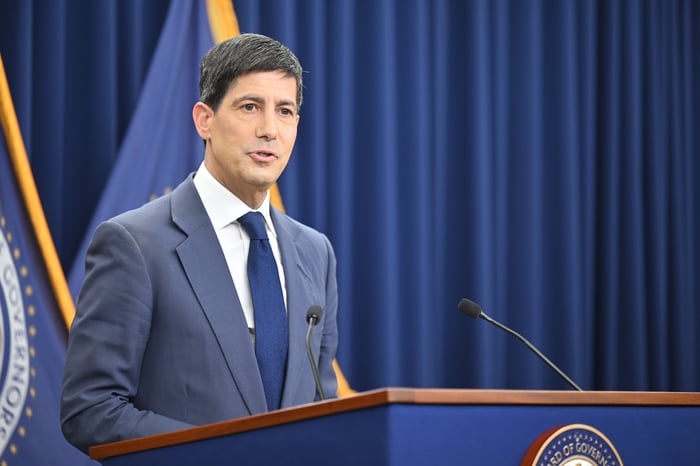
Fed Chair Kevin Warsh is reshaping how policymakers think about inflation. Image source: Official Federal Reserve Photo.
The July 29 Federal Open Market Committee (FOMC) meeting, in which policymakers left interest rates steady, featured two "firsts":
- Three FOMC members dissented in favor of a quarter-point rate hike, marking the first time since September 2016 that three dissents occurred in the same policy direction.
- The three dissents represent the biggest central bank divide this early into a new Fed chair's tenure since 1970.
But these "firsts" aren't the biggest story. Rather, it's the one word Fed Chair Warsh repeated 10 times in his prepared remarks and responses to the press after the latest FOMC meeting. Warsh's purposeful use of this word suggests that the Fed's monetary policy approach is rapidly evolving.
Kevin Warsh delivers "shock" and awe
The Dow, S&P 500, and Nasdaq Composite were less-than-enthused about the FOMC's lack of action regarding interest rates, with the Dow tumbling by more than 1,100 points (its worst single-day performance in over a year) on July 29.
Ahh... this comment is why the market freaked out.
-- Financelot (@FinanceLancelot) July 29, 2026
Kevin Warsh keeps saying growth is "strong" but his actions and refusal to admit this is a pause, say the complete opposite.
"Shocks" = economic shocks
He's worried about growth (as he should be). https://t.co/VVefIdnOax pic.twitter.com/UO4aj7LTNs
However, the biggest highlight of Warsh's remarks was his characterization of inflationary pressures as "shocks." In his prepared remarks, the head of the Fed noted:
My colleagues and I considered the economic shocks of recent years. Strained supply chains arising from the pandemic, military conflicts, energy-supply disruptions, substantial increases in tariff rates, and yes, the surge in AI-related investment.
Warsh repeated the term "shocks" 10 times while speaking with reporters after the July FOMC meeting. The insinuation is clear: these successive inflationary pressures have transformed into sticky sources of inflation. In other words, whereas shocks of the past have traditionally been short-lived, the growing list of economic shocks this decade has persisted.
Kevin Warsh's calculated use of the word "shocks," along with his rejection that the FOMC "paused" on interest rates at its July meeting, points to a growing likelihood that policymakers will raise interest rates to combat inflation that's been parked above the Fed's long-term target of 2% for the last 64 months. The sizable increase in long-dated Treasury bond yields also strongly hints at future rate hikes.
64.
-- Charlie Bilello (@charliebilello) July 30, 2026
As in 64 consecutive months with US core inflation above the Fed's 2% target.
The Fed has lost all credibility when it comes to fighting inflation.
Kevin Warsh talks a big game, but talk is cheap. The Fed should have hiked rates yesterday and ended QE. pic.twitter.com/HvimqfW6WW
The Fed chair shifting from a discussion of higher prices to one focused on economic shocks effectively reframes the FOMC's monetary policy approach and makes a rate-hiking cycle the most logical path forward to price stability. Even with 10-year and 30-year Treasury bond yields rising, this is unlikely to be enough to stabilize prices without the Fed taking action.
Although higher interest rates threaten to slow the artificial intelligence (AI) data center build-out (i.e., the stock market's No. 1 catalyst), they're a necessary evil that should benefit the U.S. economy over the long run.
Should you buy stock in S&P 500 Index right now?
Before you buy stock in S&P 500 Index, consider this:
The Motley Fool Stock Advisor analyst team just identified what they believe are the 10 best stocks for investors to buy now… and S&P 500 Index wasn’t one of them. The 10 stocks that made the cut could produce monster returns in the coming years.
Consider when Netflix made this list on December 17, 2004... if you invested $1,000 at the time of our recommendation, you’d have $386,727!* Or when Nvidia made this list on April 15, 2005... if you invested $1,000 at the time of our recommendation, you’d have $1,232,139!*
Now, it’s worth noting Stock Advisor’s total average return is 906% — a market-crushing outperformance compared to 208% for the S&P 500. Don't miss the latest top 10 list, available with Stock Advisor, and join an investing community built by individual investors for individual investors.
See the 10 stocks »
*Stock Advisor returns as of August 4, 2026.
Sean Williams has no position in any of the stocks mentioned. The Motley Fool has no position in any of the stocks mentioned. The Motley Fool has a disclosure policy.
Recommended Articles


