


Has Micron Fallen Enough? Fundamentals Remain Strong, But It May Not Be a Good Investment Yet
Over the past few weeks, Micron's stock has pulled back noticeably along with the broader memory sector. The market's concerns aren't complicated: HBM manufacturers are accelerating capacity expansion, conventional DRAM prices will eventually slow, and Chinese memory makers may bring future supply pressure. Together, these factors have compressed the market's expectations for the industry's future profitability and become the main reason behind Micron's valuation pullback. These worries are directed more at the supply-demand landscape over the next one to two years than at the company's current operating conditions. The market has begun trading the future, even as present fundamentals remain strong.
Based on the latest earnings, neither Micron nor SK Hynix shows any clear sign of fundamental weakening. Micron's revenue, gross margin, free cash flow, and data center business are all at historic highs, HBM4 is ramping up, and the company's guidance for next quarter shows no obvious slowdown in AI demand, while multi-year HBM supply agreements further improve the predictability of future revenue. SK Hynix's HBM, AI server memory, and enterprise SSD businesses have likewise maintained rapid growth. This correction is not happening after earnings deteriorate — it's happening while earnings are still growing rapidly.
This is exactly the stage at which cyclical stocks are most easily misunderstood. Stocks never wait until revenue declines, inventory piles up, or gross margins start deteriorating before they peak. When the financial data looks its best, the market has often already begun trading the next round of supply-demand shifts and reassessing how long current profitability can be sustained.
So the real question now isn't whether Micron is a good company — it's whether the market's worries about future capacity expansion, peaking prices, and supply pressure are already fully reflected in the current stock price.
My assessment is that this correction has already released a substantial portion of the valuation pressure, and the probability of another decline of similar magnitude is falling. But that doesn't mean the stock will quickly return to its prior highs. Even with healthy fundamentals, Micron may still enter a period of earnings realization and valuation digestion.
Not falling much further doesn't mean bouncing back quickly.
Chapter 1 | Why Has the Market Suddenly Stopped Trusting Memory?
A year ago, the market worried there wasn't enough HBM; today, it worries there might be too much in the future. This means memory stocks have shifted from trading insufficient supply to trading future supply.
In the past, as long as demand kept being revised upward and orders kept increasing, earnings forecasts would rise accordingly. Now that supply shortage has become market consensus, for the stock to keep rising it must prove that future demand can continue to exceed already-high expectations. So even as earnings keep hitting new highs, the stock price may adjust ahead of time.
The market is trading future effective supply
Every up-cycle in the memory industry tends to follow the same pattern: prices rise, profits improve, capital expenditure increases, and eventually new supply forms. Currently, Micron, SK Hynix, and Samsung are all expanding investment in HBM, advanced nodes, and packaging, so it's no surprise the market has started worrying about future supply growth. But higher capex doesn't mean effective supply increases immediately. Getting HBM from expanded capacity to actually reaching the market still requires process ramp-up, advanced packaging, yield improvement, and customer qualification. Only products that can be stably mass-produced and pass customer validation constitute truly effective supply.
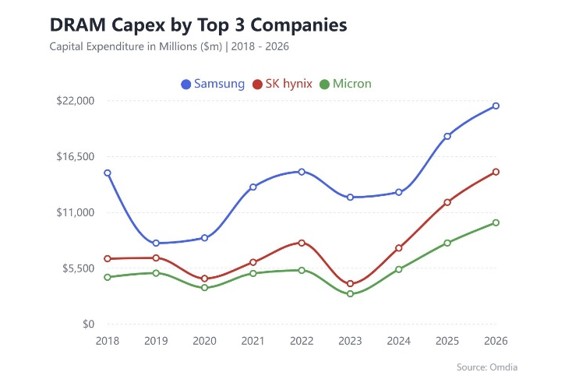
Source: Global Semi Research (Substack)
So what can be confirmed right now is that the industry is expanding capacity — what cannot be confirmed is when this new capacity will actually exceed demand. The market is simply pricing in that possibility ahead of time.
HBM tightness doesn't mean the whole memory industry is tight
HBM, conventional DRAM, and NAND are all memory products, but their pricing logic differs.
HBM serves AI accelerators, has long qualification cycles, concentrated customers, and high technical barriers; ordinary DRAM and NAND are more standardized and more sensitive to industry supply-demand shifts. So continued HBM shortages aren't inconsistent with peaking prices in ordinary DRAM and NAND.
Micron's biggest change right now is the rising share of HBM, server DRAM, and enterprise SSDs, which is driving improvements in revenue mix and margins. But for the stock, what the market cares about isn't just how high profits are — it's whether profit improvement can keep accelerating.
Chinese manufacturers mainly affect long-term valuation
In the near term, Chinese manufacturers' impact on the highest-end HBM remains limited. But in conventional DRAM and NAND markets, new supply could gradually push down long-term price and capital-return expectations. So Chinese manufacturers typically affect not current earnings first, but rather the market's judgment of the industry's long-term profitability.
Over the past two years, what drove Micron higher wasn't just earnings growth — more importantly, it was continuous upward revisions to earnings forecasts. Now the market has started trading future supply ahead of time. This correction isn't fundamentally about demand suddenly disappearing — it's about valuation adjusting ahead of the financial statements. For Micron, the biggest future challenge may not be an earnings decline, but rather that if earnings stay high over the next few quarters without new upward revisions, the stock may digest its valuation through a long period of sideways trading instead.
Chapter 2 | Have Micron's Fundamentals Actually Gotten Worse?
If you look only at the latest earnings report, the answer is no. As of fiscal Q3 2026, Micron's revenue, gross margin, operating cash flow, and free cash flow all hit quarterly records, and inventory and the balance sheet show no sign that the company has entered a profit downturn. The real debate isn't whether current fundamentals are deteriorating — it's how long such high prices, margins, and cash flow can be sustained.
Revenue growth comes mainly from price increases, not just higher shipment volumes
In fiscal Q3 2026, Micron generated revenue of $41.46 billion, up 74% from the prior quarter's $23.86 billion and up 346% year-over-year, marking a fifth consecutive quarterly revenue record. Non-GAAP net income reached $28.86 billion, with diluted EPS of $25.11.
However, this sharp revenue growth wasn't driven by a corresponding surge in shipment volume. DRAM revenue in Q3 was $31.3 billion, 76% of total revenue, up 67% quarter-over-quarter — but DRAM bit shipments grew only in the low single digits, while average selling prices rose in the low-60% range. NAND revenue was $9.9 billion, up 99% quarter-over-quarter, with bit shipments up only in the mid-single digits while average selling prices rose in the mid-80% range. This shows the primary driver of this quarter's revenue growth was price increases, supported by a higher share of high-value products and an improved product mix.
The data center has become Micron's most important growth engine. The company's data-center-related revenue exceeded $25 billion in Q3, about 61% of total revenue. Within that, cloud memory revenue was $13.8 billion, up 78% quarter-over-quarter; core data center revenue was $11.5 billion, up 103% quarter-over-quarter. Data center SSD revenue exceeded $5 billion, more than doubling quarter-over-quarter. Beyond upgrading its product mix, Micron continues to expand long-term customer partnerships. The company has disclosed 16 multi-year Strategic Customer Agreements (SCAs) covering data center, consumer, and automotive end markets, spanning DRAM, NAND, and, where applicable, HBM. The company also stated that pricing and volume for calendar year 2026 HBM supply are fully contracted. These agreements improve the predictability of future orders and revenue and allow new capacity to lock in demand earlier, giving this AI cycle higher earnings certainty than the traditional memory industry has historically had.
This shows that Micron's revenue structure has clearly changed. Growth in HBM, server DRAM, and enterprise SSDs means the company increasingly depends on AI infrastructure rather than mainly on traditional PC and phone cycles. But it's also worth noting that this quarter's revenue growth still relies heavily on extremely strong price increases. If supply-demand tightness eases in the future and price gains slow, revenue growth could pull back noticeably even as shipment volumes and the high-end product mix keep rising.
Gross margin is still rising, but the pace of expansion is about to slow
Micron's Q3 GAAP gross margin was 84.6%, and non-GAAP gross margin was 84.9%, up 10 percentage points from the prior quarter's 74.9% — a company record. Management said the margin improvement this quarter came mainly from price increases, along with benefits from an improved product mix and operational execution.
Margins across business segments were similarly extremely high: cloud memory gross margin was 83%, core data center gross margin 87%, mobile and client gross margin 87%, and automotive and embedded gross margin 79%. This means profit improvement is no longer confined to HBM — price increases and supply tightness are spreading to broader DRAM and NAND products.
For fiscal Q4 2026, Micron expects revenue of $50 billion, plus or minus $1 billion, gross margin of about 86%, and non-GAAP EPS of about $31. In other words, the company expects both revenue and gross margin to keep hitting new records.
But a marginal shift has already appeared. Q3 gross margin rose 10 percentage points quarter-over-quarter, while the Q4 guidance is only about 1.1 percentage points above the Q3 actual level. Management also explicitly stated the Q4 guidance already accounts for a notable slowdown in price gains. So the more accurate read isn't that gross margin has peaked, but that it's still rising — just shifting from rapid leaps to moderate improvement.
This matters greatly for valuation. The company can keep extremely high margins, but as long as margin improvement stops accelerating, the market may start shifting attention from current earnings to future supply, pricing, and capex.
Operating cash flow more than covers capex, but investment intensity is rising quickly
Micron's Q3 operating cash flow reached $25.39 billion, more than double the prior quarter's $11.9 billion — a company record. Net capex was $7.08 billion, and adjusted free cash flow reached $18.3 billion, also a quarterly record.
So the more precise statement is: current operating cash flow not only covers capex, but the company can still generate substantial free cash flow after completing large-scale investment. Over the past nine months, Micron's cumulative operating cash flow reached $45.7 billion, cumulative net capex was about $16.6 billion, and it repaid about $9.4 billion in debt — showing current expansion is mainly supported by strong internal cash generation. The company expects Q4 net capex of about $10 billion, bringing full fiscal 2026 net capex to about $27 billion; management expects net capex in every quarter of fiscal 2027 to be higher than fiscal Q4 2026.
Still, capex is rising rapidly. The company expects Q4 capex of about $10 billion, bringing full fiscal 2026 capex to about $27 billion; management also expects capex in every quarter of fiscal 2027 to exceed the fiscal Q4 2026 level, with most of the increment going toward new fabs and cleanroom construction.
This means that while current cash flow is very ample, the future investment burden will also rise significantly. If prices and demand stay strong, new capacity should bring growth; but if demand growth slows while capex and capacity release proceed as planned, free cash flow could come under pressure before the income statement does.
Inventory hasn't worsened; DRAM supply remains tight
At the end of Q3, Micron's inventory value was $8.6 billion, with 120 days of inventory. Management said DRAM inventory is very tight, with days of inventory below 120.
120 days itself can't simply be labeled as unambiguously low, but based on the trend and management's description, there's currently no sign of the persistent inventory buildup, unsold products, or forced discounting typical of a cycle top. Instead, the company judges that DRAM and NAND demand still clearly exceeds industry supply and expects the supply-demand tightness to persist beyond 2027.
Note that this judgment about future supply-demand tightness is a management forecast, not an established fact. It's worth citing, but shouldn't be treated as a firm conclusion. What really needs continued monitoring is whether days of inventory keep rising, whether channel inventory accumulates, and whether shipment volumes can sustain growth once price gains slow.
The balance sheet is one of the strongest in the company's history
At the end of Q3, Micron held roughly $30.2 billion in cash, marketable investments, and restricted cash combined, with about $5.7 billion in debt, for net cash of roughly $24.4 billion. The company reduced debt by $4.4 billion during the quarter, including repurchasing and retiring some senior notes.
Compared with the end of fiscal 2025, Micron's cash and investments grew from about $11.9 billion to about $30.1 billion. Over the past nine months, the company took on no new debt financing and instead repaid about $9.4 billion in debt.
"Lower net debt" is no longer the most accurate description — Micron is now actually in a significant net cash position. A strong balance sheet means that even if the memory industry enters a downturn, the company is better positioned than in past cycles to sustain R&D, capacity expansion, and product investment without relying on costly external financing.
Fundamentals haven't turned bad, but the growth drivers are changing
Overall, there's no evidence that Micron's fundamentals have turned bad. Q3 revenue reached $41.46 billion, non-GAAP gross margin was 84.9%, operating cash flow was $25.39 billion, and adjusted free cash flow was $18.3 billion; the company holds about $30.2 billion in cash and investments with about $24.4 billion in net cash, and inventory shows no sign the industry has entered a new downturn.
What's really changing is the marginal structure of growth. This quarter's revenue growth relied mainly on sharp price increases rather than rapid growth in bit shipments; Q4 revenue and gross margin are still expected to set new records, but management already expects price gains to slow significantly. Meanwhile, capex is rising from $7.1 billion in Q3 to about $10 billion in Q4, and will increase further in fiscal 2027.
So Micron's current stage isn't fundamental deterioration — it's a gradual shift from rapid earnings upward revisions into a phase of high-earnings realization. The company is still growing, supply-demand remains tight, and the balance sheet is very strong. But for the stock, the key going forward is no longer how high this quarter's profit is, but how long price increases can continue, when new capacity will be released, and whether high margins can hold up through a larger capex cycle.
The more precise conclusion: Micron's earnings are still growing, but the stage most easily driven by continued price-led upside surprises may be gradually passing.
Chapter 3 | Micron, SK Hynix, and Samsung — Who's the Biggest Winner of the AI Era?
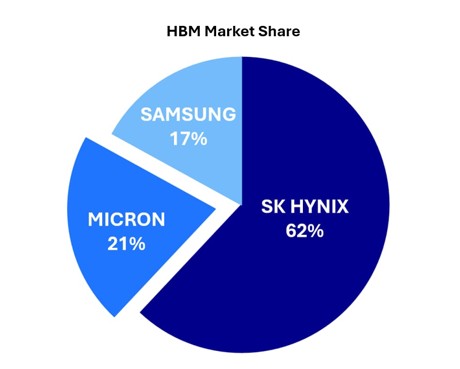
Source: Priya Bansal (Substack)
If you're comparing technology alone, the answer isn't complicated; but comparing stocks is an entirely different question. What investors should really care about isn't who has the most advanced HBM, but who is most likely to keep generating earnings that beat expectations.
While all three companies benefit from AI, they benefit in different ways.
Company | Core Strength | Main Risk |
Micron | Fastest improvement in earnings structure and cash flow quality | Still can't escape the memory industry's cyclicality |
SK Hynix | Leading HBM technology, customer relationships, and mass-production capability | High market expectations make continued outperformance harder |
Samsung | Scale, capital strength, and full supply-chain advantage | Uncertainty in HBM execution and future competitive strategy |
SK Hynix: industry leader, and also the poster child for high expectations
Over the past two years, SK Hynix has undoubtedly been the biggest beneficiary of AI memory. With its lead in HBM3 and HBM3E, and deep partnerships with core customers like NVIDIA, the company's revenue and profit have repeatedly hit record highs, with HBM becoming its most important profit source. But for the stock, being the leader doesn't necessarily mean the most room to rise. The market has already fully recognized SK Hynix's industry position and has priced in years of high growth. So going forward, the company must not only keep growing but continually exceed already-high market expectations to keep pushing the stock higher. For investing, high expectations are themselves a risk.
Samsung: the biggest supply variable
Over the past few years, Samsung's biggest controversy has centered on HBM. But as HBM4 mass production advances and qualification with major customers gradually completes, market focus has shifted from whether Samsung can enter the high-end HBM market to how Samsung will choose to compete.
As the world's largest memory maker, Samsung has the strongest capital position, the largest DRAM manufacturing capacity, and full supply-chain advantages. If it continues to maintain supply discipline, industry profitability could stay elevated; but if it once again prioritizes market share over margins, competing for customers through aggressive expansion or price competition, the entire memory industry could fall back into a profit downturn. Historically in the memory industry, cycles have ended not because demand suddenly vanished, but because supply became aggressive again. So the real thing to watch over the next few years isn't whether Samsung can execute on HBM, but whether Samsung chooses to pursue profit or market share.
Micron: the biggest change comes from earnings quality
Compared with SK Hynix's lead and Samsung's scale, Micron's biggest change comes from its earnings structure. In the past, Micron was highly dependent on the traditional DRAM cycle; now, HBM, server DRAM, and enterprise SSDs have become the core of growth, with the data center business steadily raising its share of revenue and earnings quality improving markedly. This means Micron is no longer entirely dependent on traditional memory price increases, and instead benefits more from AI infrastructure upgrades. It therefore deserves a higher valuation than traditional memory companies. At the same time, though, Micron still hasn't escaped cyclicality. Whether it's Samsung's expansion or future supply increases, industry margins could be affected again. So Micron's biggest advantage isn't being number one in the industry — it's improving the fastest; its biggest limitation is that the industry cycle still exists.
SK Hynix represents leadership, Samsung represents the variable, and Micron represents improvement. What will ultimately determine the three companies' stock prices isn't who earns the most today, but who can keep generating new upward earnings revisions.
Chapter 4 | Did AI Really Change Memory, or Just Extend This Cycle?
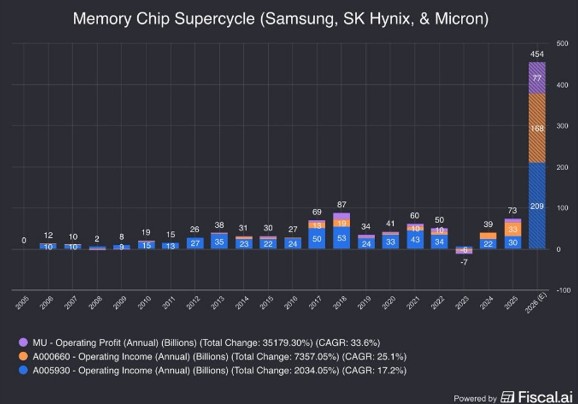
Source: Fiscal.ai
Over the past year, the biggest debate around the memory industry hasn't been whether HBM will keep growing, but whether AI has already changed the memory industry's business model. This question directly determines what valuation Micron deserves.
If AI is just bringing a new demand cycle, today's high profits will eventually fall back as supply increases; if AI has changed how the industry competes, then memory's long-term valuation midpoint should also rise.
I think both views are half right.
AI has changed the product and raised industry barriers
In the past, DRAM was more like a standardized product, where competition depended mainly on process, cost, and scale, with price determining most of the profitability. HBM has changed that model.
Today, customers aren't just buying memory chips — they're buying the performance of an entire AI system. HBM's bandwidth, power consumption, stability, and advanced packaging capability directly affect GPU computing efficiency, so product development increasingly depends on co-design with customers, qualification cycles are longer, and customer stickiness is higher. This means HBM has gradually evolved from a traditional memory product into an important component of AI infrastructure. As product value rises, so do industry barriers.
AI has raised the profit midpoint
This change shows up directly in profitability. In the past, memory companies' profits depended mainly on price increases; when prices fell, margins typically dropped quickly. Now, an increasing share of Micron's profit comes from high-value products like HBM, server DRAM, and enterprise SSDs, as well as long-term customer agreements, rather than relying solely on spot prices. So even if conventional DRAM prices eventually stabilize, overall industry profitability may not return to the lows of past cycles. This is also why Micron should command a valuation above its historical average.
But AI hasn't eliminated the cycle
That said, AI hasn't changed the memory industry's most fundamental business logic. Memory remains capital-intensive, and as long as profits are high enough, new capital will eventually flow in. Currently, Micron, SK Hynix, and Samsung are all expanding advanced-node and HBM capacity. These investments will sooner or later translate into new supply — it's just a matter of time. So I don't believe AI has eliminated the cycle. What it has really changed is the profit midpoint, not the cycle itself.
The next upswing depends on supply discipline
Over the next few years, the key variable affecting memory industry margins may not be AI demand, but supply. If AI demand keeps growing while new HBM supply consistently lags, industry margins can stay high; conversely, even if demand remains strong, as long as supply grows faster, profitability could still decline. So going forward, judging the memory industry shouldn't focus only on AI investment — it should also focus on whether the three manufacturers maintain supply discipline. Demand determines the industry's direction; supply determines the industry's profit.
AI has indeed changed memory. It has raised product value, industry barriers, and the profit midpoint, and means Micron should no longer be valued entirely like a traditional memory company. But AI hasn't eliminated the cycle — it has simply made this cycle last longer and be more profitable. What ultimately determines industry profitability is still supply, not demand.
This is also, in my view, where the market's biggest disagreement currently lies.
Chapter 5 | Why Could Strong Fundamentals Still Mean No Stock Gains for Years?
One of the hardest things for many investors to understand is: why would a company's revenue, margins, and free cash flow keep hitting new highs, yet the stock starts falling or even trades sideways for a long time?
The reason is that stocks never trade today's results — they trade whether future earnings can be sustained. This is especially true for cyclical industries.
A typical memory cycle usually goes through three phases: in the early recovery, the market trades the coming upcycle first and valuations expand rapidly; then earnings get realized, with revenue and profit rising alongside the stock; and once earnings reach a historic high, the market starts trading the next round of supply ahead of time, so the stock often peaks before the fundamentals do. That's why, when the earnings report looks its best, the stock is often most likely to enter a corrective phase.
Micron is moving from earnings upgrades to earnings realization
Over the past two years, the biggest driver of Micron's stock gains wasn't profit itself — it was the market continuously raising future earnings expectations. HBM ramped faster than expected, AI data center demand kept strengthening, and gross margin recovery kept beating expectations, with every earnings report prompting analysts to raise future earnings forecasts further.
Now, this phase is changing. The market has broadly accepted that Micron will keep posting high profits for the next few quarters. So even if the company keeps delivering excellent results, it's increasingly realizing expectations already in place rather than creating new surprises. What will really drive the stock higher going forward will be new upside surprises — for example, the HBM market expanding further, market share continuing to rise, or the industry's high-margin period lasting notably longer than the market expects.
Earnings growth doesn't necessarily mean stock gains
From a valuation perspective, the stock price can be broken into two variables:
Stock Price = EPS × P/E
In the early upcycle, earnings grow rapidly and the market grows more optimistic about the future; as EPS rises, P/E often keeps expanding too, so stock gains usually outpace profit growth.
But as the cycle enters its middle-to-late stage, the market's focus shifts from how much more profit can grow to how long high profits can be sustained. If investors believe future price gains will slow, supply may increase, or margins are near a cycle peak, the market may start lowering the P/E it's willing to pay even as the company keeps posting record profits.
Over the past year, Micron has been going through exactly this process. The company's revenue, profit, and cash flow keep hitting new highs, but the market has already started lowering its expectations for how long high profits will persist in the coming years, so the forward P/E has begun compressing first. The stock's pullback doesn't mean fundamentals are deteriorating — it means the market is repricing the durability of future earnings.
Sideways trading is often more common than a crash
Many investors think cyclical stocks only have two outcomes — up or down. In fact, a third outcome is more common: sideways movement.
If the company can sustain high profits over the next few quarters, and earnings growth gradually absorbs the previously elevated valuation, then even if the stock doesn't rise much further, the P/E will naturally decline as EPS rises. This is a gentler, and more common, way of digesting valuation than a crash.
So Micron's biggest future risk may not be an earnings collapse, but rather entering a phase where earnings realization and valuation digestion happen simultaneously: the company keeps setting new records, but the stock lacks upward momentum for an extended period.
The next upswing needs a new catalyst
What could really push Micron back into an uptrend isn't continuing to post excellent earnings — it's re-raising the market's expectations for future earnings. For example:
- AI demand surprising to the upside again, with HBM staying in shortage long-term
- Micron further raising its HBM market share
- Samsung's expansion or customer qualification progress falling behind market expectations, keeping industry margins elevated
- The market confirming future supply pressure isn't as severe as previously feared
These changes all affect not today's profit, but the sustainability of earnings years from now. Only once the market again raises its earnings forecasts can the P/E expand again.
Overall, there's currently no sign of fundamental deterioration at Micron. What has really changed is the market's expectations for the next two to three years: earnings are still growing, but the room for further upward earnings revisions has clearly narrowed; after the valuation adjustment, risk has been somewhat released, but renewed expansion still requires a new catalyst. So rather than saying Micron is entering an earnings downturn, it's more accurate to say it's going through a phase of earnings realization and valuation digestion. This means the probability of another sharp decline has fallen, but for the stock to re-enter a sustained uptrend, a new upside surprise is still needed.
Chapter 6 | What Should the Market Really Watch Over the Next Year?
If the biggest question over the past two years was whether AI would bring new memory demand, the more important question over the next year has become:
Can demand keep outpacing supply?
AI is no longer a new story that needs validating. What will really determine Micron's stock price is whether industry margins can be sustained, and whether supply discipline still holds.
For investors, five indicators are worth focusing on going forward.
Key Indicator | Why It Matters | What It Means for the Stock |
Whether HBM remains persistently in shortage | Determines whether ASP and margins can stay elevated | The longer the shortage lasts, the longer high profits persist, and the easier it is for P/E to hold |
Samsung's HBM qualification, yield, and mass-production progress | Determines when high-end HBM competition intensifies | The slower the progress, the better for Micron and SK Hynix |
Capex and DRAM supply growth across the three manufacturers | Determines industry supply over the next 2–3 years | The faster the expansion, the more easily the market compresses valuations ahead of time |
HBM/data center share of revenue | Determines earnings quality and stability | The higher the share, the higher the valuation the market is willing to pay |
Management's guidance on ASP, supply-demand, and capex | Determines future earnings expectations, not just this quarter's results | Guidance changes often move the stock more than the reported numbers |
What these five indicators ultimately answer is: does today's high profit represent a permanent upward shift in the profit midpoint, or the top of the next cycle? AI demand remains the foundation of this upcycle, but once the market has broadly accepted its growth, the key driver of valuation shifts to supply. As long as HBM stays in shortage, Samsung's mass-production progress remains limited, and industry expansion doesn't outpace demand, Micron's high profits should be able to continue.
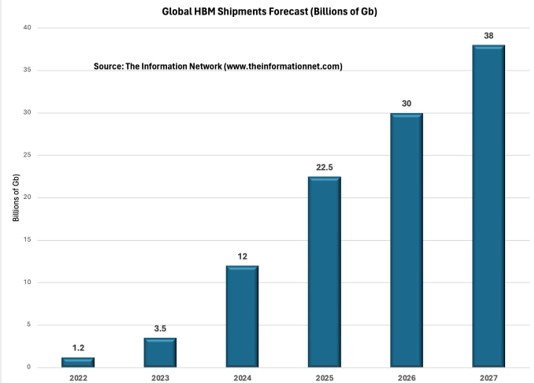
Source: The Information Network
Conversely, even if AI investment keeps growing, once new supply exceeds demand, the market may still compress industry valuations ahead of time. So researching Micron over the next year comes down to this: demand determines whether the upcycle holds, and supply determines how long high profits can last.
Chapter 7 | How Should One View Micron's Current Investment Value?
Back to the question at the start: has Micron fallen enough?
From a risk-reward standpoint, the stock has already absorbed a meaningful portion of the concerns around capacity expansion, intensifying competition, and slowing AI investment, while the company's operating performance remains solid. So the risk of another sharp decline has fallen compared with before — but that doesn't mean Micron has entered its most attractive buying window.
One of the biggest differences between this cycle and past ones is that long-term HBM supply agreements have improved earnings visibility. Customers locking in capacity ahead of time helps stabilize orders, pricing, and returns on capex, and reduces the company's exposure to short-term demand swings. This means Micron's earnings certainty over the next few quarters is higher than in traditional memory cycles, and its valuation midpoint should also be higher than historical levels.
But long-term contracts can't eliminate the cycle. They can delay price volatility, but they can't stop new supply from eventually reaching the market. If Samsung's qualification and mass production accelerate, if the three manufacturers keep expanding capex, or if HBM supply growth starts to outpace demand, the market will still lower its expectations for future margins ahead of time.
So the key to investing in Micron right now isn't judging whether the next earnings report will be good — it's judging how long high profits can last. If HBM shortages persist, Micron's share keeps rising, long-term contract coverage expands, and conventional DRAM prices stay stable, there's still room for earnings forecasts to be revised upward; conversely, if supply is released quickly, inventory rebuilds, or competition shifts back toward price, industry valuations could still come under pressure.
Micron is currently better defined as a stock whose risk has clearly compressed, but whose upside odds still need a catalyst.
For long-term investors, the company still has allocation value, especially if valuations pull back further; but for investors seeking strong excess returns over the coming year, Micron currently lacks a clear catalyst strong enough to drive a new round of valuation expansion.
The signal truly worth raising expectations for isn't another record quarterly profit — it's the simultaneous appearance of the following: an extended HBM shortage, continued gains in Micron's market share, long-term supply agreements strengthening future revenue visibility, and industry capex remaining restrained.
Until these signals appear, Micron is more likely to remain in a phase of earnings realization and valuation digestion than to re-enter a rapid uptrend.
Disclaimer: This analysis represents only a research framework based on publicly available information and does not constitute investment advice.
Recommended Articles


