


Prediction: AMD Stock Could Double by 2028. Here's Why
Key Points
AMD competes with Nvidia in the AI accelerator market.
Over the last couple of years, AMD has emerged as a formidable competitor to Nvidia in supporting hyperscale AI workloads.
Wall Street expects AMD's revenue and profit to grow by more than twofold by 2028.
- 10 stocks we like better than Advanced Micro Devices ›
Advanced Micro Devices (NASDAQ: AMD) has long been a formidable leader in the semiconductor industry. Yet the company's true expertise now shines brightest in the design of graphics processing units (GPUs) and specialized AI accelerators. These chips are the indispensable engines of modern artificial intelligence (AI) development, enabling the massive parallel computations required to train and deploy sophisticated models.
As hyperscalers race to expand their data center capacity with ever-growing capital expenditure (capex) budgets, AMD is uniquely positioned to capture a meaningful share of the infrastructure boom and deliver robust shareholder returns over the next couple of years.
Where to invest $1,000 right now? Our analyst team just revealed what they believe are the 10 best stocks to buy right now, when you join Stock Advisor. See the stocks »
Image source: The Motley Fool.
Move over, Nvidia -- AMD is making inroads with big tech
Despite Nvidia's first-mover advantage in the AI accelerator market, AMD has steadily secured a number of high-profile big tech wins that validate the company's competitive technology and open ecosystem.
Microsoft recently announced that it will be integrating AMD's Helios suite across Azure to support frontier model inference and scaling AI workloads. Helios provides access to AMD's Instinct MI455X GPUs, EPYC Venice CPUs, Pensando networking data processing units (DPUs), and ROCm software ecosystem.
In addition, Meta Platforms committed to a multi-year deployment of up to 6 gigawatts of AMD Instinct GPUs, starting with an MI450-based architecture launching in the second half of this year.
OpenAI is similarly locked in a 6-gigawatt multi-generation partnership centered on the MI450 platform. More recently, Anthropic announced a strategic partnership to deploy up to 2 gigawatts of MI450-series accelerators, with AMD also committing an equity investment of up to $5 billion in the frontier lab to deepen the relationship.
These contracts de-risk AMD's growth trajectory by providing multi-year revenue visibility, reducing reliance on any single customer, and proving that leading AI developers view the company as a credible, high-performance alternative capable of meeting their compute needs.
What does Wall Street expect from AMD over the next couple of years?
Consensus estimates from Wall Street analysts paint a picture of accelerating demand that underscores AMD's expanding role in the AI infrastructure build-out. Revenue is projected to climb from roughly $50 billion in 2026 to over $100 billion by 2028. Earnings per share (EPS) are expected to follow a similar path, rising from $7.50 this year to about $20 by 2028.
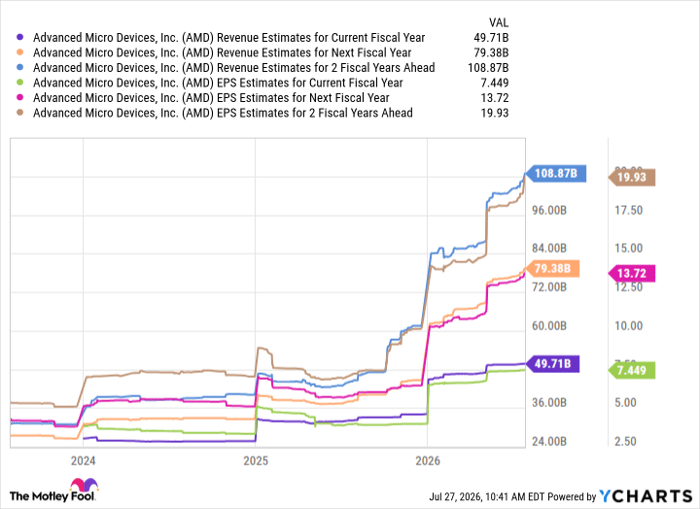
AMD Revenue Estimates for Current Fiscal Year data by YCharts
This represents compound annual growth rates exceeding 50% for both top- and bottom-line metrics over the next two years. All told, this forecast signals that demand is not merely continuing but intensifying as hyperscalers translate data center build-out plans into sustained silicon procurement.
Can AMD stock double by 2028?
AMD currently trades at a forward price-to-earnings (P/E) multiple of 64. Given the company's undeniable valuation expansion over the last year, I think the chances of sustaining a multiple this frothy through 2028 are slim.
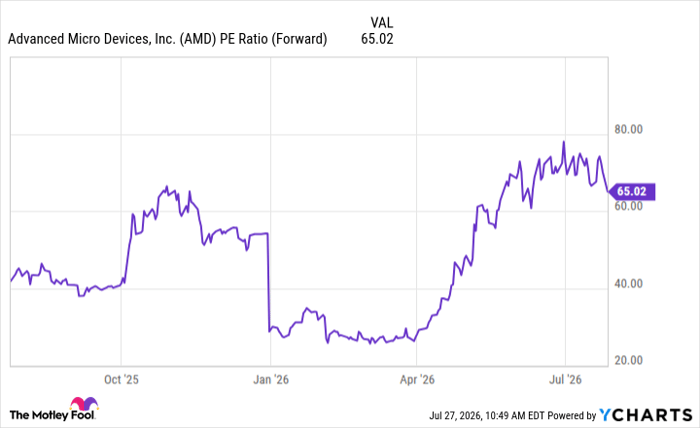
AMD PE Ratio (Forward) data by YCharts
Even if AMD's forward P/E were to compress to a range of 48 to 52, this would imply a stock price between $960 and $1,040 should the company achieve the 2028 EPS target of $20. This represents share price appreciation up to 101%, given AMD's current stock price.
I think this is a reasonable outcome given AMD's elevated growth profile, the scarcity of pure-play AI accelerator suppliers, and the market's historical willingness to award premium valuations to semiconductor leaders capturing secular AI-driven tailwinds. AMD presents a compelling opportunity for investors seeking exposure to the next phase of AI infrastructure spending.
Should you buy stock in Advanced Micro Devices right now?
Before you buy stock in Advanced Micro Devices, consider this:
The Motley Fool Stock Advisor analyst team just identified what they believe are the 10 best stocks for investors to buy now… and Advanced Micro Devices wasn’t one of them. The 10 stocks that made the cut could produce monster returns in the coming years.
Consider when Netflix made this list on December 17, 2004... if you invested $1,000 at the time of our recommendation, you’d have $379,662!* Or when Nvidia made this list on April 15, 2005... if you invested $1,000 at the time of our recommendation, you’d have $1,206,116!*
Now, it’s worth noting Stock Advisor’s total average return is 886% — a market-crushing outperformance compared to 206% for the S&P 500. Don't miss the latest top 10 list, available with Stock Advisor, and join an investing community built by individual investors for individual investors.
See the 10 stocks »
*Stock Advisor returns as of July 29, 2026.
Adam Spatacco has positions in Microsoft and Nvidia. The Motley Fool has positions in and recommends Advanced Micro Devices, Meta Platforms, Microsoft, and Nvidia. The Motley Fool has a disclosure policy.
Recommended Articles


