


The Federal Reserve Should Raise Interest Rates Today, but It Won't for One Fundamental Reason
Key Points
Later today (July 29), the FOMC will announce its latest decision on interest rates.
Although the probability of a Fed rate hike has tripled over the last week, the backward-looking economic data needed to confidently raise interest rates isn't yet in policymakers' hands.
The absence of forward-looking guidance, courtesy of Fed Chair Kevin Warsh, is making things challenging for Wall Street and investors.
- 10 stocks we like better than S&P 500 Index ›
Today is a pivotal day for Wall Street's major stock indexes, the Dow Jones Industrial Average (DJINDICES: ^DJI), S&P 500 (SNPINDEX: ^GSPC), and Nasdaq Composite (NASDAQINDEX: ^IXIC), as well as consumers. Mere hours from now, the 12 voting members of the Federal Open Market Committee (FOMC) will render their verdict on interest rates.
Although the probability of the Fed raising the federal funds target rate on July 29 has effectively tripled over the last week from 12.8% to 37.9%, according to the CME Group's FedWatch Tool, it's unlikely that policymakers will increase interest rates. This prediction of inaction boils down to one fundamental factor that governs the FOMC: it's a reactive, not proactive, body.
Missed Nvidia in 2009? This Rare Signal Is Flashing Again. In 2009, a "Double Down" signal flashed for a little-known chipmaker called Nvidia. For the first time in years, that same "Total Conviction" signal is flashing for a company 1/100th the size of Nvidia. Continue »
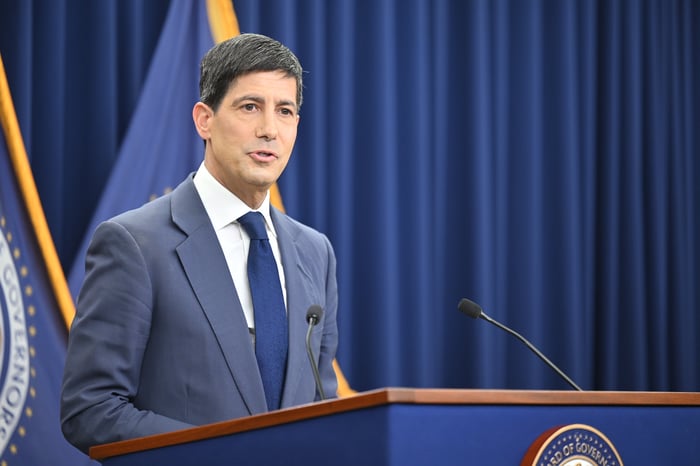
Fed Chair Kevin Warsh and the FOMC will announce their interest rate decision at 2 p.m. ET on July 29. Image source: Official Federal Reserve Photo.
Economic data, not guesswork, guides monetary policy decisions
From a statistical standpoint, economic data points to eventual rate hikes -- just not at the July FOMC meeting.
On the one hand, energy supply issues are rearing their head once more. Iran has, yet again, shut down the Strait of Hormuz to most maritime traffic, thereby choking off the daily flow of up to 20 million barrels of petroleum liquids. Higher oil prices translate into steeper costs at the fuel pump for businesses and consumers, with no end to the Middle East military conflict in sight.
We've also witnessed the early stages of Trumpflation evolving. Inflation that's specifically driven by President Donald Trump's policies (Trumpflation) is no longer just an energy issue. The stickiness of Core Personal Consumption Expenditures (PCE) in the wake of a decline in headline inflation in June suggests that inflationary pressures have spilled over into the broader economy.
BREAKING: US May PCE inflation, the Fed's preferred inflation metric, rises to 4.1%, the highest reading since April 2023.
-- The Kobeissi Letter (@KobeissiLetter) June 25, 2026
Core PCE inflation rose to 3.4%, its highest since October 2023.
US inflation is now officially running at more than double the Fed's 2% target.
But while we have evidence that fuel prices are climbing, once again, policymakers lack the tangible, broad-based, backward-looking evidence they would need to adjust interest rates. For example, June Core PCE won't be released until July 30, one day after the two-day FOMC meeting concludes.
Additionally, headline inflation dipped from 4.2% in May to 3.5% in June. Without hard evidence of a reacceleration to this figure, which we'll likely see in July's inflation data (reported in mid-August), courtesy of rapidly rising energy prices, the FOMC is apt to stand pat on interest rates.

Image source: Getty Images.
Fed Chair Kevin Warsh is making things challenging for Wall Street
What makes this interest rate decision even more challenging for Wall Street and investors is that Fed Chair Kevin Warsh has done away with forward-looking guidance.
For more than two decades, it had been customary for the FOMC to include language in its meeting statements that hinted at its next move (i.e., easing or tightening bias). Warsh axed this language at his first FOMC meeting as Fed chair in June, arguing that forward-looking guidance can potentially hamstring policymakers into decisions that don't fit dynamic economic data.
BREAKING: Fed Chair Kevin Warsh announces that the Fed has "dropped" forward guidance.
-- The Kobeissi Letter (@KobeissiLetter) June 17, 2026
"Forward guidance is not the business we should be in," he says.
With a relatively tight-lipped Fed chair and no forward-looking guidance, this marks one of the most uncertain interest rate decisions of the century. While it's unlikely the Fed will adjust interest rates later today (July 29) without economic data to react to, there's an exceptionally high probability of a rate hike at the Sept. 15-16 FOMC meeting.
If and when interest rates do rise, it could stymie the partially debt-financed artificial intelligence data center build-out and halt the Dow's, S&P 500's, and Nasdaq Composite's parabolic rallies in their tracks.
Should you buy stock in S&P 500 Index right now?
Before you buy stock in S&P 500 Index, consider this:
The Motley Fool Stock Advisor analyst team just identified what they believe are the 10 best stocks for investors to buy now… and S&P 500 Index wasn’t one of them. The 10 stocks that made the cut could produce monster returns in the coming years.
Consider when Netflix made this list on December 17, 2004... if you invested $1,000 at the time of our recommendation, you’d have $379,662!* Or when Nvidia made this list on April 15, 2005... if you invested $1,000 at the time of our recommendation, you’d have $1,206,116!*
Now, it’s worth noting Stock Advisor’s total average return is 886% — a market-crushing outperformance compared to 206% for the S&P 500. Don't miss the latest top 10 list, available with Stock Advisor, and join an investing community built by individual investors for individual investors.
See the 10 stocks »
*Stock Advisor returns as of July 29, 2026.
Sean Williams has no position in any of the stocks mentioned. The Motley Fool has positions in and recommends CME Group. The Motley Fool has a disclosure policy.
Recommended Articles


