


AT&T Beat on Earnings, Announced a $10 Billion Buyback, and Still Trades at 8 Times Earnings With a 4.6% Yield.
Key Points
Adjusted earnings per share rose to $0.65 from $0.54 in the year-ago quarter.
Management raised its 2026 share repurchase plan to about $10 billion, up from $8 billion.
The company expects free cash flow of at least $18 billion this year, growing to more than $21 billion by 2028.
- 10 stocks we like better than AT&T ›
The market has spent years treating AT&T (NYSE: T) as a bond that happens to trade on an exchange. Slow growth, a big dividend, and not much to think about in between.
The company's second-quarter report, delivered on Wednesday, July 22, mostly confirms that description on the revenue line. Second-quarter revenue rose 2.3% year over year to $31.6 billion. But nobody is buying this stock for the top line anyway.
Missed Nvidia in 2009? This Rare Signal Is Flashing Again. In 2009, a "Double Down" signal flashed for a little-known chipmaker called Nvidia. For the first time in years, that same "Total Conviction" signal is flashing for a company 1/100th the size of Nvidia. Continue »
What the quarter did change is the size of the indirect "payments" shareholders get via share repurchases. Management lifted its 2026 buyback plan to about $10 billion from $8 billion, and the stock closed Friday at $24.13 after a 5.1% gain in the session -- still about 19% below its 52-week high of $29.79, and yielding 4.6%.
So does the cash actually cover everything management has now promised?
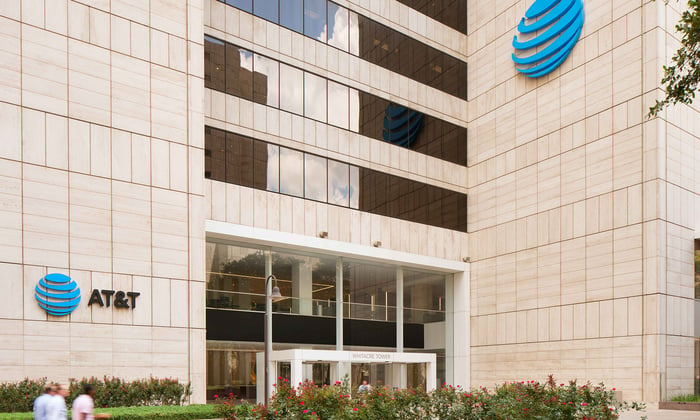
Image source: AT&T.
A slow top line and a fast bottom line
Notably, underneath that 2.3% revenue figure, the profit lines are moving considerably faster.
Non-GAAP (adjusted) earnings per share came in at $0.65, up from $0.54 a year earlier -- growth of about 20% year over year. Diluted earnings per share from continuing operations rose to $0.66 from $0.62. And adjusted EBITDA margin expanded 110 basis points to 39.1%.
Free cash flow, the figure that actually pays the dividend, was $4.7 billion in the second quarter, up from $4.4 billion in the year-ago period.
And the operating detail behind it is better than the revenue growth rate suggests. AT&T added 432,000 postpaid phone subscribers and 646,000 internet customers, split between 367,000 fiber and 279,000 fixed wireless. Fiber now passes 38.6 million locations, up by a million in three months.
That mix matters. Fiber and postpaid phone customers are the higher-margin, longer-tenured end of this business, and the margin expansion is what a shift toward them looks like in the numbers.
Where the free cash flow goes
Here is the arithmetic that decides the investment case.
AT&T pays $1.11 per share annually across about 6.9 billion shares, which comes to about $7.6 billion of dividends. Add the roughly $10 billion of repurchases management now plans, and the company intends to hand shareholders somewhere near $18 billion this year.
Its guidance for 2026 free cash flow is at least $18 billion.
In other words, the dividend and the buyback together consume essentially all of it. That isn't a hidden problem. It's the plan, and management said as much. But it does define what an investor is buying: a payout covered with almost no cushion this year -- unless, of course, you consider the company's capital allocated for repurchases a cushion for the dividend. And this would be a fair way to think about it.
But the company's multi-year outlook suggests there could be greater breathing room for the dividend in the future. Management guided for free cash flow above $19 billion in 2027 and above $21 billion in 2028, against a commitment to return more than $45 billion to shareholders across the three years. Stack those up and the company expects to generate about $58 billion while returning $45 billion, which leaves some runway for paying down debt.
Of course, debt is the part income investors should look at hardest. Net debt stood at $126.4 billion at quarter's end, or 2.68 times adjusted EBITDA. Management expects that ratio to climb to about 3.2 times once its transaction with EchoStar closes, then work back toward 2.5 times over about three years.
So leverage is going up before it comes down, at a company already returning all of its free cash flow.
That is the trade-off, and I think it's a fair one at this price. The stock trades at about eight times earnings, though the sharper comparison uses the $2.25 to $2.35 in adjusted earnings per share management guided to for 2026, which puts shares closer to 10 times. Even at the 52-week high of $29.79, that guidance would imply under 13 times.
A 4.6% yield covered by contracted, recurring revenue, from a company that grew adjusted earnings about 20% year over year last quarter while buying back its own stock, is a reasonable thing to own. CEO John Stankey said the accelerated repurchase reflects a gap between the company's operating fundamentals and how the market values the shares, and the numbers back that up more than they don't.
I wouldn't call it a bargain, though. AT&T grows revenue 2% a year -- a concerning rate, and one that is just a few percentage points from flipping to a decline.
Still, for income investors, this quarter made the case stronger. The dividend is covered, the fiber business is finally producing the margin expansion it promised, and the stock sits nearly a fifth below its 52-week high. I'd own it for the yield, keep the position modest, and treat the buyback as a bonus rather than the reason.
Should you buy stock in AT&T right now?
Before you buy stock in AT&T, consider this:
The Motley Fool Stock Advisor analyst team just identified what they believe are the 10 best stocks for investors to buy now… and AT&T wasn’t one of them. The 10 stocks that made the cut could produce monster returns in the coming years.
Consider when Netflix made this list on December 17, 2004... if you invested $1,000 at the time of our recommendation, you’d have $377,990!* Or when Nvidia made this list on April 15, 2005... if you invested $1,000 at the time of our recommendation, you’d have $1,269,518!*
Now, it’s worth noting Stock Advisor’s total average return is 896% — a market-crushing outperformance compared to 206% for the S&P 500. Don't miss the latest top 10 list, available with Stock Advisor, and join an investing community built by individual investors for individual investors.
See the 10 stocks »
*Stock Advisor returns as of July 26, 2026.
Daniel Sparks and his clients do not have positions in any of the stocks mentioned. The Motley Fool has no position in any of the stocks mentioned. The Motley Fool has a disclosure policy.
Recommended Articles


