


Dividend ETFs vs. Bond ETFs: Here's Which One Makes More Sense for Income Investors in This Market
Key Points
Bonds pay a fixed income stream, which inflation would eat into over time.
Many companies have long histories of growing their dividends, which helps offset the long-term impact of inflation.
- 10 stocks we like better than Vanguard Total Bond Market ETF ›
Income-focused investors often face a dilemma. Do they invest in lower-risk fixed-income investments like bonds, or take on more risk to potentially earn a higher return from dividend stocks?
However, one risk factor most investors don't consider is the current market environment, which can meaningfully shift the risk/reward balance. Here's a look at whether it makes more sense to invest in dividend or bond ETFs in today's market.
Missed Nvidia in 2009? This Rare Signal Is Flashing Again. In 2009, a "Double Down" signal flashed for a little-known chipmaker called Nvidia. For the first time in years, that same "Total Conviction" signal is flashing for a company 1/100th the size of Nvidia. Continue »
Image source: Getty Images.
The risk of fixed income in the current environment
Bonds provide investors with a stream of fixed income from interest payments. It can be highly bankable income, especially if the bond is from a high-quality issuer such as the U.S. Government or an investment-grade company. That fixed return makes bonds fairly low-risk investments.
ETFs make it easy to invest in bonds for income. A top option is the Vanguard Total Bond Market ETF (NASDAQ: BND). The fund invests in taxable investment-grade U.S. dollar-denominated bonds, excluding inflation-protected and tax-exempt bonds. It currently holds nearly 11,500 bonds. Its portfolio has an average coupon of 3.9%, though the yield to maturity is higher at 4.7% due to the value it purchased its bond holdings. It primarily invests in longer-term bonds and has an average yield-to-maturity of more than eight years. As a result, it should provide investors with a low-to-mid single-digit annual income yield for the next several years.
There's just one problem. Inflation is currently running at a 3.5% annualized rate. While that's down from 4.2% the prior month, inflation would steadily eat into the income produced by this bond ETF, eroding the purchasing power of an investor's income over time.
The case for dividend growth in an inflationary environment
Income investors would face the same inflationary impact on their dividend income whether they invested in a stock or an ETF that pays a stable dividend. However, many stocks pay steadily rising dividends. That dividend growth would help them overcome inflation's impact and generate a real return.
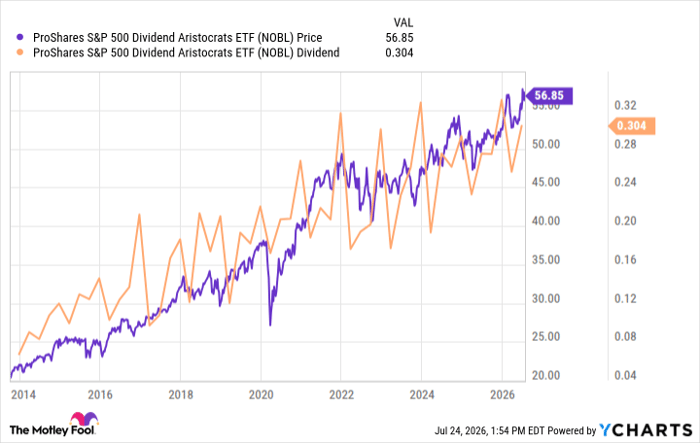
Several ETFs focus on dividend growth stocks. One notable option is the S&P 500 Dividend Aristocrats® ETF (NYSEMKT: NOBL), which focuses on companies that have increased their dividends for at least 25 consecutive years (the term Dividend Aristocrats® is a registered trademark of Standard & Poor's Financial Services LLC). That growth does two things. It increases the income paid by the fund while also growing the value of its shares:
NOBL data by YCharts
While the ETF offers a lower income yield compared to a bond right now (over 2%), the income stream should steadily grow over time, likely at a much faster rate than inflation. This growth in both dividend income and share value has enabled the fund to deliver an average annual total return of 10.7% since its inception in 2013, more than offsetting inflation.
Dividends make more sense while inflation remains high
The fixed income offered by bond ETFs seems less risky than dividend income. However, that doesn't account for the currently elevated inflationary environment, which would quickly erode the purchasing power of fixed income. That's why investing in dividend growth stocks makes more sense right now. A fund like the S&P 500 Dividend Aristocrats® ETF should provide a growing stream of dividend income and price appreciation, more than offsetting inflation's impact.
Should you buy stock in Vanguard Total Bond Market ETF right now?
Before you buy stock in Vanguard Total Bond Market ETF, consider this:
The Motley Fool Stock Advisor analyst team just identified what they believe are the 10 best stocks for investors to buy now… and Vanguard Total Bond Market ETF wasn’t one of them. The 10 stocks that made the cut could produce monster returns in the coming years.
Consider when Netflix made this list on December 17, 2004... if you invested $1,000 at the time of our recommendation, you’d have $377,990!* Or when Nvidia made this list on April 15, 2005... if you invested $1,000 at the time of our recommendation, you’d have $1,269,518!*
Now, it’s worth noting Stock Advisor’s total average return is 896% — a market-crushing outperformance compared to 206% for the S&P 500. Don't miss the latest top 10 list, available with Stock Advisor, and join an investing community built by individual investors for individual investors.
See the 10 stocks »
*Stock Advisor returns as of July 26, 2026.
Matt DiLallo has positions in Vanguard Total Bond Market ETF. The Motley Fool has positions in and recommends ProShares S&P 500 Dividend Aristocrats ETF and Vanguard Total Bond Market ETF. The Motley Fool has a disclosure policy.
Recommended Articles


