

Salesforce vs. ServiceNow: Which Agentic AI Stock Is Actually the Better Buy Right Now?

Source The Motley Fool

Key Points

  • AI fears have caused widespread selling of software stocks, including Salesforce and ServiceNow.

  • Both companies have leaned into agentic AI with tangible results.

  • But AI is still a wild card, and only one stock offers an adequate margin of safety right now.

  • 10 stocks we like better than Salesforce ›

Artificial intelligence (AI) is revolutionizing the software industry. AI is making it easier to develop software, while AI agents, digital workers that can autonomously perform tasks, might be the future for enterprises. It creates an uncertain future, but one with immense opportunities for Salesforce (NYSE: CRM) and ServiceNow (NYSE: NOW).

Salesforce is the king of customer relationship management (CRM) software, while ServiceNow dominates workflow automation in corporations. Each of these enterprise software giants is racing to reestablish its competitive footing in the market. Both have embraced agentic AI, bringing it to customers before they look for it elsewhere.

Where to invest $1,000 right now? Our analyst team just revealed what they believe are the 10 best stocks to buy right now, when you join Stock Advisor. See the stocks »

When it comes to choosing which of these AI-forward software-as-a-service (SaaS) stocks deserves your money right now, a clear winner stands out.

AI-related icons hover above an open laptop.

Image source: Getty Images.

ServiceNow's AI pivot is delivering results

It wasn't long ago that ServiceNow was selling off almost every day as AI companies began showing how capable AI agents can be. ServiceNow's core business is workflow automation, software that makes repetitive tasks within companies, such as submitting an IT support ticket, easier and quicker. But those types of tasks are exactly what AI agents can do really well.

ServiceNow quickly realized this and pivoted to building its business around AI. In a nutshell, ServiceNow wants to help customers deploy and manage AI agents. It can function like a control tower at an airport, directing which plane goes where and when. AI agents can operate without human intervention, so there needs to be some form of supervision, and ServiceNow's software already sits in its customers' critical IT areas.

Management is guiding for about $15.7 billion in subscription revenue this year, but believes it will grow to at least $30 billion by 2030. Additionally, it believes that AI will account for 30% of its annual contract value by then. The strong outlook hasn't saved the stock from the AI sell-off; shares are still nearly 60% below their high.

Salesforce's AI demise seems unlikely

AI has become increasingly good at coding entire applications from prompts. As much as that has cast a shadow over Salesforce and other app companies, there's a big difference between coding a demo and managing it or fixing bugs. Salesforce is also one of the stickiest enterprise software products. It has become an ecosystem where companies can run their sales, marketing, customer service, and more.

Like ServiceNow, Salesforce has aggressively rolled out agentic AI tools and features. For instance, Agentforce is rapidly growing. To date, its AI agents performed 3.8 billion discrete tasks as of the first quarter of fiscal year 2027 (ended April 30), and grew 111% from the prior quarter. One clear difference from ServiceNow is that Salesforce isn't growing nearly as fast. The company is guiding for 10% to 11% revenue growth this year, but that includes more than 4% from its recent acquisition of Informatica.

Once the post-acquisition benefits have faded, Salesforce might still only generate single-digit revenue growth. Wall Street's AI-fueled selling of software stocks has affected Salesforce, too. The stock currently sits about 57% off its high. Investors have remained cautious, likely because it's still too early to know how AI might evolve and impact these software companies even a few years from now.

Why Salesforce might be the better buy right now

Investors should weigh both the opportunities and risks that AI technology presents to these companies. Paying a reasonable valuation for a stock is one of the best ways to protect your investment from the unknown.

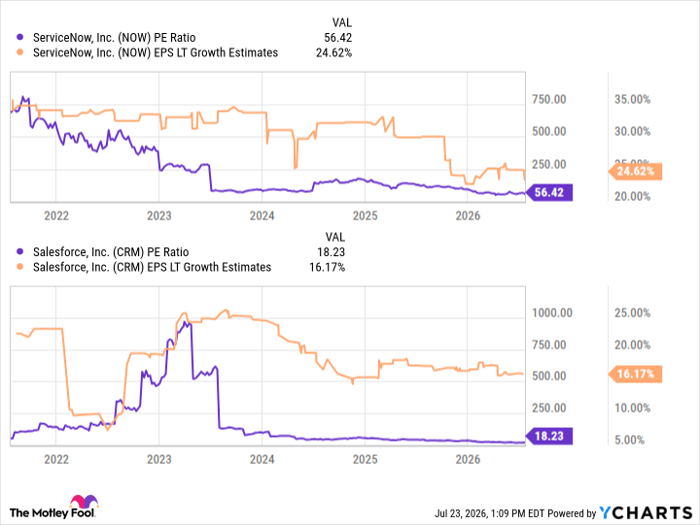
ServiceNow is clearly growing much faster than Salesforce, but the stock is also far more expensive. Analysts estimate that ServiceNow will grow earnings by an average 24.6% annually over the long term. That's great, but it's less exciting for investors when you're paying more than 56 times earnings for shares. Suppose AI doesn't go the way ServiceNow hopes, and its growth slows? The stock could fall a long way from that valuation.
NOW PE Ratio Chart

NOW PE Ratio data by YCharts

On the other hand, analysts see Salesforce growing earnings by an average of 16.1% annually moving forward. It's not nearly as fast, but the stock is a much better value at just over 18 times earnings. The fastest-growing company is not always the best investment. In this case, Salesforce is the better buy right now.

Should you buy stock in Salesforce right now?

Before you buy stock in Salesforce, consider this:

The Motley Fool Stock Advisor analyst team just identified what they believe are the 10 best stocks for investors to buy now… and Salesforce wasn’t one of them. The 10 stocks that made the cut could produce monster returns in the coming years.

Consider when Netflix made this list on December 17, 2004... if you invested $1,000 at the time of our recommendation, you’d have $377,990!* Or when Nvidia made this list on April 15, 2005... if you invested $1,000 at the time of our recommendation, you’d have $1,269,518!*

Now, it’s worth noting Stock Advisor’s total average return is 896% — a market-crushing outperformance compared to 206% for the S&P 500. Don't miss the latest top 10 list, available with Stock Advisor, and join an investing community built by individual investors for individual investors.

See the 10 stocks »

*Stock Advisor returns as of July 26, 2026.

Justin Pope has no position in any of the stocks mentioned. The Motley Fool has positions in and recommends Salesforce and ServiceNow. The Motley Fool has a disclosure policy.

Disclaimer: For information purposes only. Past performance is not indicative of future results.
placeholder
Natural Gas sinks to pivotal level as China’s demand slumpsNatural Gas price (XNG/USD) edges lower and sinks to $2.56 on Monday, extending its losing streak for the fifth day in a row. The move comes on the back of China cutting its Liquified Natural Gas (LNG) imports after prices rose above $3.0 in June. It
Author  FXStreet
Jul 01, 2024
Natural Gas price (XNG/USD) edges lower and sinks to $2.56 on Monday, extending its losing streak for the fifth day in a row. The move comes on the back of China cutting its Liquified Natural Gas (LNG) imports after prices rose above $3.0 in June. It
placeholder
Bitcoin briefly loses 2025 gains as crypto plunges over the weekend.Bitcoin experienced a sharp decline this weekend, briefly erasing its 2025 gains and dipping below its year-opening value of $93,507. The cryptocurrency fell to a low of $93,029 on Sunday, representing a 25% drop from its all-time high in October. Although it has rebounded slightly to around $94,209, the pressures on the market remain significant. The downturn occurred despite the reopening of the U.S. government on Thursday, which many had hoped would provide essential support for crypto markets. This year initially appeared promising for cryptocurrencies, particularly after the inauguration of President Donald Trump, who has established the most pro-crypto administration thus far. However, ongoing political tensions—including Trump's tariff strategies and the recent government shutdown, lasting a historic 43 days—have contributed to several rapid price pullbacks for Bitcoin throughout the year. Market dynamics are also being influenced by Bitcoin whales—investors holding large amounts of Bitcoin—who have been offloading portions of their assets, consequently stalling price rallies even as positive regulatory developments emerge. Despite these sell-offs, analysts from Glassnode argue that this behavior aligns with typical patterns seen among long-term investors during the concluding stages of bull markets, suggesting it is not indicative of a mass exodus. Notably, Bitcoin is not alone in its struggles, as Ethereum and Solana have also recorded declines of 7.95% and 28.3%, respectively, since the start of the year, while numerous altcoins have faced even steeper losses. Looking ahead, questions linger regarding the viability of the four-year cycle thesis, particularly given the increasing institutional support and regulatory frameworks now in place in the crypto landscape. Matt Hougan, chief investment officer at Bitwise, remains optimistic, suggesting a potential Bitcoin resurgence in 2026 driven by the “debasement trade” thesis and a broader trend toward increased adoption of stablecoins, tokenization, and decentralized finance. Hougan emphasized the soundness of the underlying fundamentals, pointing to a positive outlook for the sector in the longer term.
Author  Mitrade
Nov 17, 2025
Bitcoin experienced a sharp decline this weekend, briefly erasing its 2025 gains and dipping below its year-opening value of $93,507. The cryptocurrency fell to a low of $93,029 on Sunday, representing a 25% drop from its all-time high in October. Although it has rebounded slightly to around $94,209, the pressures on the market remain significant. The downturn occurred despite the reopening of the U.S. government on Thursday, which many had hoped would provide essential support for crypto markets. This year initially appeared promising for cryptocurrencies, particularly after the inauguration of President Donald Trump, who has established the most pro-crypto administration thus far. However, ongoing political tensions—including Trump's tariff strategies and the recent government shutdown, lasting a historic 43 days—have contributed to several rapid price pullbacks for Bitcoin throughout the year. Market dynamics are also being influenced by Bitcoin whales—investors holding large amounts of Bitcoin—who have been offloading portions of their assets, consequently stalling price rallies even as positive regulatory developments emerge. Despite these sell-offs, analysts from Glassnode argue that this behavior aligns with typical patterns seen among long-term investors during the concluding stages of bull markets, suggesting it is not indicative of a mass exodus. Notably, Bitcoin is not alone in its struggles, as Ethereum and Solana have also recorded declines of 7.95% and 28.3%, respectively, since the start of the year, while numerous altcoins have faced even steeper losses. Looking ahead, questions linger regarding the viability of the four-year cycle thesis, particularly given the increasing institutional support and regulatory frameworks now in place in the crypto landscape. Matt Hougan, chief investment officer at Bitwise, remains optimistic, suggesting a potential Bitcoin resurgence in 2026 driven by the “debasement trade” thesis and a broader trend toward increased adoption of stablecoins, tokenization, and decentralized finance. Hougan emphasized the soundness of the underlying fundamentals, pointing to a positive outlook for the sector in the longer term.
placeholder
When is the BoJ rate decision and how could it affect USD/JPY?The Bank of Japan (BoJ) will announce its interest rate decision between 03.30 and 05.00 GMT, followed by Governor Kazuo Ueda's press conference at 06.30 GMT.
Author  FXStreet
Dec 19, 2025
The Bank of Japan (BoJ) will announce its interest rate decision between 03.30 and 05.00 GMT, followed by Governor Kazuo Ueda's press conference at 06.30 GMT.
placeholder
ECB Policy Outlook for 2026: What It Could Mean for the Euro’s Next MoveWith the ECB likely holding rates steady at 2.15% and the Fed potentially extending cuts into 2026, EUR/USD may test 1.20 if Eurozone growth proves resilient, but weaker growth and an ECB pivot could pull the pair back toward 1.13 and potentially 1.10.
Author  Mitrade
Dec 26, 2025
With the ECB likely holding rates steady at 2.15% and the Fed potentially extending cuts into 2026, EUR/USD may test 1.20 if Eurozone growth proves resilient, but weaker growth and an ECB pivot could pull the pair back toward 1.13 and potentially 1.10.
placeholder
Gold Price Forecast: Oil Price Breaking $100 Fuels Inflation Concerns, Will Gold Prices Fall Further?As of the Asian session on July 24, gold prices ( XAUUSD) fell continuously during intraday trading, briefly approaching the $4,000 mark. Looking at the chart, gold prices rebounded this
Author  TradingKey
Jul 24, Fri
As of the Asian session on July 24, gold prices ( XAUUSD) fell continuously during intraday trading, briefly approaching the $4,000 mark. Looking at the chart, gold prices rebounded this
goTop
quote