

Every Time President Trump Talks About Iran, Oil Prices Move. Here's the Pattern Investors Should Watch.

Source The Motley Fool

Key Points

  • With the mid-term elections on the horizon, there are material political implications to a re-escalation of the Middle East conflict.

  • U.S. President Donald Trump has de-escalated tensions before as oil has risen above $100 per barrel.

  • Investors looking at the energy sector should consider taking a longer-term view when buying stocks.

  • 10 stocks we like better than Chevron ›

Oil is on the rise again amid flaring tensions in the Middle East. That's not remotely shocking, given the Strait of Hormuz's importance. The Strait is effectively closed right now. Roughly 20% of the world's oil moves through that single sea passage, so the raging geopolitical conflict has upended the energy market.

While the conflict has been active for only a relatively short time, a trend appears to be emerging. When oil prices rise sharply, U.S. President Donald Trump de-escalates the conflict. There's no way to know if that will happen again, however, which is why long-term investors need to take a big-picture view of the energy sector with stocks like Chevron (NYSE: CVX) and ExxonMobil (NYSE: XOM).

Missed Nvidia in 2009? This Rare Signal Is Flashing Again. In 2009, a "Double Down" signal flashed for a little-known chipmaker called Nvidia. For the first time in years, that same "Total Conviction" signal is flashing for a company 1/100th the size of Nvidia. Continue »

President of the United States Donald Trump.

Image source: The White House.

Predicting a geopolitical conflict is a risky investment approach

Donald Trump is well aware that mid-term elections are coming up later in 2026. He is also aware that the geopolitical conflict in the Middle East is affecting U.S. citizens economically and emotionally. The hotter the conflict rages, the worse the mood is likely to get in the United States. The worse the mood, the more likely that elections don't go well for the President.

With oil spiking again, recently breaking over $100 per barrel, consumers start to worry about rising costs. That feeds into fears around inflation, which is running hotter than the Federal Reserve would like right now. That could lead to a rate hike, which would fuel concerns about a recession. And all of that comes as voters will be heading to the polls in a few months, with control of the Senate and the House up for grabs.
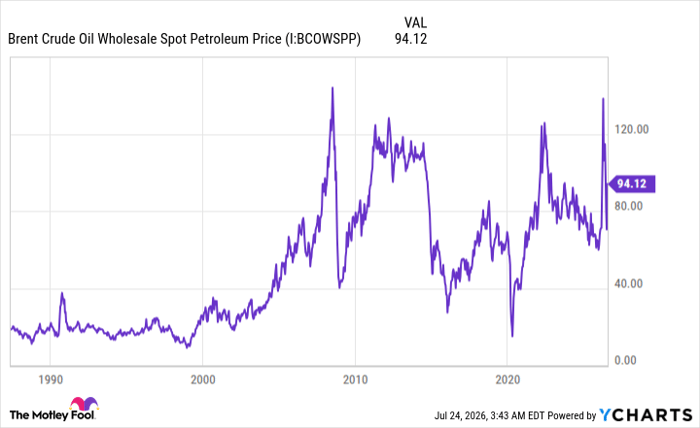
Brent Crude Oil Wholesale Spot Petroleum Price Chart

Brent Crude Oil Wholesale Spot Petroleum Price data by YCharts

It makes sense that Donald Trump would consider de-escalating the conflict to lower oil prices. Which appears to be something he's done before. However, as an investor, you should probably look at the bigger picture when considering investing in the energy sector. Historically, geopolitical events have gotten out of control before. There's no way to know what will actually happen this time around.

The energy sector is volatile

The unfortunate truth is that Wall Street is so focused on the short-term impact of the current geopolitical conflict that investors have lost sight of the long term. Wall Street tends to be myopic, so this isn't surprising, but the long-term truth is that the energy sector is inherently volatile. This is just another episode of volatility. It is headline-grabbing, but it isn't really unusual.

You could try to play the news-driven ups and downs in oil prices by buying and selling an upstream oil company like Devon Energy (NYSE: DVN). It operates in the U.S. market, so its production isn't impacted by the conflict. And its revenues and earnings will still benefit materially from higher energy prices. But it will also see revenues and earnings fall when energy prices fall. The stock is likely to trend along with energy prices if you believe you can predict the future of energy prices.

Most investors will be better off with a larger, more diversified energy investment, such as the integrated giants Exxon and Chevron. These companies are two of the world's largest energy businesses. While some of their production is directly impacted by the Middle East conflict, they have assets in other regions that are not. And they will benefit from rising oil prices, just as an upstream energy producer would. However, they also have midstream (pipeline) and downstream (chemical and refining) assets to help soften the blow when oil prices fall.

In addition, Exxon and Chevron have two of the strongest balance sheets in the integrated energy peer group. Exxon's debt-to-equity ratio is roughly 0.2x, while Chevron's is 0.25x. That gives each of these energy giants the wherewithal to take on debt during downturns to support their businesses and dividends.

Bet on reliable dividends, not energy prices

Chevron's dividend has been increased annually for 38 years. Exxon's dividend has been increased annually for 43 years. Those are incredible dividend records given the inherent volatility of the energy sector. It is a testament to the resilience of the two businesses across the entire energy cycle, not just the upside. That is a pattern worth following.

Most long-term investors should have some energy exposure given the important of oil and natural gas to the global economy. However, trying to time the political and geopolitical decisions of President Trump probably isn't the best investment approach when deciding on an energy stock. Most investors will be better off sticking with industry giants like Exxon and Chevron, focusing on their reliable dividend checks instead of oil prices. Right now, Chevron offers a 3.6% yield, with Exxon's 2.6% still well above the S&P 500 index's (SNPINDEX: ^GSPC) roughly 1% yield.

Should you buy stock in Chevron right now?

Before you buy stock in Chevron, consider this:

The Motley Fool Stock Advisor analyst team just identified what they believe are the 10 best stocks for investors to buy now… and Chevron wasn’t one of them. The 10 stocks that made the cut could produce monster returns in the coming years.

Consider when Netflix made this list on December 17, 2004... if you invested $1,000 at the time of our recommendation, you’d have $377,990!* Or when Nvidia made this list on April 15, 2005... if you invested $1,000 at the time of our recommendation, you’d have $1,269,518!*

Now, it’s worth noting Stock Advisor’s total average return is 896% — a market-crushing outperformance compared to 206% for the S&P 500. Don't miss the latest top 10 list, available with Stock Advisor, and join an investing community built by individual investors for individual investors.

See the 10 stocks »

*Stock Advisor returns as of July 25, 2026.

Reuben Gregg Brewer has no position in any of the stocks mentioned. The Motley Fool has positions in and recommends Chevron. The Motley Fool has a disclosure policy.

Disclaimer: For information purposes only. Past performance is not indicative of future results.
placeholder
Natural Gas sinks to pivotal level as China’s demand slumpsNatural Gas price (XNG/USD) edges lower and sinks to $2.56 on Monday, extending its losing streak for the fifth day in a row. The move comes on the back of China cutting its Liquified Natural Gas (LNG) imports after prices rose above $3.0 in June. It
Author  FXStreet
Jul 01, 2024
Natural Gas price (XNG/USD) edges lower and sinks to $2.56 on Monday, extending its losing streak for the fifth day in a row. The move comes on the back of China cutting its Liquified Natural Gas (LNG) imports after prices rose above $3.0 in June. It
placeholder
Bitcoin briefly loses 2025 gains as crypto plunges over the weekend.Bitcoin experienced a sharp decline this weekend, briefly erasing its 2025 gains and dipping below its year-opening value of $93,507. The cryptocurrency fell to a low of $93,029 on Sunday, representing a 25% drop from its all-time high in October. Although it has rebounded slightly to around $94,209, the pressures on the market remain significant. The downturn occurred despite the reopening of the U.S. government on Thursday, which many had hoped would provide essential support for crypto markets. This year initially appeared promising for cryptocurrencies, particularly after the inauguration of President Donald Trump, who has established the most pro-crypto administration thus far. However, ongoing political tensions—including Trump's tariff strategies and the recent government shutdown, lasting a historic 43 days—have contributed to several rapid price pullbacks for Bitcoin throughout the year. Market dynamics are also being influenced by Bitcoin whales—investors holding large amounts of Bitcoin—who have been offloading portions of their assets, consequently stalling price rallies even as positive regulatory developments emerge. Despite these sell-offs, analysts from Glassnode argue that this behavior aligns with typical patterns seen among long-term investors during the concluding stages of bull markets, suggesting it is not indicative of a mass exodus. Notably, Bitcoin is not alone in its struggles, as Ethereum and Solana have also recorded declines of 7.95% and 28.3%, respectively, since the start of the year, while numerous altcoins have faced even steeper losses. Looking ahead, questions linger regarding the viability of the four-year cycle thesis, particularly given the increasing institutional support and regulatory frameworks now in place in the crypto landscape. Matt Hougan, chief investment officer at Bitwise, remains optimistic, suggesting a potential Bitcoin resurgence in 2026 driven by the “debasement trade” thesis and a broader trend toward increased adoption of stablecoins, tokenization, and decentralized finance. Hougan emphasized the soundness of the underlying fundamentals, pointing to a positive outlook for the sector in the longer term.
Author  Mitrade
Nov 17, 2025
Bitcoin experienced a sharp decline this weekend, briefly erasing its 2025 gains and dipping below its year-opening value of $93,507. The cryptocurrency fell to a low of $93,029 on Sunday, representing a 25% drop from its all-time high in October. Although it has rebounded slightly to around $94,209, the pressures on the market remain significant. The downturn occurred despite the reopening of the U.S. government on Thursday, which many had hoped would provide essential support for crypto markets. This year initially appeared promising for cryptocurrencies, particularly after the inauguration of President Donald Trump, who has established the most pro-crypto administration thus far. However, ongoing political tensions—including Trump's tariff strategies and the recent government shutdown, lasting a historic 43 days—have contributed to several rapid price pullbacks for Bitcoin throughout the year. Market dynamics are also being influenced by Bitcoin whales—investors holding large amounts of Bitcoin—who have been offloading portions of their assets, consequently stalling price rallies even as positive regulatory developments emerge. Despite these sell-offs, analysts from Glassnode argue that this behavior aligns with typical patterns seen among long-term investors during the concluding stages of bull markets, suggesting it is not indicative of a mass exodus. Notably, Bitcoin is not alone in its struggles, as Ethereum and Solana have also recorded declines of 7.95% and 28.3%, respectively, since the start of the year, while numerous altcoins have faced even steeper losses. Looking ahead, questions linger regarding the viability of the four-year cycle thesis, particularly given the increasing institutional support and regulatory frameworks now in place in the crypto landscape. Matt Hougan, chief investment officer at Bitwise, remains optimistic, suggesting a potential Bitcoin resurgence in 2026 driven by the “debasement trade” thesis and a broader trend toward increased adoption of stablecoins, tokenization, and decentralized finance. Hougan emphasized the soundness of the underlying fundamentals, pointing to a positive outlook for the sector in the longer term.
placeholder
ECB Policy Outlook for 2026: What It Could Mean for the Euro’s Next MoveWith the ECB likely holding rates steady at 2.15% and the Fed potentially extending cuts into 2026, EUR/USD may test 1.20 if Eurozone growth proves resilient, but weaker growth and an ECB pivot could pull the pair back toward 1.13 and potentially 1.10.
Author  Mitrade
Dec 26, 2025
With the ECB likely holding rates steady at 2.15% and the Fed potentially extending cuts into 2026, EUR/USD may test 1.20 if Eurozone growth proves resilient, but weaker growth and an ECB pivot could pull the pair back toward 1.13 and potentially 1.10.
placeholder
My Top 5 Stock Market Predictions for 2026Five 2026 market predictions written in a native, news-style voice: AI’s winners and losers, broader sector leadership, dividend demand, valuation cooling as the Shiller CAPE sits at 39 (Dec. 31, 2025), and quantum-computing bursts—while keeping all original facts and numbers unchanged.
Author  Mitrade
Jan 06, Tue
Five 2026 market predictions written in a native, news-style voice: AI’s winners and losers, broader sector leadership, dividend demand, valuation cooling as the Shiller CAPE sits at 39 (Dec. 31, 2025), and quantum-computing bursts—while keeping all original facts and numbers unchanged.
placeholder
Gold Price Forecast: Oil Price Breaking $100 Fuels Inflation Concerns, Will Gold Prices Fall Further?As of the Asian session on July 24, gold prices ( XAUUSD) fell continuously during intraday trading, briefly approaching the $4,000 mark. Looking at the chart, gold prices rebounded this
Author  TradingKey
Jul 24, Fri
As of the Asian session on July 24, gold prices ( XAUUSD) fell continuously during intraday trading, briefly approaching the $4,000 mark. Looking at the chart, gold prices rebounded this
goTop
quote