


Elon Musk Wouldn't Rule Out a Tesla-SpaceX Merger on the July 22 Earnings Call. Here's What It Would Mean for the Shares You Own Today.
Key Points
Asked about combining Tesla and SpaceX, Elon Musk pointed to growing overlap between the companies and said the topic requires a formal process.
SpaceX carries a higher market value than Tesla, at about $1.5 trillion versus about $1.2 trillion.
Any deal faces an unusual pricing problem and a likely national security review.
- These 10 stocks could mint the next wave of millionaires ›
The most interesting exchange on Tesla's (NASDAQ: TSLA) July 22 earnings call wasn't about margins. An analyst asked CEO Elon Musk whether he eventually sees synergies from combining Tesla with SpaceX (NASDAQ: SPCX), the rocket and satellite company that went public in June. Musk didn't say yes. More notably, he didn't say no.
There's "more and more overlap" between the two companies, Musk said on the call. He pointed in particular to Terafab, SpaceX's planned chipmaking venture, which he said is "really going to be a gigantic project."
Missed Nvidia in 2009? This Rare Signal Is Flashing Again. In 2009, a "Double Down" signal flashed for a little-known chipmaker called Nvidia. For the first time in years, that same "Total Conviction" signal is flashing for a company 1/100th the size of Nvidia. Continue »
As for a deal, Musk said he couldn't discuss "combining companies and that kind of thing" in that setting. It has to happen through "the appropriate process."
That is not a denial. And coming from the CEO of both companies, it's enough to make a merger a live question for two of the largest shareholder bases in the market.
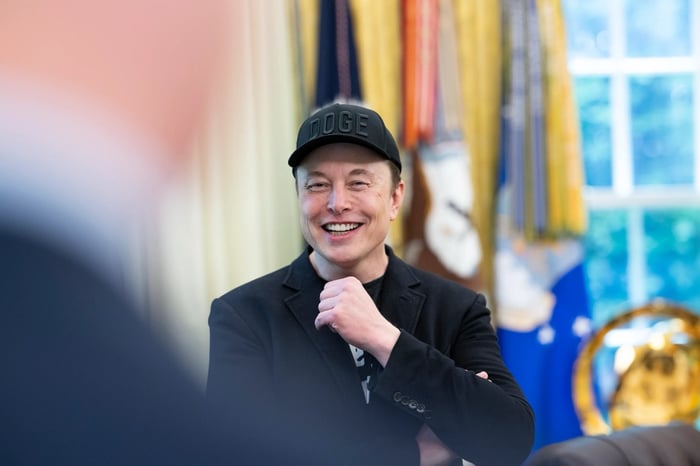
Image source: White House.
The overlap is already real business
The companies are intertwined today. Tesla's general counsel noted on the call that the relationship deepened this year through an investment and a framework agreement between the two companies. Grok, the AI (artificial intelligence) assistant built into Tesla vehicles, comes from the xAI business SpaceX absorbed before its initial public offering (IPO). Tesla's Cybercab robotaxis are expected to lean on SpaceX's Starlink network for connectivity. And Terafab could eventually supply the chips Tesla needs for its cars and robots.
Bankers have noticed, too. JPMorgan told clients this month that a combination would make strategic sense on paper, uniting Musk's ambitions in AI, transportation, and space under one roof. But the firm also cautioned that executing a deal is a far messier matter than the logic suggests.
The messy part deserves the emphasis. Two obstacles stand out.
The first is pricing. A merger needs an exchange ratio (how many shares of one company each share of the other is worth), and both of these stocks trade on stories rather than current profits. SpaceX carries a $1.5 trillion market value on trailing-12-month revenue of about $19 billion (up 33% from the year before), and it's still unprofitable. Tesla, valued at about $1.2 trillion, trades at more than 300 times earnings after this week's post-earnings sell-off.
Musk himself complicates the math. He controls about 85% of SpaceX's voting power, versus about 20% of Tesla's, so he effectively sits on both sides of the negotiation. Tesla's board needs an independent process robust enough to survive the shareholder lawsuits that reliably follow deals like this one.
The second obstacle is Washington. SpaceX is a major defense and government contractor. Tesla operates one of its largest factories in Shanghai and depends on China for a meaningful share of its sales and supply chain. Folding a national security asset into a company with deep Chinese exposure invites regulatory scrutiny in both countries -- and Starlink isn't even approved to operate in China. Of course, a review like that could stretch on for years, with no guarantee of approval.
Which shareholders would a deal reward?
It depends entirely on the exchange ratio, and that's the problem. SpaceX shareholders own the larger company by market value, and the asset Musk has the deeper economic interest in. Tesla shareholders get exposure to Starlink's fast-growing revenue in a deal, but they'd be paying with stock the ultimate decision maker has less personal incentive to defend. Every version of the math involves the same person on both sides of the table.
My take is that investors shouldn't own either stock because of a potential merger. A combination may eventually happen, and Musk's comments suggest the idea is at least alive. But the timing and terms are unknowable today, and the regulatory path could take years.
What investors can evaluate is each business on its own. Tesla just reported a 1.4% operating margin for the second quarter as it pours money into AI and robotaxis, and its shares sank about 14% on Thursday. SpaceX is weeks away from its first earnings report, due Aug. 4. Both stocks already price in spectacular futures, and I think each company should have to prove its own case first. Treat any merger as news to react to if it comes. Betting on it in advance is just speculation.
Don’t miss this second chance at a potentially lucrative opportunity
Ever feel like you missed the boat in buying the most successful stocks? Then you’ll want to hear this.
On rare occasions, our expert team of analysts issues a “Double Down” stock recommendation for companies that they think are about to pop. If you’re worried you’ve already missed your chance to invest, now is the best time to buy before it’s too late. And the numbers speak for themselves:
- Nvidia: if you invested $1,000 when we doubled down in 2009, you’d have $542,126!*
- Apple: if you invested $1,000 when we doubled down in 2008, you’d have $61,306!*
- Netflix: if you invested $1,000 when we doubled down in 2004, you’d have $371,519!*
Right now, we’re issuing “Double Down” alerts for three incredible companies, available when you join Stock Advisor, and there may not be another chance like this anytime soon.
See the 3 stocks »
*Stock Advisor returns as of July 24, 2026.
JPMorgan Chase is an advertising partner of Motley Fool Money. Daniel Sparks has clients with positions in Tesla. The Motley Fool has positions in and recommends JPMorgan Chase and Tesla. The Motley Fool has a disclosure policy.
Recommended Articles


