


Nvidia vs. Intel: Which is the Better AI Chip Stock to Own for the Next 3 Years?
Key Points
Intel's impressive rally has made the stock expensive, while Nvidia remains significantly cheap despite clocking robust growth.
Nvidia is going to eat Intel's lunch by moving into the server CPU market.
It is easy to see which one of these semiconductor stocks will deliver stronger gains over the next three years.
- 10 stocks we like better than Intel ›
Shares of Nvidia (NASDAQ: NVDA) and Intel (NASDAQ: INTC) have enjoyed contrasting fortunes on the stock market over the past year. While Intel stock has jumped by more than 4x during this period, Nvidia's gains have been way lower at just 20%.
Investors have been buying Intel stock hand over fist to capitalize on the company's turnaround. The semiconductor giant has been cutting its losses, and its chips have been gaining traction in artificial intelligence (AI) data centers to support inference and agentic AI workloads. Nvidia, on the other hand, continues to deliver impressive growth, but concerns about the growing competition in AI chips seem to have dented investor confidence.
Missed Nvidia in 2009? This Rare Signal Is Flashing Again. In 2009, a "Double Down" signal flashed for a little-known chipmaker called Nvidia. For the first time in years, that same "Total Conviction" signal is flashing for a company 1/100th the size of Nvidia. Continue »
Does this mean Intel is the better semiconductor stock to buy and hold for the next three years due to its resurgence? Or will Nvidia's dominant presence in this market help it regain its mojo and deliver stronger gains than Intel? Let's find out.
Image source: The Motley Fool.
Nvidia's growth is significantly better than Intel's
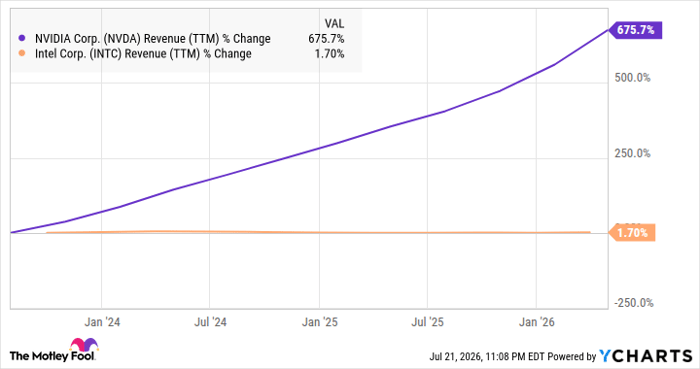
Nvidia reportedly controls 80% of the AI accelerator market, which includes graphics cards, server processors, and custom AI chips. Intel failed to make a mark in AI graphics processing units (GPUs) when they were in high demand, while Nvidia ran away with the market thanks to its early inroads in this space. This explains why Nvidia's growth has been much better than Intel's.
Data by YCharts
The situation isn't expected to change much over the next three years. That's because Nvidia has diversified beyond GPUs. It is going to sell its Vera server central processing unit (CPU) as a stand-alone product, anticipating $20 billion in revenue from this product alone in 2026. Nvidia is therefore now entering a market that Intel dominates.
Mercury Research estimates that Intel controlled just over two-thirds of server CPUs in Q1 this year. However, it has been losing ground to AMD in this market, and Nvidia's arrival could make things worse for Intel. For some perspective, Intel's data center and AI (DCAI) segment revenue was $5.1 billion in Q1, growing by 22% from the year-ago period. That translates into an annual run rate of just over $20 billion.
Nvidia is already forecasting $20 billion in stand-alone server CPU sales this year. Moreover, Nvidia sees a $200 billion addressable opportunity in the server CPU market, and its 2026 server CPU forecast indicates it is poised to make a big dent in this market. Meanwhile, Nvidia is also making solid progress in fast-growing AI niches such as physical AI. At the same time, the company has already lined up potential revenue of $1 trillion from sales of its Vera Rubin and Blackwell AI processors in 2026 and 2027.
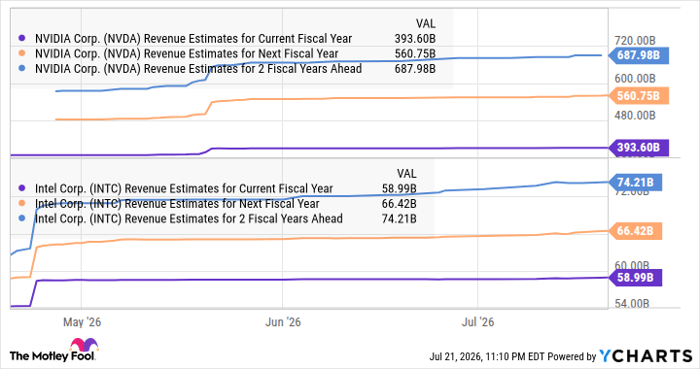
All this explains why analysts are expecting Nvidia to grow faster than Intel over the next three years.
Data by YCharts
A simple reason why Nvidia can deliver more upside than Intel
Intel's stunning surge over the past year has made it expensive. The stock is trading at 110 times forward earnings, which is way higher than Nvidia's forward earnings multiple of 23. We have already seen that Nvidia's growth rate will be higher than Intel's for the next three years, and that's going to filter down to its bottom line as well.
Data by YCharts
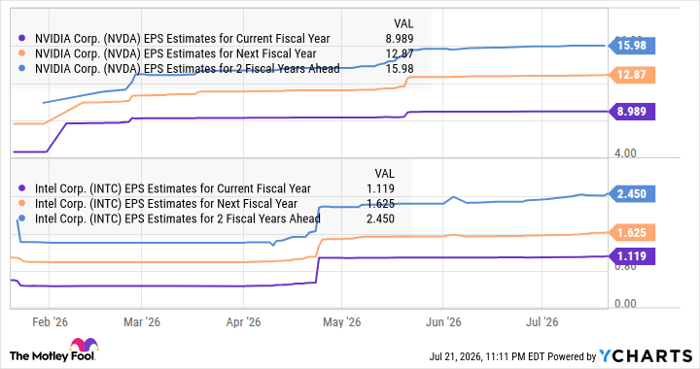
Assuming Nvidia trades at 25 times earnings after three years and its earnings per share reach $15.98 (as shown in the chart above), its stock price could jump to $400. That's nearly double its current stock price. But if Intel trades at a similar valuation and delivers $2.45 in earnings per share, its stock price would land at $71. That's lower than Intel's current stock price, suggesting it will need to trade at a higher valuation.
So, Nvidia looks like the better AI stock to buy right now compared to Intel, considering its impressive growth and cheaper valuation.
Should you buy stock in Intel right now?
Before you buy stock in Intel, consider this:
The Motley Fool Stock Advisor analyst team just identified what they believe are the 10 best stocks for investors to buy now… and Intel wasn’t one of them. The 10 stocks that made the cut could produce monster returns in the coming years.
Consider when Netflix made this list on December 17, 2004... if you invested $1,000 at the time of our recommendation, you’d have $369,577!* Or when Nvidia made this list on April 15, 2005... if you invested $1,000 at the time of our recommendation, you’d have $1,301,557!*
Now, it’s worth noting Stock Advisor’s total average return is 908% — a market-crushing outperformance compared to 208% for the S&P 500. Don't miss the latest top 10 list, available with Stock Advisor, and join an investing community built by individual investors for individual investors.
See the 10 stocks »
*Stock Advisor returns as of July 23, 2026.
Harsh Chauhan has no position in any of the stocks mentioned. The Motley Fool has positions in and recommends Advanced Micro Devices, Intel, and Nvidia. The Motley Fool has a disclosure policy.
Recommended Articles


