


The Real Constraint in AI Memory Isn't Demand. It's Supply. Here's Who's Fixing That.
Key Points
SK Hynix recently inked a multi-year partnership with Nvidia.
Micron's revenue increased 346% year over year in its most recent quarter.
SanDisk has been one of the best-performing stocks since spinning off from Western Digital.
- 10 stocks we like better than Micron Technology ›
Although most people only interact with artificial intelligence (AI) through generative AI tools like ChatGPT, there are tons of working parts behind the scenes that make it happen.
In the earlier stages of the current AI mania we're experiencing, attention was on the companies making graphics processing units (GPUs) and AI accelerators. Then, attention went to companies building out data centers and other infrastructure. Now, it seems the focus has gotten a bit more niche, with memory chip makers among the hottest (and most volatile) stocks on the market.
Where to invest $1,000 right now? Our analyst team just revealed what they believe are the 10 best stocks to buy right now, when you join Stock Advisor. See the stocks »
Demand for memory hardware has shot up in the past couple of years, far outpacing supply. And while a few key companies are working to address it, it's not an issue that'll be fixed overnight.
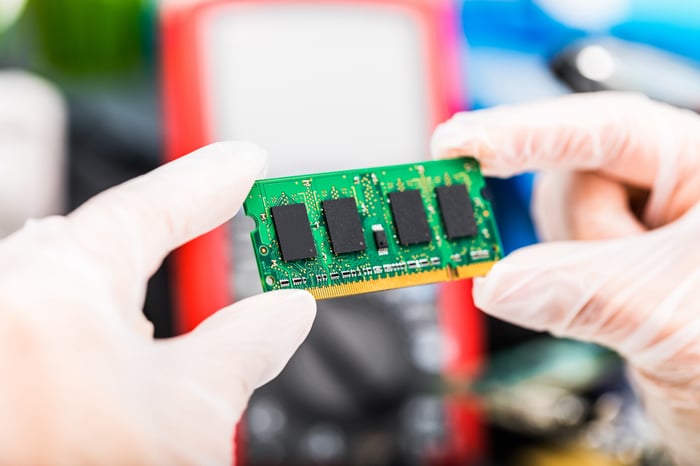
Image source: Getty Images.
At the right place at the right time
SK Hynix (NASDAQ: SKHY), Micron Technology (NASDAQ: MU), and Sandisk (NASDAQ: SNDK) are three of the key memory and storage hardware companies in the world, and they've found themselves in the right place at the right time.
As AI continues to scale, it requires much more memory and storage. Data centers are filled with countless pieces of this hardware, and as big tech companies spend trillions in the near future building them and other AI infrastructure, their need for it has only grown.
Of course, this supply shortage isn't ideal for data center operators. But for the memory companies making these products, the law of supply and demand has them bringing in cash like never before as they raise prices and flex their pricing power. Here's how much each company increased its revenue and net income in their latest quarters:
| Company | Revenue Growth | Net Income Growth |
|---|---|---|
| SK Hynix | 198% | 398% |
| Micron | 346% | 1,223% |
| SanDisk | 233% | 8,646%* |
Table by author. Growth is year over year. *Sandisk went from a $43 million loss to $3.675 billion in non-GAAP net income.
They're surely enjoying the cash, but they're also focused on addressing the supply problem. The short-term boost is cool; sustainability is much better. And with growing capital expenditure plans, it's clear they understand that as well.
Each company has something good working in its favor
SK Hynix only began trading on a U.S. stock exchange (the Nasdaq) on July 10, so it's closer to an initial public offering (IPO) stock, although it has been trading on the Korean Exchange since December 1996. The company is the market leader in high-bandwidth memory (HBM), which is working out in its favor, including inking a multiyear technology partnership with Nvidia that Nvidia says aligns with its "AI infrastructure roadmap."
Micron, up 174% this year (as of market close on July 20), is much smaller than SK Hynix in terms of market share, but it has been posting strong financial results. Its $18.3 billion in free cash flow in its most recent quarter (ended May 28) was up 165% year over year, and its gross margins increased by 10 percentage points from the previous quarter to 84.9%.
After spinning off from Western Digital in February 2025 and becoming a stand-alone, pure-play storage company, SanDisk has been one of the best-performing stocks in all of the market. Its stock is up nearly 3,700% since the spin-off and 405% this year.
It operates on a smaller scale than the other two, but its financial results have been just as impressive. In the past year, its free cash flow has increased by 1,243% to $2.96 billion, and its non-GAAP gross margins went from 22.7% to 78.4%.
Is now the time to invest in memory stocks?
The memory hardware industry is booming right now, but it's also one of the more cyclical tech industries around. Once supply catches up to demand -- and it will catch up -- and companies can no longer command premium prices, the financial growth we see now will likely slow down, and you'll see some investors jumping ship.
There's a lot of speculation right now in memory stocks, which is a large part of why they've been so volatile. If you're more on the risk-averse side, I would avoid memory stocks right now because of the volatility. If you can stomach the volatility, then SK Hynix and Micron look much better priced than SanDisk from a value standpoint and are "safer" choices.
However, a better route for most people would be investing in an exchange-traded fund (ETF) that holds the companies. The Roundhill Memory ETF (NYSEMKT: DRAM) is a good example, but it's much more of a supplemental piece than a portfolio staple.
Should you buy stock in Micron Technology right now?
Before you buy stock in Micron Technology, consider this:
The Motley Fool Stock Advisor analyst team just identified what they believe are the 10 best stocks for investors to buy now… and Micron Technology wasn’t one of them. The 10 stocks that made the cut could produce monster returns in the coming years.
Consider when Netflix made this list on December 17, 2004... if you invested $1,000 at the time of our recommendation, you’d have $369,577!* Or when Nvidia made this list on April 15, 2005... if you invested $1,000 at the time of our recommendation, you’d have $1,301,557!*
Now, it’s worth noting Stock Advisor’s total average return is 908% — a market-crushing outperformance compared to 208% for the S&P 500. Don't miss the latest top 10 list, available with Stock Advisor, and join an investing community built by individual investors for individual investors.
See the 10 stocks »
*Stock Advisor returns as of July 23, 2026.
Stefon Walters has no position in any of the stocks mentioned. The Motley Fool has positions in and recommends Micron Technology and Nvidia. The Motley Fool has a disclosure policy.
Recommended Articles


