


Why Is Alphabet (GOOGL) Selling Off After a Record $9.11 EPS Beat?
TradingKey - After closing the markets Wednesday, Alphabet (NASDAQ: GOOGL) released Q2 2026 numbers, which showed outperformance in all key data: a 24% increase in revenue year-over-year to $119.8 billion, an increase of 82% in cloud revenue, which came to $24.8 billion for Google Cloud, an earnings-per-share (EPS) record of $9.11, and more than 950 million monthly active users of Gemini App.
Alphabet’s share price, however, went down. The reason for that is that Alphabet’s capital expenditures doubled to a record $44.9 billion in the quarter and the $9.11 EPS included between $6-$7 in one-off and unrealized gains in Alphabet’s stakes in Anthropic and SpaceX. Excluding those, Alphabet’s underlying EPS of roughly $2.90 was in line with expectations.
Alphabet Reported a $9.11 EPS: The Headline Is Deceptive
Alphabet reported Q2 earnings of $9.11 per share, a 294% increase year over year, but that figure was largely a result of sizable unrealized investment gains and not a reflection of improved earnings from the core business. The company's performance benefited from increased values in its investment in various companies, most notably its 14% ownership in Anthropic as well as its investment in SpaceX, which was fueled by Anthropic's funding round and SpaceX's IPO progress. These mark-to-market gains were incorporated into earnings under US GAAP reporting standards.
If those gains were removed from the calculation, Alphabet would have reported an EPS of about $2.90 per share. This would have still been in line with Wall Street expectations. The underlying business, however, performed admirably. Revenue increased 24% year over year to $119.8 billion with Google Services increasing 15% to $94.5 billion. Search revenue increased by 17% to $63.3 billion, and advertising revenue from YouTube increased 13% to $11.06 billion. Operating margin increased to 34% from prior year. It was not this operating performance that concerned investors but rather what they found elsewhere in the report.
Alphabet Capex, Not Earnings, Are At The Forefront
In addition, capital expenditures increased 100% year over year to $44.9 billion from $22.4 billion a year ago, which is in-line with management's expectations of approximately $175 billion in capital expenditures this year. Though Google Cloud's revenue grew 82% to $24.8 billion, it is unclear whether it will be profitable enough to warrant all this capital. This spending is hurting Alphabet's free cash flow, which was 47% less in the first quarter compared to a year ago.
CEO Sundar Pichai noted that demand for AI continues to grow. According to management, 22 billion API tokens are now processed with Gemini per minute, up from 16 billion last quarter, underscoring the continued adoption of its services by customers. It remains to be seen whether management's continued focus on capital expenditures will eventually translate to the sustained cloud profitability needed over the next 12 to 18 months. If cloud margins continue to expand, the AI investment thesis remains solid. If not, investors' concerns about the AI spending spree could escalate.
GOOGL Technical Outlook: Oversold but Bears Remain in Control
The price of Alphabet stock still remains under selling pressure. Shares broke out of a symmetrical triangle pattern on the 4-hour chart and are trading below the 50 EMA ($352.47) and 200 EMA ($355.50). RSI is at 27, which indicates an oversold reading and suggests that a short-term relief rebound could occur, but the medium-term trend remains bearish as long as the stock trades below the $334.26 key level.
Alphabet's Q2 results were strong, with revenue up 24% YoY to $119.8 billion, cloud revenue up 82% YoY to $24.8 billion and margins up to 34%. However, the market focused on Alphabet's record $44.9 billion in quarterly AI-related CapEx, which is squeezing free cash flow.
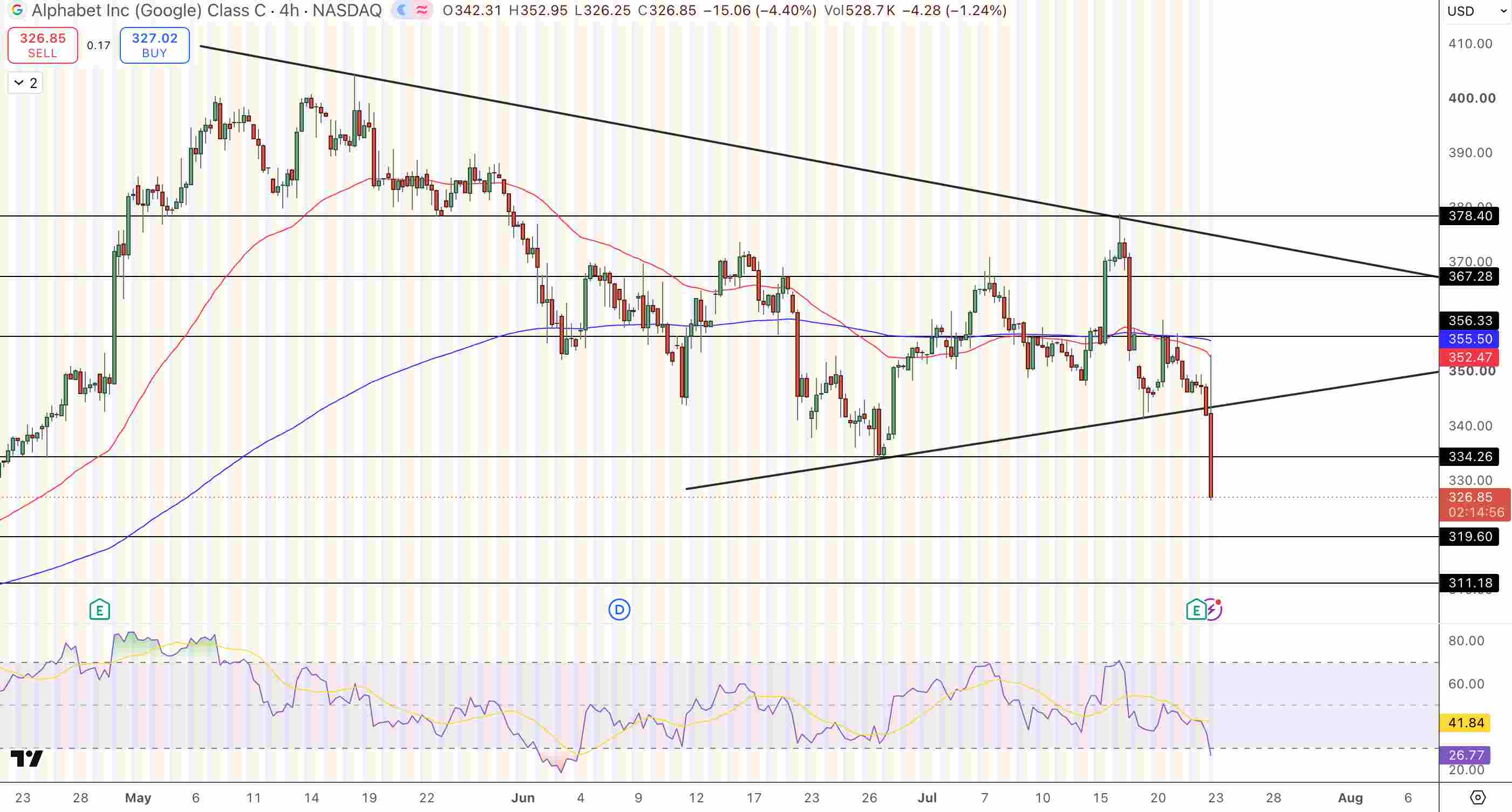
Alphabet stock price chart - Source: Tradingview
Immediate support is at $319.60, with a secondary level at $311.18. A sustained move above $334.26 could indicate that buyers are stepping in. If Alphabet stock can move above $355 and higher moving averages, the medium-term outlook will likely improve.
Why Is Alphabet's Stock Selling Off After Beating Earnings?
Alphabet's Q2 revenue of $119.8 billion was up 24% year over year, with the company beating Wall Street's expectations. Additionally, Alphabet reported EPS of $9.11 on the headline figure. A lot of the earnings surprise, however, came from unrealised gains on Alphabet investments in AI startups Anthropic and SpaceX.
If we exclude the one-off gains, operating earnings per share would be roughly $2.90. That's a number closer to Wall Street estimates. Another reason for the stock's selloff is investors focused on Alphabet's record $44.9 billion in quarterly CapEx spending on AI initiatives, which is weighing on free cash flow.
What Is Driving Google Cloud's 82% Growth?
Alphabet announced revenue from the Google Cloud segment of $24.8 billion during the Q2 earnings period, up 82% compared to a year ago. A significant portion of the revenue growth came from AI solutions demand, particularly enterprise customers and cloud infrastructure providers.
Google Cloud Platform and the Gemini LLM, which now has 950 million monthly active users and 22 billion API tokens per minute (16 billion in the previous quarter), remain popular with business customers. The company is not just seeing customer switching; there is clear demand for AI infrastructure.
What Does Alphabet's $44.9 Billion Capex Mean for Investors?
Alphabet said it will spend $44.9 billion this quarter on CapEx, putting it on track for $175 billion this year in capital spending. Alphabet has been making a lot of investments in AI and cloud infrastructure. However, investors are still watching to see how strong cloud growth and margin expansion might support a return of free cash flow growth in the next 12 to 18 months.
Bottom Line
Alphabet reported Q2 2026 earnings of $9.11 per share with revenue of $119.8 billion, up 24% year over year. Cloud revenue was up 82% year over year to $24.8 billion. Gemini is now being used by 950 million active users. This sell-off makes sense, as $6 or $7 of the $9.11 in EPS was from the unrealised gains on Alphabet investments in Anthropic and SpaceX, leaving the core operating EPS at about $2.90. Alphabet's CapEx jumped to $44.9 billion year-over-year, which is pressuring free cash flow.
The next level of support is $319.60, and $311.18 is below that. The first bullish signal will be seeing the stock trade above $334.26. Alphabet's business remains strong in the operating segment. The question now is whether the company will be able to produce significant growth in the cloud margins within the next 12 to 18 months to make up for the gap in free cash flows resulting from the unprecedented $44.9 billion per quarter of CapEx.
Recommended Articles


