

Today’s Market Recap: Oil Prices Weigh on Tech Sector, Google Cloud Concerns Linger, Tesla Sold Off

Source Tradingkey

Tracking the Market Trend

TradingKey - As tensions between the U.S. and Iran continue to escalate, oil prices surged to a six-week high, weighing on tech stocks. At the close of trading on July 22, Eastern Time, the Dow Jones Industrial Average fell 0.01% to 52,219.35; the Nasdaq Composite Index fell 0.57% to 25,690.90; the S&P 500 fell 0.14% to 7,499.04.

Meta(META) fell more than 2%, leading the decline among the “Big Seven” tech companies. SpaceX(SPCX)fell more than 6%, hitting a new all-time low since its IPO. Chip stocks were mixed, with the Philadelphia Semiconductor Index rising 0.44%. Most bank stocks rose. Energy stocks were broadly higher.

Google(GOOGL) and Tesla (TSLA) came under pressure in after-hours trading, while AI infrastructure stocks bucked the trend and surged. In after-hours trading, Google fell more than 3% and Tesla dropped over 5%; SanDisk(SNDK) rose 3% and Micron (MU) gained 2.9%, with AI infrastructure-related stocks performing strongly.

Commodities and cryptocurrencies were generally stronger. The U.S. dollar traded sideways, failing to sustain its rally; Bitcoin stabilized near $66,000. Spot gold(XAUUSD) rose as much as 2%, while silver(XAGUSD)gained 1.5%; WTI crude oil futures rose nearly 3%, and Brent crude oil futures rose 3.36%.

Market Headline

Ban Trump from Issuing Cryptocurrency! U.S. Senate to Vote on the “Clarity Act” as Early as Next Week. Republican senators updated the bill on Wednesday to explicitly prohibit the president and federal officials from issuing or sponsoring digital assets such as cryptocurrency. Republicans need to secure the support of at least seven Democratic senators to clear the 60-vote threshold. Trump’s previous earnings of tens of billions of dollars from cryptocurrency ventures have become a key point of contention in the negotiations. The vote could take place within the next two weeks, after which the Senate will enter its August recess.

Google Cloud’s Q2 revenue soared 82% as AI investments begin to pay off. Alphabet reported second-quarter revenue of $119.8 billion, up 24% year-over-year; operating profit reached $40.8 billion, up 30%; and net income hit $112.1 billion, surging 298% year-over-year, driven by equity gains from companies like Anthropic. Google Cloud revenue reached $24.8 billion, far exceeding the expected $22.5 billion and surging 82% year-over-year. Capital expenditures totaled $44.9 billion, slightly above expectations. Full-year capital expenditure guidance was raised to $195–205 billion, an 8% increase from the previous midpoint. However, market concerns over the return on these massive investments sent the stock down 4.2% in after-hours trading. The company plans to expand its use of third-party computing power in Q3, driving gains of 3.7% for CoreWeave, 2.9% for Micron, and 3.4% for Lumentum.

Tesla’s Q2 revenue rose 26%, but profits fell 18%, falling far short of expectations. The automotive business grew 23%, the services business grew 50%, and energy storage returned to positive growth but fell short of expectations. EPS was 35% below expectations, gross margin fell to 16.3%, and operating profit was less than 30% of expectations. Free cash flow turned negative for the first time in two years, though it was better than expected. FSD subscribers reached 1.48 million, up 56%, exceeding expectations by nearly 6%. AI computing power doubled in six months, with Cortex 2 exceeding 115 MW; the first Optimus production line is being installed and will soon begin production. Capital expenditures doubled quarter-over-quarter, causing free cash flow to turn negative. Musk described Optimus as the most challenging product to mass-produce, and Micron is providing memory allocations under reasonable terms.

IBM(IBM) reported a mere 1% increase in second-quarter revenue and lowered its full-year guidance. Revenue came in at $17.2 billion, and adjusted earnings per share were $2.93, both below expectations. Sales of the Z-series mainframes plummeted 42%, dragging down the infrastructure business by 7%. The software business remained relatively robust, growing by 5%. Since the company had issued an earnings warning a week earlier, its stock price actually rose by about 3% in after-hours trading.

OpenAI is investing over $30 billion to build data centers and is simultaneously launching an enterprise platform. It is constructing a 3.2-gigawatt data center in Georgia, with the first phase of power expected to come online in 2028. At the same time, it is launching Presence, an enterprise AI agent platform that integrates AI models with corporate data to provide automation solutions for customer service, sales, and other scenarios. The company’s cloud spending target is projected to reach $750 billion.

AMD (AMD) secured a multi-billion-dollar chip order from Anthropic. Starting in the first half of 2027, Anthropic will purchase AMD’s latest MI450 chips, totaling 2 gigawatts. AMD is also investing $5 billion for an equity stake, with funds to be disbursed in installments based on deployment milestones.

SpaceX AI is expanding its data center in Texas, with the facility potentially surpassing the Memphis site in scale. Musk’s SpaceX AI plans to build at least one gigawatt-scale AI data center in Texas, aiming to match or even exceed the Memphis facility. The company’s first-quarter AI capital expenditures reached $7.7 billion, a threefold increase year-over-year; this rapid expansion is also creating pressure on funding and energy supply.

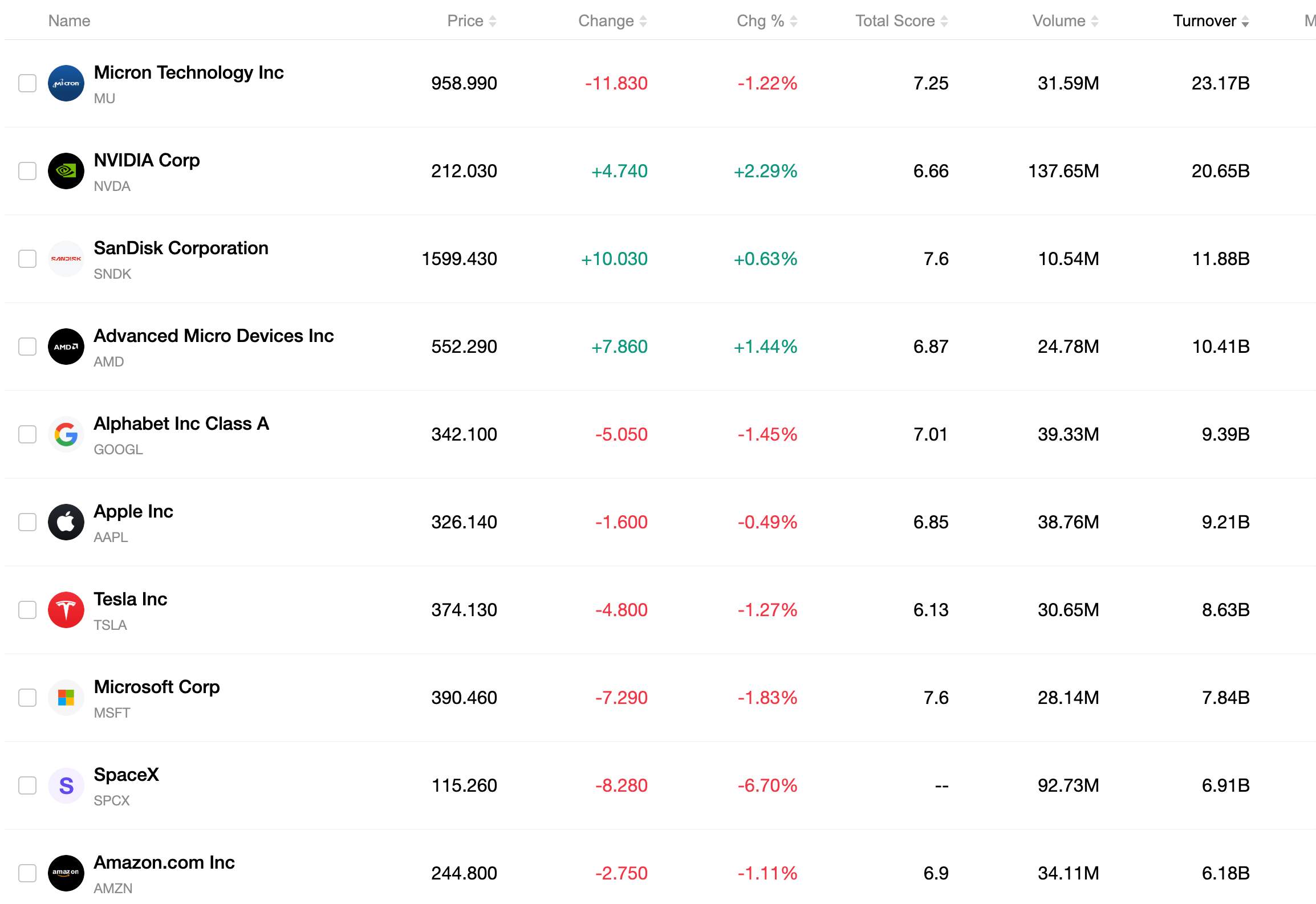
Top 10 Most Traded Stocks

The table below lists the ten most actively traded stocks in the market recently. Backed by massive trading volumes and excellent liquidity, these assets have become key benchmarks for tracking global market dynamics.
US-723-cdd16f8da6bf43ffaf01dc56aa187840

Disclaimer: For information purposes only. Past performance is not indicative of future results.
placeholder
Bitcoin CME gaps at $35,000, $27,000 and $21,000, which one gets filled first?Prioritize filling the $27,000 gap and even try higher.
Author  FXStreet
Aug 22, 2023
Prioritize filling the $27,000 gap and even try higher.
placeholder
Pinduoduo Earnings Incoming: Morgan Stanley Sees Long-Term Profit Potential​Insights – On November 21, Chinese e-commerce giant Pinduoduo (PDD) will release its Q3 2024 earnings.
Author  Mitrade
Nov 20, 2024
​Insights – On November 21, Chinese e-commerce giant Pinduoduo (PDD) will release its Q3 2024 earnings.
placeholder
Bitcoin briefly loses 2025 gains as crypto plunges over the weekend.Bitcoin experienced a sharp decline this weekend, briefly erasing its 2025 gains and dipping below its year-opening value of $93,507. The cryptocurrency fell to a low of $93,029 on Sunday, representing a 25% drop from its all-time high in October. Although it has rebounded slightly to around $94,209, the pressures on the market remain significant. The downturn occurred despite the reopening of the U.S. government on Thursday, which many had hoped would provide essential support for crypto markets. This year initially appeared promising for cryptocurrencies, particularly after the inauguration of President Donald Trump, who has established the most pro-crypto administration thus far. However, ongoing political tensions—including Trump's tariff strategies and the recent government shutdown, lasting a historic 43 days—have contributed to several rapid price pullbacks for Bitcoin throughout the year. Market dynamics are also being influenced by Bitcoin whales—investors holding large amounts of Bitcoin—who have been offloading portions of their assets, consequently stalling price rallies even as positive regulatory developments emerge. Despite these sell-offs, analysts from Glassnode argue that this behavior aligns with typical patterns seen among long-term investors during the concluding stages of bull markets, suggesting it is not indicative of a mass exodus. Notably, Bitcoin is not alone in its struggles, as Ethereum and Solana have also recorded declines of 7.95% and 28.3%, respectively, since the start of the year, while numerous altcoins have faced even steeper losses. Looking ahead, questions linger regarding the viability of the four-year cycle thesis, particularly given the increasing institutional support and regulatory frameworks now in place in the crypto landscape. Matt Hougan, chief investment officer at Bitwise, remains optimistic, suggesting a potential Bitcoin resurgence in 2026 driven by the “debasement trade” thesis and a broader trend toward increased adoption of stablecoins, tokenization, and decentralized finance. Hougan emphasized the soundness of the underlying fundamentals, pointing to a positive outlook for the sector in the longer term.
Author  Mitrade
Nov 17, 2025
Bitcoin experienced a sharp decline this weekend, briefly erasing its 2025 gains and dipping below its year-opening value of $93,507. The cryptocurrency fell to a low of $93,029 on Sunday, representing a 25% drop from its all-time high in October. Although it has rebounded slightly to around $94,209, the pressures on the market remain significant. The downturn occurred despite the reopening of the U.S. government on Thursday, which many had hoped would provide essential support for crypto markets. This year initially appeared promising for cryptocurrencies, particularly after the inauguration of President Donald Trump, who has established the most pro-crypto administration thus far. However, ongoing political tensions—including Trump's tariff strategies and the recent government shutdown, lasting a historic 43 days—have contributed to several rapid price pullbacks for Bitcoin throughout the year. Market dynamics are also being influenced by Bitcoin whales—investors holding large amounts of Bitcoin—who have been offloading portions of their assets, consequently stalling price rallies even as positive regulatory developments emerge. Despite these sell-offs, analysts from Glassnode argue that this behavior aligns with typical patterns seen among long-term investors during the concluding stages of bull markets, suggesting it is not indicative of a mass exodus. Notably, Bitcoin is not alone in its struggles, as Ethereum and Solana have also recorded declines of 7.95% and 28.3%, respectively, since the start of the year, while numerous altcoins have faced even steeper losses. Looking ahead, questions linger regarding the viability of the four-year cycle thesis, particularly given the increasing institutional support and regulatory frameworks now in place in the crypto landscape. Matt Hougan, chief investment officer at Bitwise, remains optimistic, suggesting a potential Bitcoin resurgence in 2026 driven by the “debasement trade” thesis and a broader trend toward increased adoption of stablecoins, tokenization, and decentralized finance. Hougan emphasized the soundness of the underlying fundamentals, pointing to a positive outlook for the sector in the longer term.
placeholder
Japanese Yen bears turn cautious near four-decade low amid looming intervention risksThe USD/JPY enters a bullish consolidation phase during the Asian session on Wednesday and holds steady above the 163.00 mark, near its highest level since 1986 set the previous day.
Author  FXStreet
Yesterday 01: 18
The USD/JPY enters a bullish consolidation phase during the Asian session on Wednesday and holds steady above the 163.00 mark, near its highest level since 1986 set the previous day.
placeholder
Gold rallies to over two-week high, eyes $4,150 as traders track US-Iran diplomacy effortsGold (XAU/USD) rallies to an over two-week high, around the $4,140-$4,141 area, during the Asian session on Wednesday amid hopes that US-Iran diplomacy could ease energy prices and temper hawkish US Federal Reserve (Fed) expectations.
Author  FXStreet
16 hours ago
Gold (XAU/USD) rallies to an over two-week high, around the $4,140-$4,141 area, during the Asian session on Wednesday amid hopes that US-Iran diplomacy could ease energy prices and temper hawkish US Federal Reserve (Fed) expectations.
goTop
quote