


Why This Forgotten Global Automaker Could Outperform Rivals Over the Next 5 Years
Key Points
Thanks to declining market share, among other issues, Stellantis' stock has shed immense value over the past three years.
Stellantis' $70 billion turnaround should power optimism and send the stock higher over the next five years.
Early evidence shows the beginning of a turnaround in Stellantis' crucial North America market.
- 10 stocks we like better than Stellantis ›
When we think about the major global automakers these days, many investors forget all about Stellantis (NYSE: STLA), while General Motors (NYSE: GM) and Ford Motor Company (NYSE: F) remain hot topics. It's understandable, considering Stellantis' declining relevance in multiple markets, lack of a true branding identity, and numerous management missteps. No doubt, Stellantis has many, many issues to fix in the coming years to regain lost global notoriety. That said, the company could be in oversold territory, and Wall Street forward estimates suggest analysts are in "prove it" mode regarding the company's massive $70 billion turnaround plan. Here's a look at how Stellantis is poised to outperform its rivals over the next five years.
How bad is it?
Over the past three years, General Motors, Ford, and Stellantis have traded in completely different trajectories. GM has been thriving, and its stock has doubled over the past three years, while Ford has essentially remained flat, but Stellantis checked in with a staggering near 70% decline. To get a better idea of just how much value Stellantis has shed, take a look at this next graph.
Where to invest $1,000 right now? Our analyst team just revealed what they believe are the 10 best stocks to buy right now, when you join Stock Advisor. See the stocks »
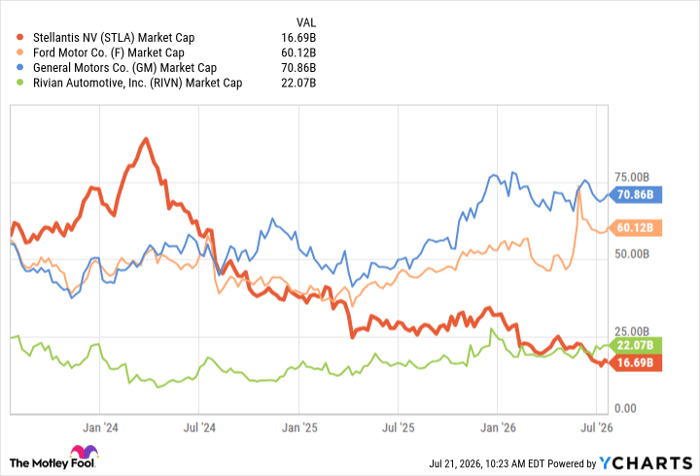
STLA Market Cap data by YCharts
Not only does Stellantis' market cap equal a fraction of rivals GM or Ford, but it has also even sunk below that of young electric vehicle (EV) maker Rivian (NASDAQ: RIVN). That's right; Stellantis, a global automaker with millions of shipments annually, has a market cap below Rivian, which only sells four electric vehicles and has only achieved its first full year of gross profitability in 2025, and remains a long way away from net profitability.
Evidence of turnaround starting
Roughly a decade ago, Stellantis, then operating as Fiat Chrysler Automobiles in this reference, was peaking in the U.S. market. By 2019, however, its market share began a sharp decline that would last until about 2023, before leveling off over the next couple of years. This is the first year investors are seeing life from its core Jeep and Ram brands in North America.
Let's take a look at Stellantis' second-quarter consolidated shipments, which reached 1.6 million units globally, a 10% increase from the prior year. That increase was due to Stellantis' results in North America, which posted strong 38% growth in shipments during the second quarter.
Stellantis' growth in North America was largely driven by new or refreshed products, which the company has lacked in recent years. Highly profitable products, such as the Ram 1500 (light-duty) HEMI, the new Ram 1500 TRX SRT, the refreshed Jeep Grand Wagoneer and Grand Cherokee, and a ramp-up of the all-new Jeep Cherokee, were highlighted as driving the turnaround in shipments.
This should just be the beginning of a surging Stellantis in North America, which remains a core engine for profitable growth. In fact, Stellantis' recently unveiled $70 billion global turnaround strategy is committing 60% of its brand and product spending to North America. Out of its 14-brand global portfolio, Jeep and Ram are two of the four brands that will receive massive investment over the next five years. Jeep is even expected to help turn the business around overseas.
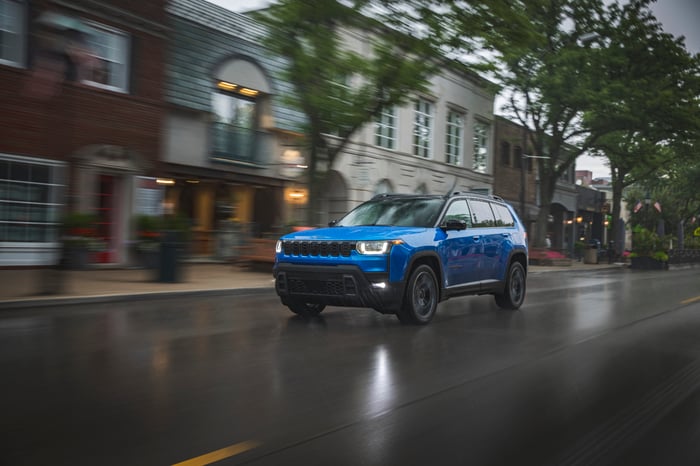
Jeep will play a huge role in Stellantis' turnaround. Image source: Stellantis.
Those investments will not only help revive the Jeep and Ram brands but also give the company an identity centered on highly profitable full-size trucks and SUVs. The other side of its strategy is to attack affordability by launching seven all-new vehicles in North America priced under $40,000 and another two under $30,000. While the trucks and SUVs will carry profitability, the more affordable products will help the company utilize more of its production capacity to improve profitability more broadly.
What it all means
Wall Street is currently refusing to give Stellantis a better valuation, and that's understandable, but it gives individual investors an opportunity to get in before Wall Street changes its tune. There's early evidence that refreshed and all-new models are already sparking Stellantis sales in North America, and there are more reinforcements on the way. Stellantis has the potential to soar over the next three to five years if it gets traction with its new models -- and it's not a stretch to imagine Jeep and Ram outperforming expectations. The past three years showed GM and Ford stock trading much more favorably than Stellantis' 70% decline, but don't be shocked if Stellantis flips that graph over the next three to five years.
Should you buy stock in Stellantis right now?
Before you buy stock in Stellantis, consider this:
The Motley Fool Stock Advisor analyst team just identified what they believe are the 10 best stocks for investors to buy now… and Stellantis wasn’t one of them. The 10 stocks that made the cut could produce monster returns in the coming years.
Consider when Netflix made this list on December 17, 2004... if you invested $1,000 at the time of our recommendation, you’d have $370,332!* Or when Nvidia made this list on April 15, 2005... if you invested $1,000 at the time of our recommendation, you’d have $1,272,280!*
Now, it’s worth noting Stock Advisor’s total average return is 904% — a market-crushing outperformance compared to 208% for the S&P 500. Don't miss the latest top 10 list, available with Stock Advisor, and join an investing community built by individual investors for individual investors.
See the 10 stocks »
*Stock Advisor returns as of July 22, 2026.
Daniel Miller has positions in Ford Motor Company and General Motors. The Motley Fool recommends General Motors and Stellantis. The Motley Fool has a disclosure policy.
Recommended Articles


