


Taiwan Semiconductor Manufacturing Just Showed the Artificial Intelligence (AI) Build-Out Is Alive and Well With This Jaw-Dropping Announcement
Key Points
Taiwan Semiconductor just announced another $100 billion investment to expand its foundry operations in Arizona.
The stock has sold off over the past few weeks.
TSMC trades at an attractive forward P/E level.
- 10 stocks we like better than Taiwan Semiconductor Manufacturing ›
Taiwan Semiconductor Manufacturing (NYSE: TSM) may be one of the most important companies to the health of the AI infrastructure build-out. Its foundries churn out the logic chips designed by nearly every one of the major players in the space, and it just made an announcement that supports the idea that we're still in the early innings of the AI build-out. During its second-quarter earnings call, it announced it would make an additional $100 billion investment in expanding its chipmaking facilities in Arizona. If Taiwan Semiconductor suspected that the AI build-out was nearing completion, it wouldn't be increasing its production capacity.
Given its leading position in a still-growing space, I think Taiwan Semiconductor is one of the lowest-risk, highest-potential-reward options in the market, and it still looks like a phenomenal investment now, even after rising over 30% so far this year.
Where to invest $1,000 right now? Our analyst team just revealed what they believe are the 10 best stocks to buy right now, when you join Stock Advisor. See the stocks »

Image source: Taiwan Semiconductor Manufacturing Company.
AI computing power starts with Taiwan Semiconductor
Taiwan Semiconductor is the world's leading third-party chip foundry, which means it takes chip designs from its clients and manufactures them on their behalf. Its customers include tech giants Nvidia, AMD, Apple, Broadcom, and Tesla. This puts TSMC in a strong position, as it often manufactures chips for rivals such as Nvidia and AMD, allowing it to profit regardless of which of those customers is winning in the marketplace. Taiwan Semiconductor accounts for nearly three-quarters of all semiconductor industry revenue in the world, according to research by The Motley Fool. During the quarter, 66% of its revenue came from high-performance computing, showcasing that AI is eating up a lot of Taiwan Semiconductor's production capacity, and explaining its plan to expand its Arizona foundries.
Taiwan Semiconductor is one of the top ways to invest in the AI arms race, and it's honestly not as expensive as you might guess, considering its solid growth rate. (Revenue grew by 34% in U.S. dollars during Q2.) At 24 times forward earnings, Taiwan Semiconductor trades at only a small premium to the S&P 500 (SNPINDEX: ^GSPC), which averages 21.7 times forward earnings.
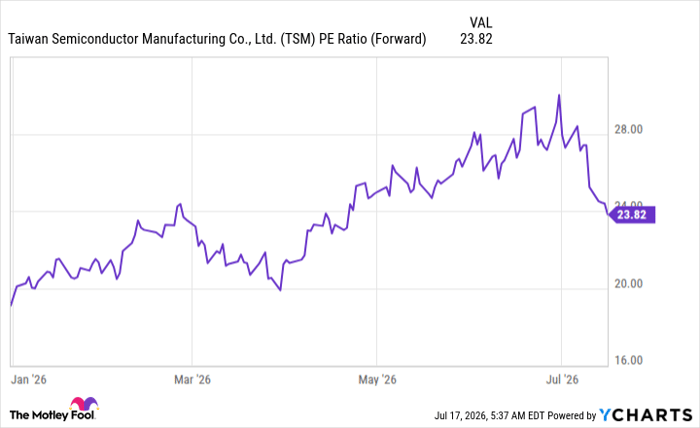
TSM PE Ratio (Forward) data by YCharts.
Few companies have as much guaranteed success as Taiwan Semiconductor does as long as spending on AI computing power remains robust. All signs point to that assumption remaining correct over the next few years, which gives me confidence that Taiwan Semiconductor will be a market-crushing stock over that period, making it a no-brainer buy today.
Should you buy stock in Taiwan Semiconductor Manufacturing right now?
Before you buy stock in Taiwan Semiconductor Manufacturing, consider this:
The Motley Fool Stock Advisor analyst team just identified what they believe are the 10 best stocks for investors to buy now… and Taiwan Semiconductor Manufacturing wasn’t one of them. The 10 stocks that made the cut could produce monster returns in the coming years.
Consider when Netflix made this list on December 17, 2004... if you invested $1,000 at the time of our recommendation, you’d have $371,842!* Or when Nvidia made this list on April 15, 2005... if you invested $1,000 at the time of our recommendation, you’d have $1,244,783!*
Now, it’s worth noting Stock Advisor’s total average return is 900% — a market-crushing outperformance compared to 207% for the S&P 500. Don't miss the latest top 10 list, available with Stock Advisor, and join an investing community built by individual investors for individual investors.
See the 10 stocks »
*Stock Advisor returns as of July 19, 2026.
Keithen Drury has positions in Broadcom, Nvidia, Taiwan Semiconductor Manufacturing, and Tesla. The Motley Fool has positions in and recommends Advanced Micro Devices, Apple, Broadcom, Nvidia, Taiwan Semiconductor Manufacturing, and Tesla. The Motley Fool has a disclosure policy.
Recommended Articles


