


Vanguard VCLT vs. VGLT: Which Long-Term Bond ETF Deserves Your Portfolio?
Key Points
The Vanguard Long-Term Corporate Bond ETF is a fine idea for fixed income investors who want extra income.
The Vanguard Long-Term Treasury ETF is an option for those who want to avoid credit risk.
Keep in mind that both ETFs are sensitive to changes in interest rates.
- 10 stocks we like better than Vanguard Long-Term Corporate Bond ETF ›
In the fixed-income market, experienced and novice investors alike can benefit from a refresher. Here's a reminder: When investing in bonds, the two primary forms of risk to consider are credit and interest rate risk.
Even with mountains of debt, the U.S. carries some of the highest sovereign credit ratings in the world, so income investors considering exchange-traded funds (ETFs) such as the Vanguard Long-Term Treasury ETF (NASDAQ: VGLT) don't worry much about credit issues. But with long-term bonds, interest rates are paramount.
Missed Nvidia in 2009? This Rare Signal Is Flashing Again. In 2009, a "Double Down" signal flashed for a little-known chipmaker called Nvidia. For the first time in years, that same "Total Conviction" signal is flashing for a company 1/100th the size of Nvidia. Continue »
When it comes to corporate bonds and funds such as the Vanguard Long-Term Corporate Bond ETF (NASDAQ: VCLT), end users must consider both credit and rate risk. After all, some issuers default, leaving bondholders with pennies on the dollar, if that.
With that said, let's look at two of the giants of the Vanguard bond stable to pin down which one might merit a place in your portfolio.
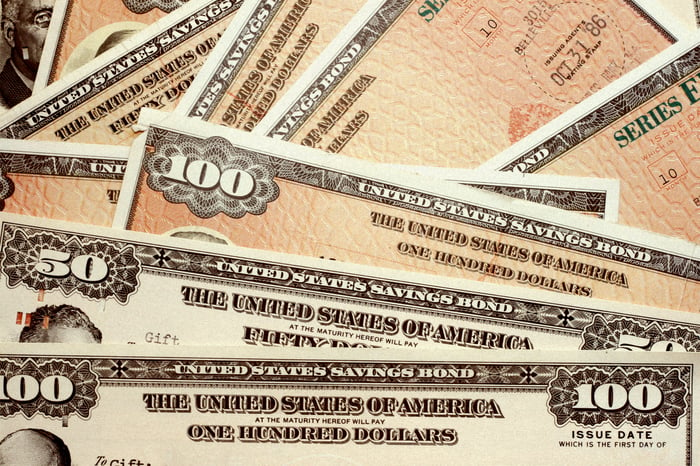
These cost-effective Vanguard bond ETFs are ideal for long-term fixed income investors. Image source: Getty Images.
Make the corporate call for more income
For investors seeking extra income, corporate bonds are a fine asset class to consider. The $8.4 billion Vanguard Long-Term Corporate Bond ETF embodies that spirit, as evidenced by its 30-day SEC yield of nearly 6%.
That's high, given that approximately 56% of this ETF's 2,778 holdings are rated AA or A, confirming it is an investment-grade ETF. As such, credit risk is somewhat subdued. The yield and the stout credit sound pretty good, but smart investors are probably wondering what the "but" is with this ETF. It's simple and revealed in its name: This is a long-duration ETF.
The average duration for this ETF's holdings is 12.2 years. For the sake of simplicity, let's call it 12 years. This means that in a hypothetical scenario in which the Federal Reserve raises interest rates by 1% over a series of meetings with no reductions to offset those hikes, a bond (or this ETF) with a duration of 12 years loses 12% of its value.
That's not a knock on this corporate bond ETF, but it is a statement of obvious risk. Consider this fund and others like it as reminders that there are no free lunches in investing. Meaning 6% yields aren't given away without investors accepting some risk. In this case, it's rate risk.
In addition to the tempting yield, this ETF has some high points, including a deep bench of holdings and an annual fee of just 0.03%, making it one of the cheapest bond ETFs of any stripe.
A patriotic play
As its name implies, the Vanguard Long-Term Treasury ETF holds Treasury bonds. Ninety-nine of them, to be precise. Even with Uncle Sam's impressive credit rating, this Vanguard fund lobs off a yield of almost 5.1%. That seems pretty high for an ETF with essentially no credit risk. So what gives?
As with the corporate bond fund, the Treasury ETF's name reveals the issue. It, too, is a long-term bond fund. In this case, the average holding duration is 13.8 years. Call it 14 years, and for every 1% rise in rates, a bond or fixed-income fund with a duration of 14 years loses 14%.
That's a reminder about the rough road of recovery math. A $100 bond that loses 14% is worth $86, meaning it has to gain more than 16% just to get the investor back to breakeven.
Of course, duration cuts both ways, and if the Fed surprises with a string of rate cuts, this ETF and its corporate counterpart would rally. Plus, the Vanguard Long-Term Treasury ETF is among the least expensive bond ETFs to own, with an annual expense ratio of 0.03%.
And the winner is...
Well, it depends on individual investors' risk tolerances and where they're at in life. Hopefully and hypothetically, the bond market will "play ball" with investors in the coming years, and there won't be significant spikes in Treasury yields that expose the vulnerabilities of long-duration debt.
Assuming a more sanguine rate environment plays out, the Vanguard Long-Term Treasury ETF is a fine idea for retirees and those close to retirement, thanks to its dependable income stream and lack of credit risk.
On the other hand, the Vanguard Long-Term Corporate Bond ETF is arguably more appropriate for those with longer retirement runways, as well as for long-term investors who currently have limited or no fixed-income exposure.
Should you buy stock in Vanguard Long-Term Corporate Bond ETF right now?
Before you buy stock in Vanguard Long-Term Corporate Bond ETF, consider this:
The Motley Fool Stock Advisor analyst team just identified what they believe are the 10 best stocks for investors to buy now… and Vanguard Long-Term Corporate Bond ETF wasn’t one of them. The 10 stocks that made the cut could produce monster returns in the coming years.
Consider when Netflix made this list on December 17, 2004... if you invested $1,000 at the time of our recommendation, you’d have $371,842!* Or when Nvidia made this list on April 15, 2005... if you invested $1,000 at the time of our recommendation, you’d have $1,244,783!*
Now, it’s worth noting Stock Advisor’s total average return is 900% — a market-crushing outperformance compared to 207% for the S&P 500. Don't miss the latest top 10 list, available with Stock Advisor, and join an investing community built by individual investors for individual investors.
See the 10 stocks »
*Stock Advisor returns as of July 19, 2026.
Todd Shriber has no position in any of the stocks mentioned. The Motley Fool has no position in any of the stocks mentioned. The Motley Fool has a disclosure policy.
Recommended Articles


