


I'm Calling It: Bloom Energy Will Be a Very Different Stock After 2026 for 1 Reason
Key Points
While the technology has been around for years, interest in hydrogen fuel cells has been minimal at best.
With data centers hungry for power, however, the AI industry is now exploring all of its viable options.
Evidence that the fuel cell business is reaching critical mass is starting to stack up in a big way.
- 10 stocks we like better than Bloom Energy ›
After another big run-up early this year, Bloom Energy (NYSE: BE) is stumbling again. Shares are down nearly 40% from their late-June peak, in fact, suggesting investors still don't remain fully convinced that hydrogen fuel cells will play a prominent role in the energy industry's future.
It's becoming increasingly difficult to hold onto those doubts, though, given all the deals now being made between fuel cell makers like Bloom and electricity-hungry AI data centers' owners and operators. Case(s) in point: Just a few days ago, artificial intelligence data center company ECL inked a contract to deploy 300 megawatts worth of hydrogen fuel cells made by Sweden's PowerCell.
Missed Nvidia in 2009? This Rare Signal Is Flashing Again. In 2009, a "Double Down" signal flashed for a little-known chipmaker called Nvidia. For the first time in years, that same "Total Conviction" signal is flashing for a company 1/100th the size of Nvidia. Continue »
Shortly before that, heavy equipment maker Siemens agreed to co-develop distributed energy solutions specifically for data centers with FuelCell Energy, just days after FuelCell Energy made a similar deal with Fit Energy USA.
For its part, late last month investment manager and project developer Brookfield announced it would be quintupling its initial $5 billion purchase of power infrastructure manufactured by Bloom Energy. That follows April's announcement that technology giant Oracle more than doubled the amount of power it initially needed from Bloom's onsite fuel cell power solutions, from 1.2 gigawatts to 2.8 gigawatts.
Read between the lines. Hydrogen fuel cells are finally entering the mainstream as an option for powering artificial intelligence data centers. Now that the proverbial floodgates are open, investors will have little choice but to notice the companies making the noise. With Bloom Energy, they'll not only find a company that's already profitable, but one expected to become increasingly so.
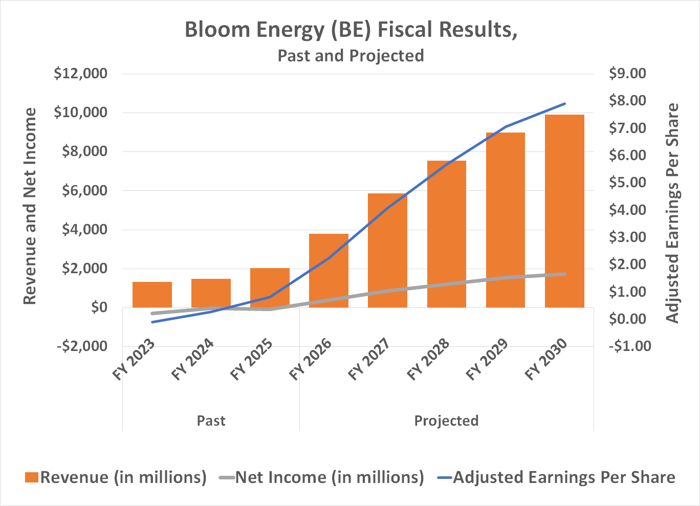
Data source: Morningstar. Chart by author.
Moreover, the fact that Bloom's solid-oxide fuel cells can also utilize natural gas or biogas clearly makes its tech uniquely marketable within a fuel cell market that Mordor Intelligence expects to grow an average of 37% per year through 2031.
In other words, the hydrogen fuel industry is at a tipping point. Nobody will be able to deny or ignore this by the end of the year. This, of course, lays a much firmer foundation for Bloom Energy shares.
Should you buy stock in Bloom Energy right now?
Before you buy stock in Bloom Energy, consider this:
The Motley Fool Stock Advisor analyst team just identified what they believe are the 10 best stocks for investors to buy now… and Bloom Energy wasn’t one of them. The 10 stocks that made the cut could produce monster returns in the coming years.
Consider when Netflix made this list on December 17, 2004... if you invested $1,000 at the time of our recommendation, you’d have $371,842!* Or when Nvidia made this list on April 15, 2005... if you invested $1,000 at the time of our recommendation, you’d have $1,244,783!*
Now, it’s worth noting Stock Advisor’s total average return is 900% — a market-crushing outperformance compared to 207% for the S&P 500. Don't miss the latest top 10 list, available with Stock Advisor, and join an investing community built by individual investors for individual investors.
See the 10 stocks »
*Stock Advisor returns as of July 19, 2026.
James Brumley has no position in any of the stocks mentioned. The Motley Fool has positions in and recommends Bloom Energy, Brookfield Asset Management, and Oracle. The Motley Fool recommends Brookfield Renewable and Siemens Energy Ag. The Motley Fool has a disclosure policy.
Recommended Articles


