


Musk Just Announced Starship Launch This Thursday, Will SpaceX Share Price Soar or Hit New Low?
TradingKey - SpaceX is scheduled to conduct its Flight 13 return-to-flight as early as this Thursday. Will SpaceX's stock price stage a sharp rebound or fall to the $100 mark?
On July 20, Elon Musk's space exploration technology company SpaceX ( SPCX) announced in a post on X, "We are currently targeting as early as July 23 (Thursday) for the thirteenth flight test of Starship (Flight 13)." Musk retweeted the post and said, "The next Starship launch attempt will be on Friday," and subsequently commented, "I meant Thursday (duh)."
 Tweets posted by SpaceX and Musk, Source: X
During after-hours trading last Thursday (July 16), Starship's 13th test flight was forced to abort at the moment of ignition, triggering a slide of over 4% in the stock price. Over the past six trading days, SpaceX's stock price has fallen consecutively, dropping from $150 to a low of $123, breaching key levels one after another, with a cumulative decline of 18% and a drawdown of up to 45% from its historical peak.
So, can Starship's return-to-flight this week save SpaceX's stock price? The answer is no, because the downward pressure on SpaceX's stock is not only affected by the Starship launch, but also due to unresolved headwinds: namely, the AI bubble and the expiration of the lock-up period. Recently, global tech stocks, especially AI stocks, have been undergoing a brutal "bubble-bursting" valuation correction. Meanwhile, SpaceX's merger with xAI in early 2026 has made its valuation highly correlated with AI. Currently, the Philadelphia Semiconductor Index (SOX) is showing systemic risk with collective drawdowns, and SPCX has also been used as an "ATM" for institutions to cash out.
In addition, a tsunami of potential selling pressure from the expiration of SpaceX's lock-up period is looming. Currently, SpaceX has only released an ultra-low free float of 3% to 5% of its shares. However, as its first quarterly earnings report in early August approaches, the first batch of insider holdings, as high as 20%, is about to face lock-up expiration. Short-term capital, fearing the deluge of shares after the lock-up expires, may choose to sell ahead of time in mid-to-late July.
Although Starship's return-to-flight this time cannot completely reverse the trend of SpaceX's stock price, its significance cannot be ignored. If Starship Flight 13 executes a flawless launch this Thursday, successfully delivers 20 Starlink V3 satellites into orbit, and is recovered smoothly, it would mean the exhaustion of this particular negative catalyst coupled with oversold conditions. The stock price would highly likely trigger a strong rebound from here, though the ceiling would be $150—the opening price on its first trading day, which has now turned from a support level into a resistance level.
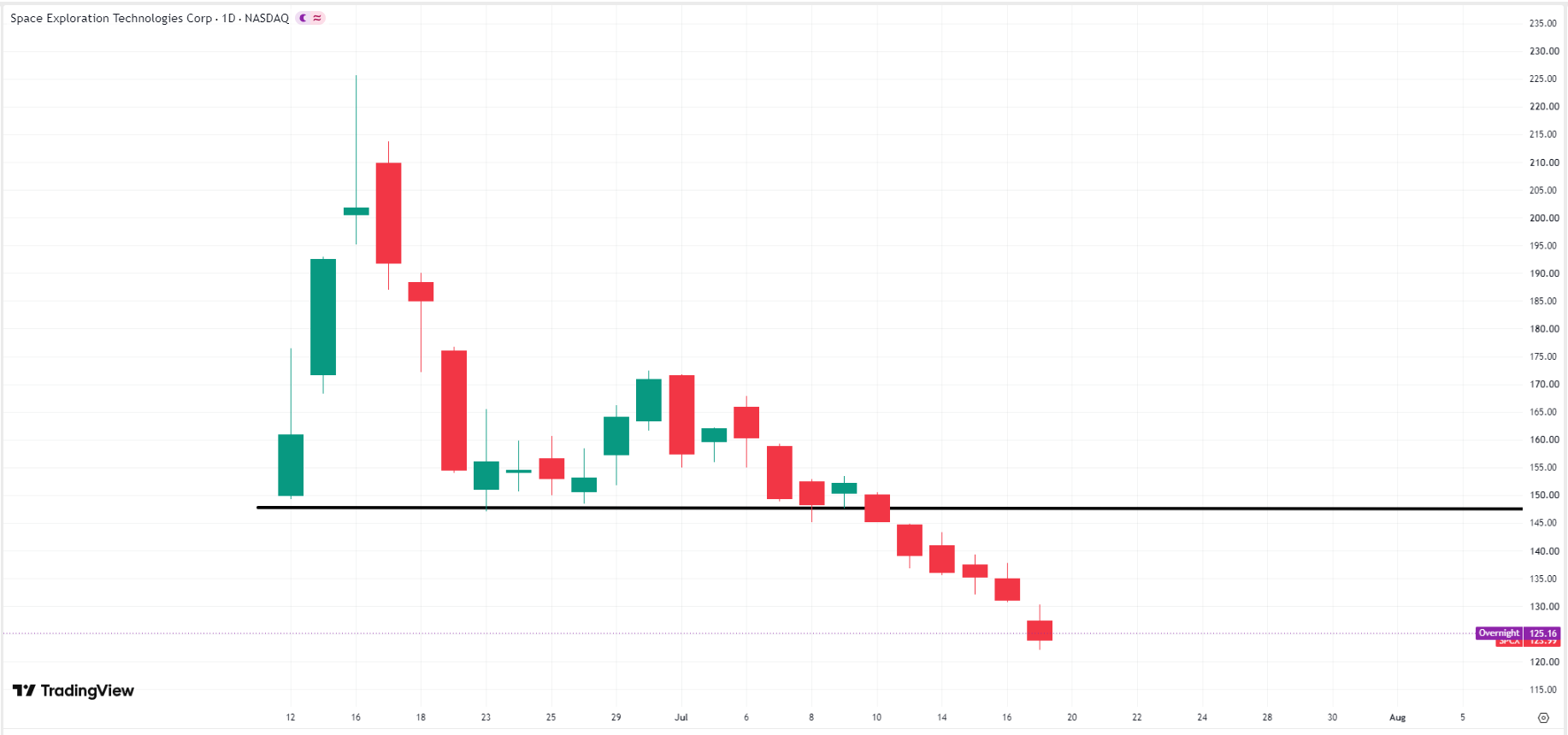 SpaceX stock price chart, Source: TradingView
Conversely, if Thursday's launch suffers another engine shutdown or disintegrates in mid-air, the stock price could plunge uncontrollably, falling straight toward the $100 psychological level or even into double digits. Until then, SpaceX is highly likely to continue consolidating at low levels. However, short-term investors should remain highly vigilant and avoid blindly stepping in to catch a falling knife before the launch results settle on Thursday.
Recommended Articles


