


Falls Over 4% Pre-Market as SpaceX Starship 13th Test Flight Aborted: Share Price May Test New Post-Listing Low
TradingKey - On Friday, SpaceX ( SPCX) tumbled over 4% in premarket trading, with its share price slipping below $130, and is expected to hit a new low since its listing after the opening bell.
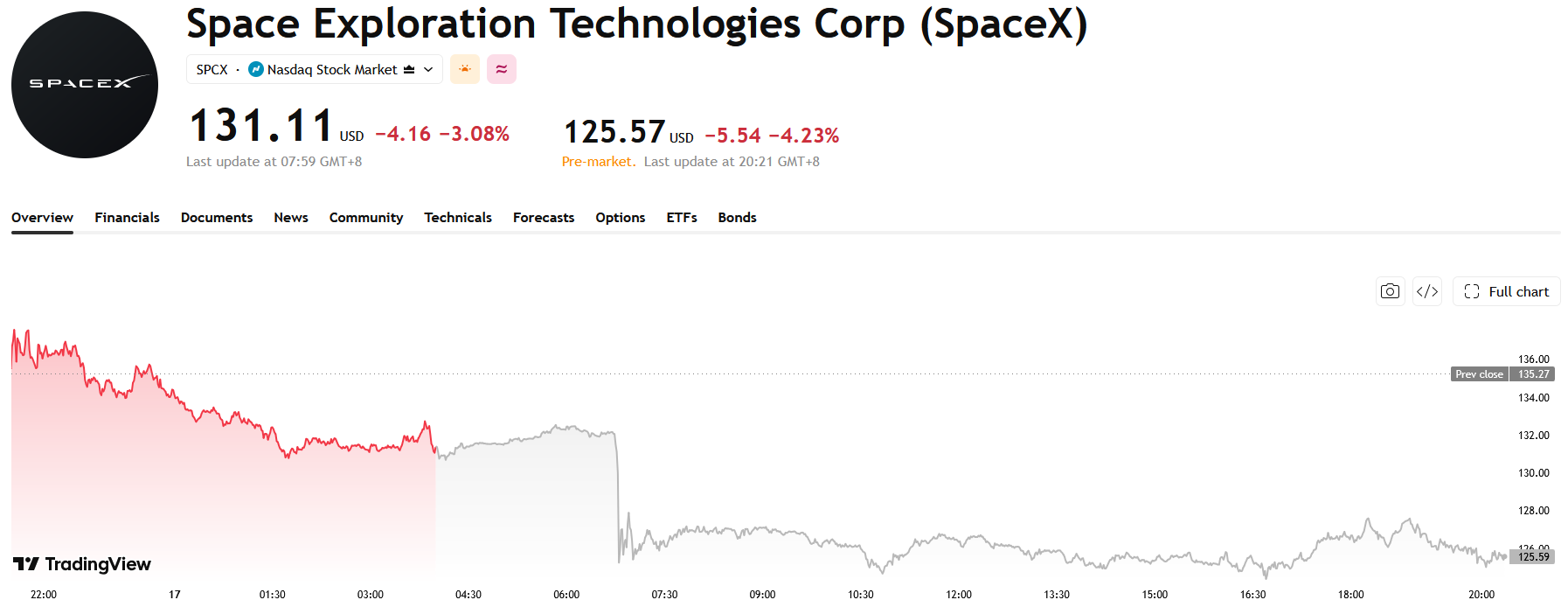
Source: TradingView
The catalyst was the last-minute cancellation of the company's scheduled 13th test flight of "Starship" just before launch. This was not only the second flight test of the Starship V3 configuration, but also SpaceX's first major test flight since completing its IPO, drawing significant market attention.
The temporary halt of the test flight once again raised investor concerns regarding the company's pace of technological advancement and short-term stock price performance.
Starship Launch Aborted at Final Moment, Musk Says Restart as Early as Next Week
According to the original plan, Starship was scheduled to open its launch window at 6:45 p.m. ET on July 16 (5:45 p.m. local Texas time) to conduct its 13th flight mission from the Starbase facility in southern Texas.
However, after the countdown entered its final stage, the launch system automatically aborted the ignition sequence due to an engine anomaly, and the rocket ultimately failed to clear the launch pad.
Subsequently, SpaceX founder Elon Musk stated on the social media platform X that some Raptor engines failed to start normally, triggering the system's automatic abort sequence.
The team has currently begun offloading propellant and plans to replace two engines to improve the reliability of the next launch. If subsequent inspections go smoothly, another launch attempt could be made as early as early next week.
SpaceX also stated that its engineering team will comprehensively investigate the cause of the failure and reschedule the launch after completing relevant testing.
In fact, this is not the first time Starship has experienced a launch setback.
During the 12th test flight in May this year, although Starship's upper-stage spacecraft successfully flew toward the Indian Ocean, the Super Heavy booster's primary guidance simulation Marg's intrinsically in the robot xl five-artner field's every move, due to 5 of the 33 Raptor engines failing to reignite, ultimately failed to achieve a controlled landing in the Gulf of Mexico.
The U.S. Federal Aviation Administration (FAA) subsequently ordered an investigation and did not approve SpaceX for subsequent test flights until Monday, requiring the company to implement four corrective measures, including software and hardware upgrades, during the interim. This launch abort once again exposed the reliability issues of Starship's engine system, particularly the stability challenges when multiple engines work in coordination.
Share Price Falls Below Offering Price, Market Reassesses SpaceX Short-Term Risks
For capital markets, the test flight cancellation occurred at a sensitive juncture.
Since completing its record-breaking IPO at $135 per share in June, SpaceX's stock price initially climbed rapidly but has since steadily pulled back. On Thursday, the company's stock closed below its offering price for the first time, at $131.11; following the announcement of the test flight cancellation, trading in after-hours and pre-market sessions continued to weaken, indicating a further cooling of investor sentiment.
The market is paying close attention to the Starship program not only because it is critical to SpaceX's future deep space exploration plans, but also because the Starlink satellite internet business is highly dependent on Starship's large-scale launch capacity.
As the weight of third-generation Starlink satellites continues to increase, only Starship can provide sufficient payload capacity; therefore, the development and launch progress of Starship directly affects the pace of future satellite deployment and the speed of Starlink's commercial expansion.
Recommended Articles


