


Gemini 3.5 Pro Delay of Several Months Sparks Market Concerns, Google Left Behind by OpenAI in AI Programming Track?
TradingKey - As the core product of Alphabet's ( GOOGL) ( GOOG) artificial intelligence strategy, Gemini 3.5 Pro was originally highly anticipated by the market. However, according to multiple people familiar with the matter, the release of this flagship model has been postponed by several months from its original schedule.
Following the news, market concerns over Google's AI competitiveness quickly intensified, with Alphabet's stock price falling over 4% on the day, and continuing to slide more than 1% in subsequent overnight trading.
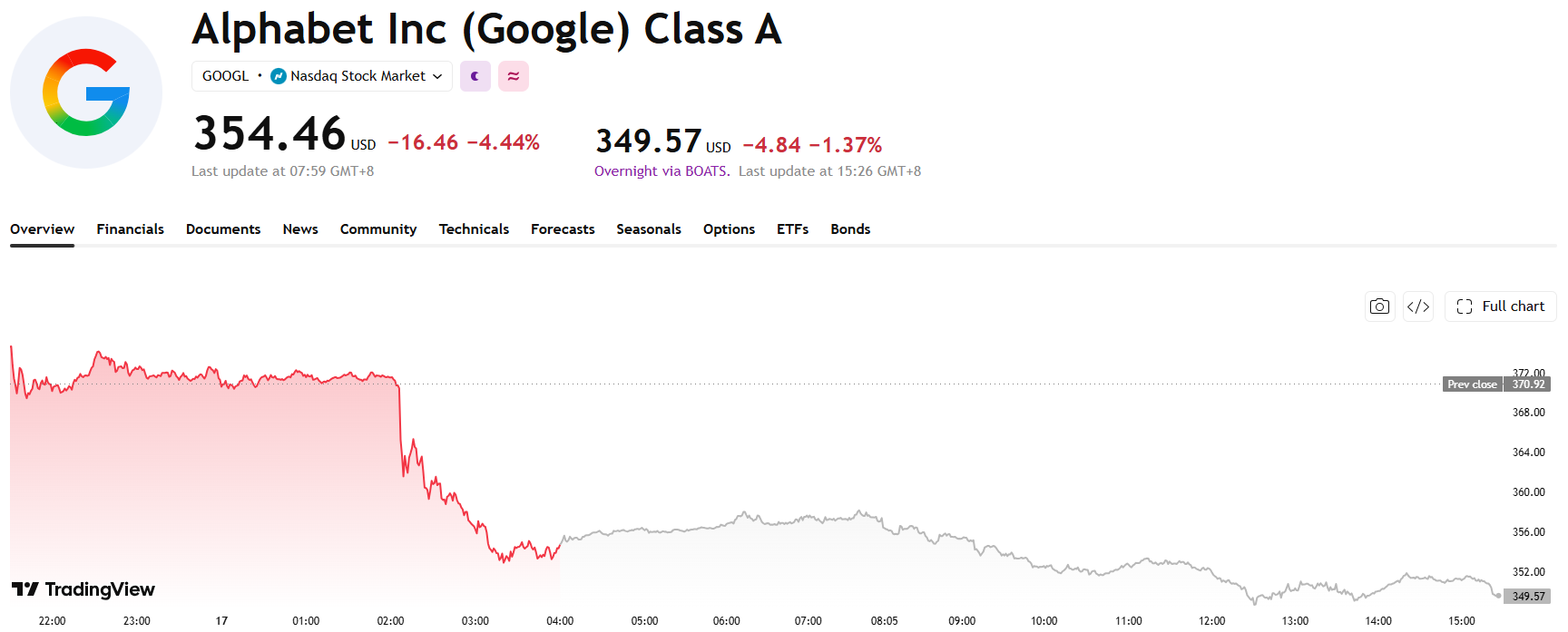
Source: TradingView
It is understood that the delay is not due to product roadmap adjustments, but rather Google's desire to continue improving the model's overall capabilities, particularly in AI coding, which is currently the most fiercely contested area.
Gemini 3.5 Pro was originally scheduled for release in June this year, with Google CEO Sundar Pichai hinting at the plans during the I/O developer conference in May. In an effort to catch up with competitors' lead in the AI coding space, Google updated the model's training data late last month, but the test results fell short of expectations, forcing a delay in the release process.
For Google, this means it is facing growing time pressure. Over the past few months, OpenAI, Anthropic, and Meta have successively launched next-generation models, continuously setting new industry benchmarks in intelligent coding, agents, and complex reasoning capabilities, which has gradually eroded Gemini's previous competitive edge.
Currently, Google is testing the model with partners and remains in communication with the U.S. government regarding AI safety standards, but has not yet announced a new release timeline.
OpenAI Leads AI Programming Track, Google Pressure to Catch Up Continues to Mount
Over the past few months, competition in large models has gradually shifted from general chat capabilities to coding, agents, and complex reasoning, with OpenAI continuously expanding its lead.
Recently, OpenAI has continuously upgraded its GPT series models and built a complete developer ecosystem around Codex Agent, enterprise development tools, and IDE workflows. This enables AI to not only generate code but also participate in the entire software development lifecycle, including requirements analysis, code debugging, testing, and project collaboration. Leveraging its leading model capabilities and mature developer ecosystem, OpenAI is further solidifying its dominant position in AI coding.
Meanwhile, Anthropic continues to win the favor of developers and enterprise clients thanks to the robust performance of its Claude series models in long-form code generation, complex engineering tasks, and enterprise-grade software development. The next-generation models released by Meta also focus heavily on enhancing agentic coding capabilities, aiming to capture the developer market.
By contrast, although Google has multiple R&D teams including DeepMind, Google Cloud, and Android, pursuing multiple technological paths in parallel has fragmented its resources.
Meanwhile, differing technical philosophies still persist internally within the company.
Some senior engineers maintain that core code should be written primarily by humans to ensure engineering quality and safety standards.
During the early stages of AI adoption, Google also restricted employees from using Gemini to write or analyze internal code, primarily out of concern that proprietary corporate code would enter model training data. Although these restrictions were later gradually relaxed, they still, to some extent, slowed down the pace of internal exploration of AI coding tools.
Gemini's recent delay, to some extent, reflects Google's desire to narrow the performance gap with OpenAI and Anthropic as much as possible before the official release, particularly in coding capabilities, which dictate the competitiveness of the developer ecosystem.
External Competition Escalates, Internal R&D Pace Slowed by Complex Organization
According to several current and former employees, delays with Gemini have triggered visible anxiety within the company. Many engineers, AI researchers, and managers worry that if the flagship model is repeatedly delayed, Google could further lose its voice in the generative AI space.
Beyond the need to further optimize the model itself, Google's massive organizational structure is also a major factor affecting product advancement.
Unlike most AI startups, Gemini is not merely a standalone model; it must be deeply integrated with a vast array of core businesses including Search, YouTube, Maps, Workspace, and Cloud. Consequently, every major release requires coordination across multiple departments and stakeholders, making the entire process far more complex than it appears to the outside world.
One former employee described pushing AI projects within Google as akin to 'trying to quickly turn a massive ship.' When multiple teams push similar projects simultaneously and product directions are constantly adjusted, resources can easily be diluted, reducing the execution efficiency of a unified strategy.
Following the sudden emergence of ChatGPT in late 2022, Google briefly entered a so-called 'Code Red' state, hoping to bypass internal bureaucracy and accelerate product iteration. However, people familiar with the matter said that now that the AI race has become a daily reality for the company, organizational efficiency remains an issue that is difficult to fully resolve.
AI Race Enters New Phase of Competing on Execution
The delay of Gemini 3.5 Pro reflects not just a slowdown in the development progress of a single product, but also signifies the new challenges Google faces in the AI era.
The company boasts the industry's richest data resources, the world's largest internet product ecosystem, and leading AI infrastructure. However, its massive organizational structure, complex product synergy, and increasingly fierce industry competition also make it difficult to timely translate technological advantages into product advantages.
For investors, the key focus going forward is no longer just about when Gemini 3.5 Pro will be officially released, but whether Google can leverage its next-generation models to narrow the gap with OpenAI and Anthropic, and continue to integrate AI capabilities into its core businesses such as search, cloud computing, and advertising, thereby further consolidating its competitive position in the generative AI era.
Recommended Articles


