


Netflix Stock Price Forecast: Why Did Stock Price Fall 9% on Q2 Earnings Growth? Can Stock Price Still Rise?
TradingKey - As of July 16 ET, Netflix ( NFLX) stock was last at $74.35, up 0.91% on the day, touching an intraday high of $74.68. However, after the company released its second-quarter earnings report, its after-hours stock price plunged 9.05%.
Why Is Netflix Stock Falling?
The core reason for the post-market decline in Netflix's stock price was that both its second-quarter revenue and third-quarter guidance failed to significantly beat market expectations. According to the earnings report, Netflix's Q2 revenue was $12.56 billion, up approximately 13% year-over-year, but slightly below the market expectation of $12.58 billion; net income was $3.4 billion, up from $3.13 billion in the prior-year period; and earnings per share was $0.80, slightly beating the market expectation of $0.79.
The data shows that while the company's profitability remains strong, its revenue and future guidance disappointed the market. The company expects third-quarter revenue of approximately $12.9 billion, below the market expectation of about $13 billion; its third-quarter EPS guidance of approximately $0.82 also fell short of the market consensus of $0.84. For a streaming giant long considered by the market to be a high-quality growth stock, a slight earnings beat is not enough to offset the pressure from weak revenue guidance.
Another factor weighing on the stock price is that Netflix is further reducing its disclosures of subscriber and viewership data. The company had previously stopped regularly disclosing subscriber counts and plans to change its "What We Watched" viewership report from biannual to annual in the future. Although management wants to steer the market to focus more on revenue, margins, and cash flow, amid slowing growth, reduced transparency is easily interpreted by investors as a sign that subscriber growth and watch time may no longer be as robust as in the past.
In addition, Netflix's stock price had already priced in high growth expectations. The advertising business, live sports, the paid sharing crackdown, and price hikes had all supported the market's optimistic outlook for the company's future revenue growth. However, the latest earnings report indicates that while the advertising and live sports businesses are still progressing, they have not yet fully relieved the pressure of a slowing overall revenue growth rate. Consequently, investors chose to take profits following the earnings release, leading to a significant decline in the stock price after-hours.
Can Netflix Stock Still Rise?
From a medium- to long-term perspective, Netflix's stock price still has a foundation for gains, but it needs to reprove the quality of its growth. Netflix remains one of the most profitable platforms in the global streaming industry, with second-quarter net profit reaching $3.4 billion, indicating that the company still holds an edge in content investment, cost control, and subscriber monetization.
Whether Netflix's stock price can rebound in the future first depends on whether its advertising business can continue to scale up. The company expects full-year advertising revenue of approximately $3 billion. Although this scale remains small relative to total revenue, the significance of the advertising business lies in unlocking a second growth curve. As low-priced ad-supported plans reach more users, Netflix can raise its revenue ceiling beyond subscription fees through ad inventory, brand advertising, and live content monetization. If the advertising business grows faster than market expectations, it will help restore investor confidence.
Secondly, live content and sports events could serve as new growth catalysts. Netflix is ramping up its layout in live sports, variety shows, and major events. Such content can boost user engagement, reduce churn rates, and enhance the appeal of its advertising business. Compared to traditional series and movies, live content possesses greater immediacy and social propagation effects, helping Netflix expand its advertiser reach.
In addition, AI applications could also improve platform efficiency. Netflix is utilizing large language models to optimize search and recommendation experiences, and is testing features like voice search and natural language search. In the short term, AI's contribution to revenue is limited, but in the long term, it could improve user retention, content distribution efficiency, ad matching capabilities, and content production efficiency. If AI can help Netflix increase the return on investment per unit of content spend, it will also support margins and valuation.
However, for Netflix's stock price to rebound, it cannot rely solely on long-term narratives; it also needs subsequent earnings reports to deliver stronger revenue guidance. If third- and fourth-quarter revenue continues to fall short of market expectations, investors may further question the company's growth momentum. Conversely, if advertising revenue accelerates and live content drives new subscriber acquisition while margins remain stable, Netflix's stock price still has a chance to recover from its post-earnings decline.
Technical Analysis of Netflix Stock Price Trend
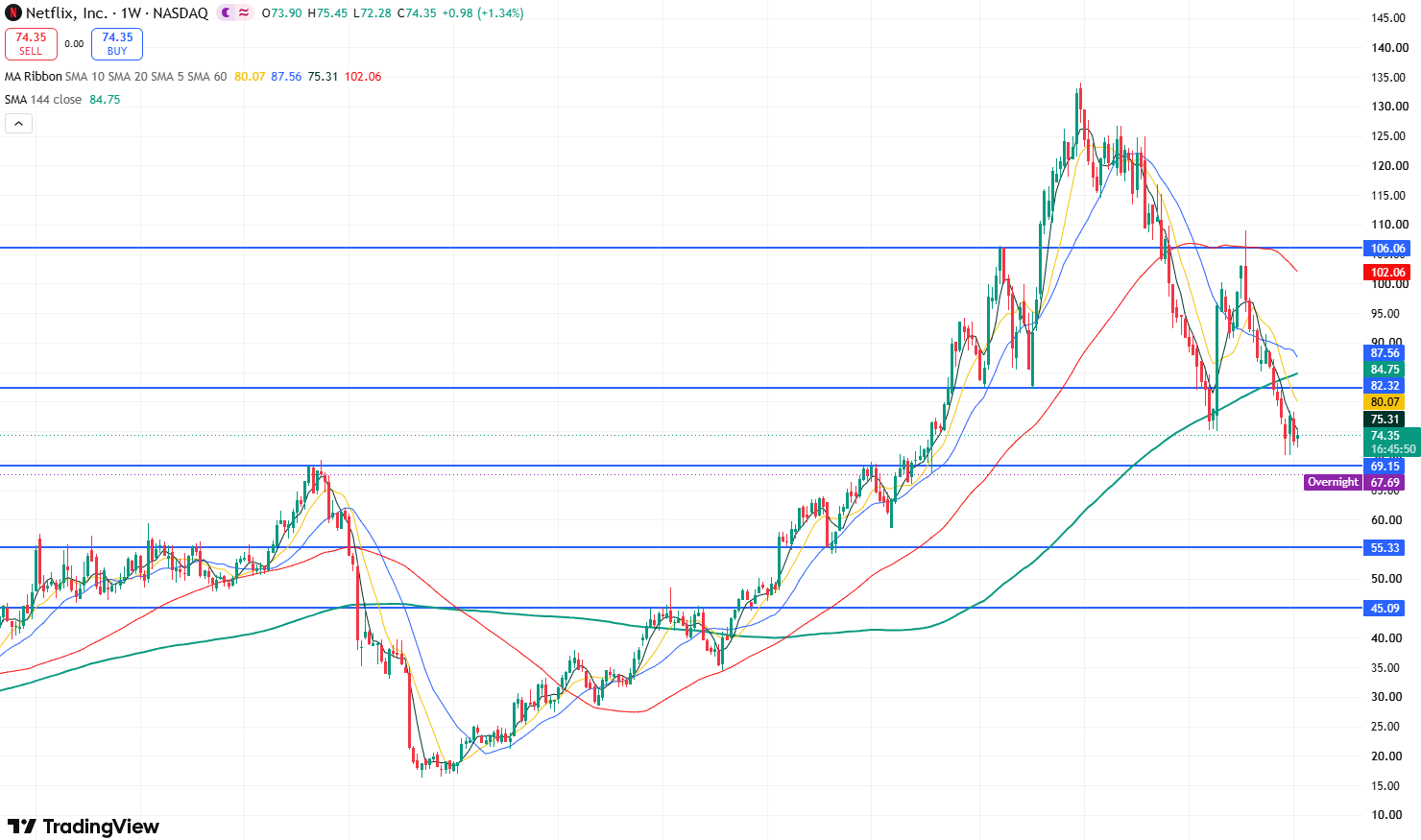
Netflix stock price weekly chart, Source: TradingView
Judging from Netflix's weekly stock price chart, after hitting an all-time high of $134.12 in June 2025, the stock price continued to correct. As the stock broke below the key support level of $82 in February this year, bullish momentum was significantly weakened, and market sentiment gradually turned bearish. Subsequently, the stock price weakened again after a rebound, and after breaking below the February low of $75, bearish momentum was further strengthened.
Currently, the overall trend of the stock price leans downward, with the primary support below to watch at $69. If this level fails to hold, the stock price may enter a deeper correction phase, potentially testing near the $55 support level, and could even fall further toward $45.
On the upside, the primary resistance range above to watch is $76-$82. If the stock price can effectively break through this range and establish a firm foothold above $82, the upside potential will be unlocked, opening the door to test the resistance level near $106, and further up, to test the all-time high of $134.12.
Recommended Articles


