


Micron Technology (MU) Stock Forecast: AI Memory Boom Keeps Bulls Focused on $1,100 After Trendline Rebound
TradingKey - Micron Technology (NASDAQ: MU) is now at $934.33, and the 4-hour chart shows a massive bounce off ascending trendline support as buyers returned to the stock following a small correction. This rebound comes after Micron delivered another quarter of all-time record results thanks to record demand for HBM for AI. In previous cycles for memory, consumer electronics have played a huge role, but this time around it is driven by hyperscale data centers, sovereign AI data centers, and enterprise GPU data centers. With HBM fully sold out through 2027, expanding customer demand, and another quarter of aggressive guidance, Micron has been the biggest beneficiary of the strongest demand environment the semiconductor industry has experienced.
Micron AI Leadership Reinforced by Record Earnings
Micron released one of the most impressive quarterly results of its history for fiscal Q3 2026: Revenues of $41.46 billion up 346% from a year ago and up 74% from last quarter. The massive sequential revenue gain reflects an explosive rate of AI infrastructure growth from hyperscalers and other data center customers. GAAP net income reached $28.24 billion, while non-GAAP earnings climbed to $28.86 billion. The strong performance shows that Micron generated enormous incremental profits on revenue growth from much higher ASP pricing and much higher HBM content mixed with strong demand for HBM and a focus on disciplined supply management.
DRAM remains the largest earnings driver as Micron sold $31.3 billion of DRAM, which accounts for 3/4 of revenues. Strong AI server shipments have allowed Micron to sell higher volumes of DRAM at higher prices. NAND revenues rose to $9.9 billion as Micron benefitted from higher price realizations across enterprise SSDs and high-performance SSDs. Data Center was again the fastest growing market segment with $25 billion of revenue as enterprise SSD shipments of nearly $5 billion were a significant portion of the total.
AI clusters have become ubiquitous and demand for advanced memory is expected to grow significantly as cloud hyperscalers deploy additional clusters and AI accelerators alongside next-gen GPUs. Gross margin reached approximately 85% compared with 38% a year earlier. Higher HBM shipments, improved yields, and better pricing allowed Micron to grow its profitability much more than it grows revenue.
Micron’s balance sheet is incredibly strong. Q3 generated record $25.39 billion of operating cash flow and $18.09 billion of adjusted free cash flow. With over $30 billion in liquidity at the end of Q3, management was able to significantly increase production of HBM without materially affecting financial risk. More importantly, Micron will be able to continue to secure strategic supply agreements with large hyperscalers and other AI companies. Micron has secured roughly $22 billion in financial commitments with a total of approximately $100 billion in contracted multi-year revenue. This gives the company incredible visibility into future demand from the hyperscale and other data center segments.
HBM Demand Continues Supporting Long-Term Growth
For Micron, the central theme in our AI cycle investing framework remains high-bandwidth memory, which is now among the primary building blocks of next-generation AI accelerators. Management indicates its capacity is sold out through 2026, 2027, and customers have booked into 2028. Micron's latest HBM4 products have a total bandwidth of more than 2.8 TB/s and are now in mass production for next-generation AI systems and also have begun sampling higher-capacity variants to support the deployment of larger AI training centers.
The company is still transitioning to its latest 1γ (gamma) DRAM and G9 NAND technologies, with the expectation these products will have lower production costs and deliver a better value proposition. Micron's gross margin can still be maintained with normal prices in the latter half of this cycle. Capital expenditures for fiscal year 2026 are expected to increase to around $27 billion, and in fiscal 2027, capital expenditures are expected to increase to above the mid-$40 billion as supply is being built to meet future demand.
Despite the remarkable run in MU stock price, the share price is also supported by earnings growth and is still trading at a 22 trailing P/E ratio. Looking forward, earnings growth is still expected to be rapid given the demand profile and the multiple is expected to fall to 6-7 as earnings grow. Analysts remain bullish on the stock with earnings estimates still indicating significant gains from the current levels of MU as we do not foresee AI demand growth slowing in the near term. Even in a cyclical semiconductor environment, the demand profile for Micron continues to be supported by the AI cycle rather than just inventory replenishment cycles as was the case over the past few years.
There are still risks for Micron and these include a potential cyclical downturn and oversupply for memory, geopolitical risks related to China for the company, and its ability to execute on its large build-out of semiconductor manufacturing facilities. But given the customer commitments and the high supply constraint of high-bandwidth memory within the industry for now, we do not expect a sudden downturn from supply.
MU Technical Analysis: Ascending Trendline Keeps Bulls in Control
As MU tested its trendline on the 4H again and formed another bullish candle (3.55%) with increased volume on a rebound from its previous trendline support on a higher low formation pattern. The price has now formed a sequence of higher lows, with buyers continuing to be active during the current consolidation.
The recent bullish candle has helped absorb selling pressures, and the recent uptrend is supported by buyers' participation near its current support levels.
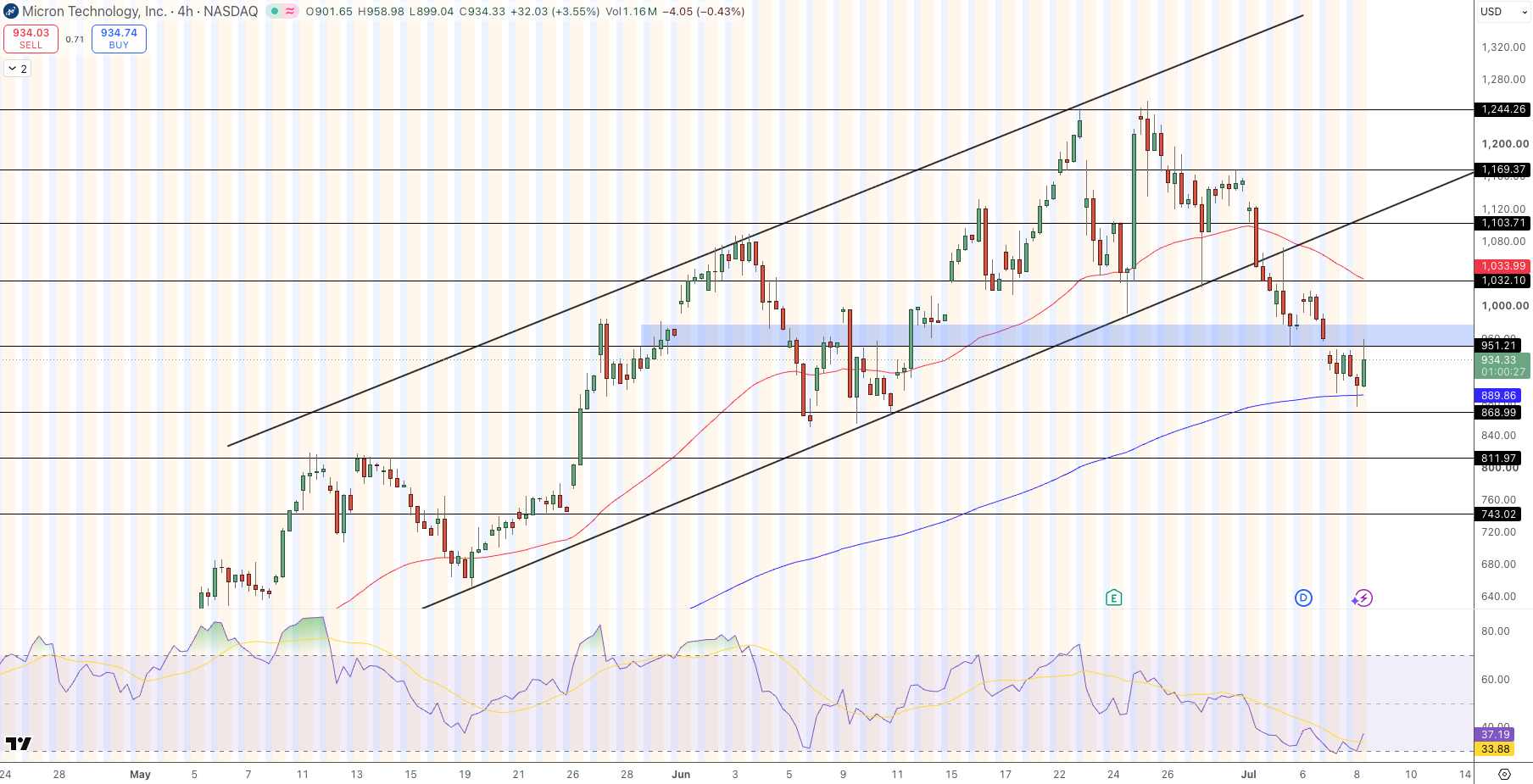
Micron Technology (MU) Stock Price Chart - Source: Tradingview
RSI (14) is currently at 37 and is about to reach oversold levels but also started to diverge on recent lower lows, which implies an increased probability for an improved price action. As long as the price remains above its trendline support (between $889 to $849) which is also aligned with previous demand zones, it suggests a continuation of the uptrend, with resistance seen around the upper channel target of $1,033 and $1,103.
Trade Setup
Entry: Long above $1,014Target: $1,100Stop Loss: Close below $889
A close above $1,014 confirms continued momentum and increased odds for the bullish thesis to play out as price moves towards resistance.
Why Is Micron Benefiting More Than Previous Memory Cycles?
Unlike prior memory cycles which were led by PCs and smartphones, this one is led by the buildout of AI infrastructure. High bandwidth memory is crucial for next-gen AI accelerators and thus has much greater pricing power and customer stickiness than typical memory offerings.
Is Micron's Valuation Still Reasonable?
Sure, Micron's market cap is much higher than in the past, but earnings growth has also increased at a much faster pace. Forward valuation remains attractive relative to earnings, assuming AI infrastructure buildout continues at its current pace.
Bottom Line
With record top and bottom line growth, a backlog of HBM orders and multi-year customer contracts as well as a solid technical structure that has yet to break its key uptrend, Micron heads into the second half of 2026 with momentum both fundamental and technical on its side. Micron is in one of the best growth sectors in the semiconductor space, AI, and the charts tell that story: buyers continue to step in along the uptrend support line with the overall bullish trend still in place. The stock only needs to close back above $1,014 and the stage may be set for the next leg higher toward $1,103. Micron will benefit in a major way from the on-going need for high-bandwidth memory from AI infrastructure buildouts.
Recommended Articles


