


After Plummeting 27% in 2026, Is Palantir Stock Finally a Buy? 3 Words From Palantir CEO Alex Karp May Reveal the Answer
Key Points
Palantir specializes in developing comprehensive data visualizations called ontologies.
According to Palantir CEO Alex Karp, other SaaS vendors are beginning to copy Palantir's ontology approach.
While rising competition could be a headwind for Palantir, the overall market for AI-driven software should expand as new use cases and entrants emerge.
- 10 stocks we like better than Palantir Technologies ›
In a recent appearance on CNBC, Palantir Technologies (NASDAQ: PLTR) CEO Alex Karp discussed why the company's approach to artificial intelligence (AI) stands apart from legacy software-as-a-service (SaaS) providers.
At a basic level, Palantir develops something called an ontology. Ontologies are structured models that define key inputs -- employees, assets, transactions, or events -- along with the underlying properties and relationships that connect them within an organization. This creates a living visualization that AI can use to understand context and make decisions.
Where to invest $1,000 right now? Our analyst team just revealed what they believe are the 10 best stocks to buy right now, when you join Stock Advisor. See the stocks »
This approach differs markedly from traditional dashboarding tools or generic data insights workflows found in many legacy platforms. It's not surprising that Karp suggested that "now everyone's copying" Palantir's playbook.
Image source: Getty Images.
By grounding AI-driven insights in an organization's own defined logic and key relationships, Palantir's software has proven to reduce friction commonly found in less sophisticated application layers. In turn, the AI revolution has propelled Palantir from a relatively unknown software vendor to a more embedded operational intelligence command center across government agencies and Fortune 500 companies.
Breaking down Palantir's competitive dynamics
Prior to the AI revolution, Palantir was largely viewed by Wall Street as a government contractor whose software was primarily used by the Department of Defense (DOD). What most analysts didn't fully grasp is that Palantir spent nearly 20 years perfecting its ontology model tailored for enterprise and government needs.
But in early 2023, Palantir publicly launched its Artificial Intelligence Platform (AIP) -- an ecosystem that stitches together its three core platforms, Foundry, Gotham, and Apollo. By doing so, Palantir was swiftly positioned to capture market share from incumbent software providers, as the company offered an end-to-end platform for handling sensitive data, building secure integrations, and providing time-to-value in complex deployments.
This first-mover status in the ontology space helps create strong customer relationships and a foundation of operational knowledge that competitors couldn't replicate quickly.
Is more competition bad for Palantir?
Smart investors understand that when a core idea is replicated, some of the exclusivity from the incumbent begins to diminish. The reason is that customers now have more optionality -- potentially leading to pricing pressure or more frequent customization demands.
Nevertheless, Karp was subtly alluding to the fact that Palantir's software is being validated by a broader adoption of ontology-based approaches across the SaaS industry. This could be a positive because increased competition frequently accelerates new innovation.
Moreover, the broader addressable market for AI software continues to expand. Growing enterprise interest in reliable data analytics is creating a larger opportunity. As more organizations move beyond basic dashboarding tools and siloed systems toward more comprehensive platforms that support complex, AI-assisted decisions, demand should increase across the entire SaaS landscape.
This expansion will benefit the companies delivering the strongest outcomes, even as the field becomes more crowded. Against this backdrop, imitation of Palantir's ontology signals rising interest in these capabilities rather than a direct subtraction from the company's long-term potential.
Should you buy the dip in Palantir stock?
Investors evaluating whether copying Palantir's ontology approach warrants concern should weigh execution from rising competition over the act of replication itself. An expanding overall opportunity provides room for multiple winners in the long run, meaning that relative market-share shifts should not necessarily translate into absolute revenue and profit deceleration for Palantir.
The greater long-term risk for Palantir lies in failing to capitalize on validated demand rather than in competition finally recognizing the same opportunity. In other words, the trend of broader ontology adoption should serve more as confirmation of the direction Palantir has been pursuing than as a signal of diminished growth trajectory.
Data by YCharts.
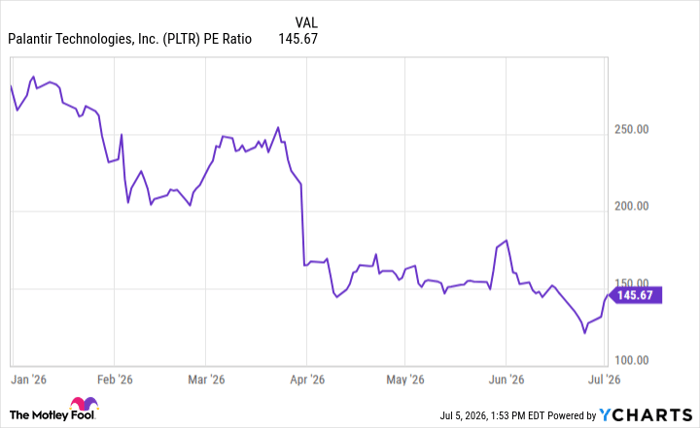
Even with a growing opportunity and validated systems, Palantir's price-to-earnings (P/E) multiple hovers around 146 -- nearly 4 times the S&P 500 Information Technology Sector's P/E Ratio. These trends suggest that even with the sell-off this year, Palantir stock remains pricey.
I think the most prudent action for investors is to wait until Palantir and its peers report second-quarter earnings in a few weeks. By doing so, investors may learn in more detail about what Palantir is starting to see in sales cycles and how emerging competitors are responding.
All told, I think Karp's words suggest that Palantir is onto something big -- making the stock a compelling opportunity. However, I think prices will be more reasonable for buying shares over time.
Should you buy stock in Palantir Technologies right now?
Before you buy stock in Palantir Technologies, consider this:
The Motley Fool Stock Advisor analyst team just identified what they believe are the 10 best stocks for investors to buy now… and Palantir Technologies wasn’t one of them. The 10 stocks that made the cut could produce monster returns in the coming years.
Consider when Netflix made this list on December 17, 2004... if you invested $1,000 at the time of our recommendation, you’d have $418,761!* Or when Nvidia made this list on April 15, 2005... if you invested $1,000 at the time of our recommendation, you’d have $1,195,804!*
Now, it’s worth noting Stock Advisor’s total average return is 918% — a market-crushing outperformance compared to 208% for the S&P 500. Don't miss the latest top 10 list, available with Stock Advisor, and join an investing community built by individual investors for individual investors.
See the 10 stocks »
*Stock Advisor returns as of July 7, 2026.
Adam Spatacco has positions in Palantir Technologies. The Motley Fool has positions in and recommends Palantir Technologies. The Motley Fool has a disclosure policy.
Recommended Articles


