

AI Storage Leader SK Hynix to List ADRs in US, UBS Recommends Arbitrage Strategy: Buy ADRs and Sell Korean Shares

Source Tradingkey

TradingKey - SK Hynix officially launched its global roadshow for American Depositary Receipts (ADRs) this Monday, planning to issue ADRs representing approximately 17.79 million common shares. Based on last Friday's closing price in Seoul, the size of this fundraising is approximately $28 billion.

The South Korean memory chip giant's stock price has surged more than 230% cumulative this year, with its market value surpassing $1 trillion. Its debut on Nasdaq is viewed as a landmark event in the capitalization process of the global chip industry amid the AI wave.
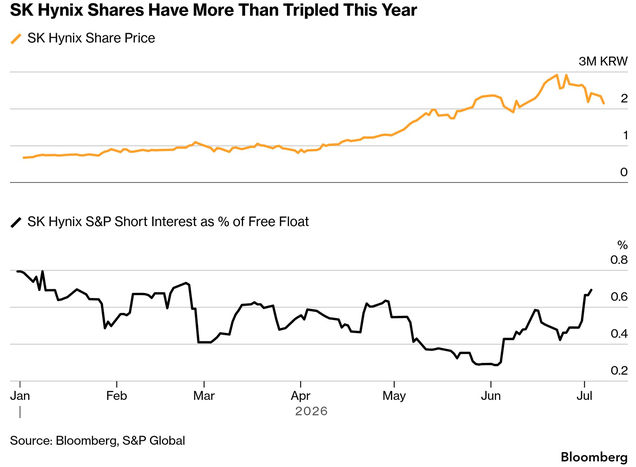
sk-5672792c45e84cb1a2f8bc0d30420ab6

Source: Bloomberg, S&P Global

UBS Group ( UBS) proposed a highly attractive arbitrage strategy in its latest client report: go long on SK Hynix ADRs while shorting its shares listed domestically in South Korea, suggesting this trade carries extremely low risk and significant scale.

The Premium Logic of SK Hynix ADRs

UBS's strategy is built on the expectation that the ADRs will trade at a premium to the local Korean shares. The report points out that institutional investors, such as hedge funds, will prefer holding ADRs due to their higher operational efficiency and lower holding costs, particularly showing clear advantages in settlement, taxation, and liquidity management.

More importantly, global retail investors have an extremely low ownership of SK Hynix's Korean shares, and the launch of the ADRs will significantly improve access for this investor segment. Although some US brokerages have recently opened trading channels for Korean stocks to overseas retail investors, UBS believes this change is too recent, and global retail ownership of SK Hynix remains low, making ADRs the preferred way for them to participate in this AI memory leader.

Uncertainty in the share conversion mechanism further reinforces the premium expectations. According to US Securities and Exchange Commission (SEC) filings, ADR holders can cancel them and exchange them for local Korean shares, but the reverse conversion may require approval from Korean regulators and is not guaranteed to be seamless.

UBS pointed out that without the flexibility of two-way conversion, inefficient conversion channels could lead to ADRs trading at a significant premium over the long term. The fact that TSMC's ADR traded at an average premium of about 16% to its local Taiwan shares this month provides a real-world reference for this premium structure.

The dual dividend of valuation recovery and passive capital inflows

SK Hynix's primary objectives for this listing are valuation recovery and capacity expansion. Leveraging its global leadership in the High Bandwidth Memory (HBM) sector, the company holds approximately a 58% market share. Its revenue exceeded 97 trillion KRW in 2025, and its net profit for the first quarter of 2026 surged by 406% year-over-year, with a net profit margin reaching as high as 77%.

The funds raised will be allocated to domestic semiconductor capacity construction, including an investment of 100 trillion KRW (approximately $64.38 billion) to build new chip factories, as well as the procurement of Extreme Ultraviolet (EUV) lithography machines from ASML in the Netherlands. Simultaneously, the South Korean government has launched a large-scale industry support initiative, with President Lee Jae-myung directing an acceleration of the approval process to facilitate the implementation of a $576 billion chip project in the southwestern region.

Currently, SK Hynix's forward 12-month price-to-earnings (P/E) ratio stands at 6.2x, lower than Micron Technology's 7x; its forward price-to-sales (P/S) ratio is 3.6x, which is also below Micron's 4.6x.

Following its Nasdaq listing, SK Hynix is expected to be included in the Nasdaq 100 Index, triggering systematic buying by passive funds. The Invesco QQQ Trust, which solely tracks this index, manages assets as high as $482 billion; its inclusion will therefore generate substantial passive capital inflows.

An analysis by HSBC suggests that the offering price is attractive to U.S. investors, with an expected upside of approximately 20% for the stock price post-listing.

The CEO of Roundhill Investments pointed out that SK Hynix has been one of the world's most important companies that U.S. institutions have found difficult to hold directly, and this listing eliminates the "accessibility discount." A chief portfolio manager at investment firm Synovus Trust also believes that listing in the world's largest capital market will help address the undervaluation of SK Hynix.

Hidden Concerns Behind High Growth

Despite the market's high anticipation for SK Hynix's listing, risks cannot be ignored; with recent selling pressure hitting U.S. chip stocks, SK Hynix's performance in its U.S. listing is seen as a key bellwether for the direction of the AI bull market.

As Samsung Electronics also pushes forward with large-scale capacity expansion, market concerns over future oversupply are intensifying.

The CEO of asset management firm Riverwealth Advisors pointed out that investors are taking on the risk of a potential speculative bubble. Furthermore, while SK Hynix's net profit is projected to surge in 2026, it also means the market has priced extremely high growth expectations into the stock, and any performance falling short of expectations could trigger a sharp correction in the stock price.

As a global leader in the AI memory chip sector, the semiconductor industry's inherent cyclical fluctuations, potential oversupply risks, and the sustainability of the AI investment boom remain issues that the market needs to watch closely.

While UBS's arbitrage strategy appears attractive, investors still need to carefully assess the risks and rewards involved.

Disclaimer: For information purposes only. Past performance is not indicative of future results.
placeholder
Bitcoin CME gaps at $35,000, $27,000 and $21,000, which one gets filled first?Prioritize filling the $27,000 gap and even try higher.
Author  FXStreet
Aug 22, 2023
Prioritize filling the $27,000 gap and even try higher.
placeholder
Pinduoduo Earnings Incoming: Morgan Stanley Sees Long-Term Profit Potential​Insights – On November 21, Chinese e-commerce giant Pinduoduo (PDD) will release its Q3 2024 earnings.
Author  Mitrade
Nov 20, 2024
​Insights – On November 21, Chinese e-commerce giant Pinduoduo (PDD) will release its Q3 2024 earnings.
placeholder
Elon Musk’s xAI and Neuralink Launch New Funding Rounds​Billionaire Elon Musk recently raised funds for his two high-profile tech companies, xAI and Neuralink.
Author  Insights
Jun 03, 2025
​Billionaire Elon Musk recently raised funds for his two high-profile tech companies, xAI and Neuralink.
placeholder
Bitcoin briefly loses 2025 gains as crypto plunges over the weekend.Bitcoin experienced a sharp decline this weekend, briefly erasing its 2025 gains and dipping below its year-opening value of $93,507. The cryptocurrency fell to a low of $93,029 on Sunday, representing a 25% drop from its all-time high in October. Although it has rebounded slightly to around $94,209, the pressures on the market remain significant. The downturn occurred despite the reopening of the U.S. government on Thursday, which many had hoped would provide essential support for crypto markets. This year initially appeared promising for cryptocurrencies, particularly after the inauguration of President Donald Trump, who has established the most pro-crypto administration thus far. However, ongoing political tensions—including Trump's tariff strategies and the recent government shutdown, lasting a historic 43 days—have contributed to several rapid price pullbacks for Bitcoin throughout the year. Market dynamics are also being influenced by Bitcoin whales—investors holding large amounts of Bitcoin—who have been offloading portions of their assets, consequently stalling price rallies even as positive regulatory developments emerge. Despite these sell-offs, analysts from Glassnode argue that this behavior aligns with typical patterns seen among long-term investors during the concluding stages of bull markets, suggesting it is not indicative of a mass exodus. Notably, Bitcoin is not alone in its struggles, as Ethereum and Solana have also recorded declines of 7.95% and 28.3%, respectively, since the start of the year, while numerous altcoins have faced even steeper losses. Looking ahead, questions linger regarding the viability of the four-year cycle thesis, particularly given the increasing institutional support and regulatory frameworks now in place in the crypto landscape. Matt Hougan, chief investment officer at Bitwise, remains optimistic, suggesting a potential Bitcoin resurgence in 2026 driven by the “debasement trade” thesis and a broader trend toward increased adoption of stablecoins, tokenization, and decentralized finance. Hougan emphasized the soundness of the underlying fundamentals, pointing to a positive outlook for the sector in the longer term.
Author  Mitrade
Nov 17, 2025
Bitcoin experienced a sharp decline this weekend, briefly erasing its 2025 gains and dipping below its year-opening value of $93,507. The cryptocurrency fell to a low of $93,029 on Sunday, representing a 25% drop from its all-time high in October. Although it has rebounded slightly to around $94,209, the pressures on the market remain significant. The downturn occurred despite the reopening of the U.S. government on Thursday, which many had hoped would provide essential support for crypto markets. This year initially appeared promising for cryptocurrencies, particularly after the inauguration of President Donald Trump, who has established the most pro-crypto administration thus far. However, ongoing political tensions—including Trump's tariff strategies and the recent government shutdown, lasting a historic 43 days—have contributed to several rapid price pullbacks for Bitcoin throughout the year. Market dynamics are also being influenced by Bitcoin whales—investors holding large amounts of Bitcoin—who have been offloading portions of their assets, consequently stalling price rallies even as positive regulatory developments emerge. Despite these sell-offs, analysts from Glassnode argue that this behavior aligns with typical patterns seen among long-term investors during the concluding stages of bull markets, suggesting it is not indicative of a mass exodus. Notably, Bitcoin is not alone in its struggles, as Ethereum and Solana have also recorded declines of 7.95% and 28.3%, respectively, since the start of the year, while numerous altcoins have faced even steeper losses. Looking ahead, questions linger regarding the viability of the four-year cycle thesis, particularly given the increasing institutional support and regulatory frameworks now in place in the crypto landscape. Matt Hougan, chief investment officer at Bitwise, remains optimistic, suggesting a potential Bitcoin resurgence in 2026 driven by the “debasement trade” thesis and a broader trend toward increased adoption of stablecoins, tokenization, and decentralized finance. Hougan emphasized the soundness of the underlying fundamentals, pointing to a positive outlook for the sector in the longer term.
placeholder
Gold Price Forecast: XAU/USD struggles to extend recovery above 20-day EMAGold price (XAU/USD) is down 0.8% to near $4,140 during the European trading session on Monday. The precious metal faces selling pressure as the three-day rally hits a pause after failing to extend above $4,202.
Author  FXStreet
Yesterday 10: 23
Gold price (XAU/USD) is down 0.8% to near $4,140 during the European trading session on Monday. The precious metal faces selling pressure as the three-day rally hits a pause after failing to extend above $4,202.
goTop
quote