

SK Hynix Has a Massive Warning for Sandisk Stock Investors

Source The Motley Fool

Key Points

  • Sandisk has been benefiting from the supply shortage in the NAND flash market.

  • SK Hynix plans to address the shortage by bringing additional capacity online.

  • Sandisk's momentum, however, is unlikely to be dented by capacity additions, given the massive AI-fueled demand for NAND flash.

  • 10 stocks we like better than Sandisk ›

Sandisk (NASDAQ: SNDK) stock has made investors significantly richer over the past year, delivering stunning gains of more than 3,660% as of this writing. The stock's phenomenal jump can be justified by the incredible increase in its revenue and earnings, fueled by the artificial intelligence (AI)-driven demand for storage chips.

The demand for the NAND flash chips that Sandisk sells has significantly outpaced supply. The supply shortage has resulted in a significant jump in NAND flash prices, powering Sandisk's growth in the process. However, a recent announcement by memory giant SK Hynix may dent the very catalyst that's fueling Sandisk growth.

Missed Nvidia in 2009? This Rare Signal Is Flashing Again. In 2009, a "Double Down" signal flashed for a little-known chipmaker called Nvidia. For the first time in years, that same "Total Conviction" signal is flashing for a company 1/100th the size of Nvidia. Continue »

Sandisk company name written in white font on a red background.

Image source: The Motley Fool.

SK Hynix plans to significantly increase NAND flash production

According to a recent report, SK Hynix is reportedly going to invest $51 billion to build a new NAND flash production facility in South Korea by 2029. The company intends to address the ongoing NAND flash supply shortage, which has been exacerbated by the rapidly rising demand for storage in AI data centers.

This seems like a red flag for Sandisk stock at first. After all, SK Hynix controls 18% of the global NAND flash market, according to Counterpoint Research. Sandisk, for comparison, has a 13% market share. Moreover, SK Hynix also sells dynamic random-access memory (DRAM), which explains why it has deeper pockets than Sandisk.

The South Korean semiconductor giant reported $35.5 billion in Q1 revenue. Sandisk, for comparison, has just over $13 billion in trailing-twelve-month revenue. So, SK Hynix is in a stronger position to move the needle in the NAND flash market, and the massive outlay that it is planning over the next three years could substantially increase supply.

Ideally, this should indeed be a cause for concern for Sandisk investors. However, a closer look at the dynamics of the NAND flash space suggests otherwise.

The additional supply is unlikely to dent Sandisk's momentum

The storage requirements of AI data centers are so strong that the market is expected to remain undersupplied through 2028. In fact, SK Hynix itself estimates that the shortage of memory chips could persist through the end of the decade despite the addition of new capacity. So, the price increases powering Sandisk's outstanding growth are unlikely to go away any time soon.
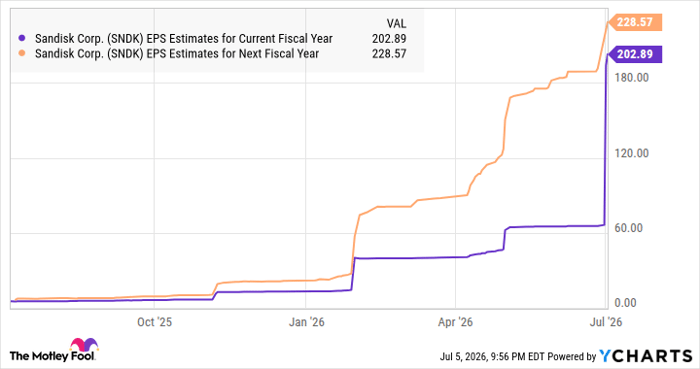
SNDK EPS Estimates for Current Fiscal Year Chart

Data by YCharts

According to Silicon Motion, a company that supplies NAND flash controllers, estimates that the shortage could get worse next year. That's the reason why market research firm TrendForce is now anticipating NAND flash industry revenue to increase to $379 billion in 2027, up significantly from the earlier estimate of $176 billion.

For comparison, the overall NAND flash revenue is anticipated to increase to $271 billion this year, up from $71.1 billion in 2025. So, the memory boom powering Sandisk's growth isn't going to disappear despite new capacity additions.

As such, investors looking to buy this AI stock can consider doing so even after its astronomical surge over the past year, especially given that it trades at an attractive 27 times forward earnings.

Should you buy stock in Sandisk right now?

Before you buy stock in Sandisk, consider this:

The Motley Fool Stock Advisor analyst team just identified what they believe are the 10 best stocks for investors to buy now… and Sandisk wasn’t one of them. The 10 stocks that made the cut could produce monster returns in the coming years.

Consider when Netflix made this list on December 17, 2004... if you invested $1,000 at the time of our recommendation, you’d have $418,761!* Or when Nvidia made this list on April 15, 2005... if you invested $1,000 at the time of our recommendation, you’d have $1,195,804!*

Now, it’s worth noting Stock Advisor’s total average return is 918% — a market-crushing outperformance compared to 208% for the S&P 500. Don't miss the latest top 10 list, available with Stock Advisor, and join an investing community built by individual investors for individual investors.

See the 10 stocks »

*Stock Advisor returns as of July 7, 2026.

Harsh Chauhan has no position in any of the stocks mentioned. The Motley Fool has no position in any of the stocks mentioned. The Motley Fool has a disclosure policy.

Disclaimer: For information purposes only. Past performance is not indicative of future results.
placeholder
Bitcoin CME gaps at $35,000, $27,000 and $21,000, which one gets filled first?Prioritize filling the $27,000 gap and even try higher.
Author  FXStreet
Aug 22, 2023
Prioritize filling the $27,000 gap and even try higher.
placeholder
Pinduoduo Earnings Incoming: Morgan Stanley Sees Long-Term Profit Potential​Insights – On November 21, Chinese e-commerce giant Pinduoduo (PDD) will release its Q3 2024 earnings.
Author  Mitrade
Nov 20, 2024
​Insights – On November 21, Chinese e-commerce giant Pinduoduo (PDD) will release its Q3 2024 earnings.
placeholder
Elon Musk’s xAI and Neuralink Launch New Funding Rounds​Billionaire Elon Musk recently raised funds for his two high-profile tech companies, xAI and Neuralink.
Author  Insights
Jun 03, 2025
​Billionaire Elon Musk recently raised funds for his two high-profile tech companies, xAI and Neuralink.
placeholder
Bitcoin briefly loses 2025 gains as crypto plunges over the weekend.Bitcoin experienced a sharp decline this weekend, briefly erasing its 2025 gains and dipping below its year-opening value of $93,507. The cryptocurrency fell to a low of $93,029 on Sunday, representing a 25% drop from its all-time high in October. Although it has rebounded slightly to around $94,209, the pressures on the market remain significant. The downturn occurred despite the reopening of the U.S. government on Thursday, which many had hoped would provide essential support for crypto markets. This year initially appeared promising for cryptocurrencies, particularly after the inauguration of President Donald Trump, who has established the most pro-crypto administration thus far. However, ongoing political tensions—including Trump's tariff strategies and the recent government shutdown, lasting a historic 43 days—have contributed to several rapid price pullbacks for Bitcoin throughout the year. Market dynamics are also being influenced by Bitcoin whales—investors holding large amounts of Bitcoin—who have been offloading portions of their assets, consequently stalling price rallies even as positive regulatory developments emerge. Despite these sell-offs, analysts from Glassnode argue that this behavior aligns with typical patterns seen among long-term investors during the concluding stages of bull markets, suggesting it is not indicative of a mass exodus. Notably, Bitcoin is not alone in its struggles, as Ethereum and Solana have also recorded declines of 7.95% and 28.3%, respectively, since the start of the year, while numerous altcoins have faced even steeper losses. Looking ahead, questions linger regarding the viability of the four-year cycle thesis, particularly given the increasing institutional support and regulatory frameworks now in place in the crypto landscape. Matt Hougan, chief investment officer at Bitwise, remains optimistic, suggesting a potential Bitcoin resurgence in 2026 driven by the “debasement trade” thesis and a broader trend toward increased adoption of stablecoins, tokenization, and decentralized finance. Hougan emphasized the soundness of the underlying fundamentals, pointing to a positive outlook for the sector in the longer term.
Author  Mitrade
Nov 17, 2025
Bitcoin experienced a sharp decline this weekend, briefly erasing its 2025 gains and dipping below its year-opening value of $93,507. The cryptocurrency fell to a low of $93,029 on Sunday, representing a 25% drop from its all-time high in October. Although it has rebounded slightly to around $94,209, the pressures on the market remain significant. The downturn occurred despite the reopening of the U.S. government on Thursday, which many had hoped would provide essential support for crypto markets. This year initially appeared promising for cryptocurrencies, particularly after the inauguration of President Donald Trump, who has established the most pro-crypto administration thus far. However, ongoing political tensions—including Trump's tariff strategies and the recent government shutdown, lasting a historic 43 days—have contributed to several rapid price pullbacks for Bitcoin throughout the year. Market dynamics are also being influenced by Bitcoin whales—investors holding large amounts of Bitcoin—who have been offloading portions of their assets, consequently stalling price rallies even as positive regulatory developments emerge. Despite these sell-offs, analysts from Glassnode argue that this behavior aligns with typical patterns seen among long-term investors during the concluding stages of bull markets, suggesting it is not indicative of a mass exodus. Notably, Bitcoin is not alone in its struggles, as Ethereum and Solana have also recorded declines of 7.95% and 28.3%, respectively, since the start of the year, while numerous altcoins have faced even steeper losses. Looking ahead, questions linger regarding the viability of the four-year cycle thesis, particularly given the increasing institutional support and regulatory frameworks now in place in the crypto landscape. Matt Hougan, chief investment officer at Bitwise, remains optimistic, suggesting a potential Bitcoin resurgence in 2026 driven by the “debasement trade” thesis and a broader trend toward increased adoption of stablecoins, tokenization, and decentralized finance. Hougan emphasized the soundness of the underlying fundamentals, pointing to a positive outlook for the sector in the longer term.
placeholder
Gold Price Forecast: XAU/USD struggles to extend recovery above 20-day EMAGold price (XAU/USD) is down 0.8% to near $4,140 during the European trading session on Monday. The precious metal faces selling pressure as the three-day rally hits a pause after failing to extend above $4,202.
Author  FXStreet
Yesterday 10: 23
Gold price (XAU/USD) is down 0.8% to near $4,140 during the European trading session on Monday. The precious metal faces selling pressure as the three-day rally hits a pause after failing to extend above $4,202.
goTop
quote