


Is Meta Platforms About to Follow in the Footsteps of Elon Musk's SpaceX?
Key Points
Meta Platforms is the parent company of social media apps Facebook, Instagram, and WhatsApp, which 3.5 billion people use every day.
The company is aggressively developing artificial intelligence (AI) models to improve its content recommendation systems, yielding positive results.
Meta might be preparing to rent some of its excess computing capacity to other AI developers, which could unlock a lucrative new revenue stream.
- 10 stocks we like better than Meta Platforms ›
Space Exploration Technologies (NASDAQ: SPCX) is Elon Musk's $2 trillion space transportation, satellite internet connectivity, and artificial intelligence (AI) company. Over the past few months, SpaceX has announced a series of deals to rent its excess data center capacity to other AI developers for a lucrative fee, which could amount to billions of dollars in monthly revenue.
According to a Bloomberg report last week, Facebook and Instagram parent company Meta Platforms (NASDAQ: META) is looking to make a similar move. It has aggressively built AI infrastructure over the past few years to train its Llama models, but it appears CEO Mark Zuckerberg wants to unlock a new revenue stream by renting out its spare computing capacity to other developers.
Missed Nvidia in 2009? This Rare Signal Is Flashing Again. In 2009, a "Double Down" signal flashed for a little-known chipmaker called Nvidia. For the first time in years, that same "Total Conviction" signal is flashing for a company 1/100th the size of Nvidia. Continue »
This could be a highly profitable move for Meta, and it comes at a time when its stock trades at a discount to the broader market. However, there is at least one concern worth considering.

Image source: The Motley Fool.
AI transformed Meta's advertising business
More than 3.5 billion people visit at least one of Meta's social media apps every day, and as that number approaches half the world's population, it's becoming harder to find new users. Ordinarily, that would mean the company would face stagnant growth in its advertising business, but it's getting around that challenge by using AI to boost engagement instead.
Meta uses AI in its recommendation algorithms to show users more of the content they enjoy viewing, and that approach is keeping them online for longer periods of time. As a result, each user is seeing more ads, and Meta is making more money. Over time, Mark Zuckerberg believes AI will make the social media experience even more personal by not only providing more accurate recommendations, but also creating content for each specific user.
That vision opens the door to new opportunities. Instead of simply providing users with pure entertainment, Facebook and Instagram will also become useful hubs people visit to improve their lives, whether they want to learn how to cook or they want to follow a specific type of news. This approach could be a game changer in terms of increasing engagement over the long term.
Meta's AI efforts are already showing up in its financial results. The company generated a record $56.3 billion in revenue during the first quarter of 2026 (ended March 31), up 33% from the year-ago period. That growth rate rapidly accelerated from 24% in the fourth quarter of 2025, just three months earlier.
A move into cloud computing could be lucrative, but there is one concern
Meta developed a family of open-source large language models (LLMs) called Llama, which are at the foundation of most of its AI initiatives. Building LLMs from scratch isn't cheap, nor is constantly improving them to stay ahead of the competition, which is why Meta's capital expenditures (capex) topped $72 billion last year. Most of the money went toward AI data center infrastructure, including chips and components.
According to management's most recent guidance, that capex figure could more than double to $145 billion during 2026. As the recent Bloomberg report suggests, Meta plans to rent out some of its spare computing capacity to other developers, which will unlock a new revenue stream.
Meta probably won't compete with other cloud providers, such as Amazon Web Services and Microsoft Azure, because they offer hundreds of services outside the AI space to help their customers thrive in the digital age. Instead, Meta will probably target the neoclouds such as CoreWeave and Nebius, which offer their customers a very narrow set of tools to help them develop AI software.
Tapping into a new source of revenue can only lead to growth, which is great news. SpaceX could bring in more than $2 billion in revenue per month from the two deals it recently signed to rent computing capacity to Anthropic and Alphabet, so this business model is unquestionably lucrative.
However, I'm wondering why Meta has spare AI capacity in the first place. The AI industry is grappling with a severe shortage of chips and components because there supposedly isn't enough computing power to go around, so it's perplexing that the likes of Meta and SpaceX would willingly rent some of their data centers to other developers. It sounds as if these companies are overbuilding, in my opinion, potentially leading to a crash in the price of computing capacity.
Meta stock looks like a bargain right now
While there are some clear risks for Meta to enter the cloud business, investors are getting a very attractive price for its stock right now. It's trading at a price-to-earnings (P/E) ratio of just 21.2, a 25% discount to its 10-year average of 28.4.
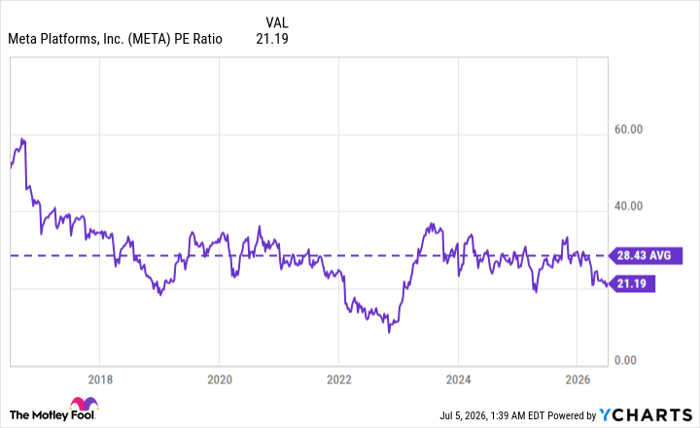
META PE Ratio data by YCharts.
Meta is also significantly cheaper than the Nasdaq-100 index, which has a P/E ratio of 35.2, so it appears to be heavily undervalued next to a basket of its big-tech peers. As a result, I think it could be a solid long-term buy right now, no matter what happens with its potential cloud business.
Should you buy stock in Meta Platforms right now?
Before you buy stock in Meta Platforms, consider this:
The Motley Fool Stock Advisor analyst team just identified what they believe are the 10 best stocks for investors to buy now… and Meta Platforms wasn’t one of them. The 10 stocks that made the cut could produce monster returns in the coming years.
Consider when Netflix made this list on December 17, 2004... if you invested $1,000 at the time of our recommendation, you’d have $418,761!* Or when Nvidia made this list on April 15, 2005... if you invested $1,000 at the time of our recommendation, you’d have $1,195,804!*
Now, it’s worth noting Stock Advisor’s total average return is 918% — a market-crushing outperformance compared to 208% for the S&P 500. Don't miss the latest top 10 list, available with Stock Advisor, and join an investing community built by individual investors for individual investors.
See the 10 stocks »
*Stock Advisor returns as of July 7, 2026.
Anthony Di Pizio has no position in any of the stocks mentioned. The Motley Fool has positions in and recommends Alphabet, Amazon, Meta Platforms, and Microsoft. The Motley Fool has a disclosure policy.
Recommended Articles


