


Sam Altman Called Any OpenAI IPO Valuation Below $1 Trillion a "Nonstarter." Should Investors Prefer OpenAI or SpaceX?
Key Points
SpaceX's impressive IPO may spur more AI companies to go public.
Investors shouldn't be holding their breath for an OpenAI IPO.
- 10 stocks we like better than Space Exploration Technologies ›
Sam Altman, the CEO of OpenAI, reportedly refuses to take the AI company public at any valuation below $1 trillion. There are already ways to invest indirectly in OpenAI, the company behind ChatGPT. But an IPO would finally give investors a chance to participate directly.
Why is Altman so adamant about bringing the company public with at least a $1 trillion valuation? He likely saw the success of Space Exploration Technologies' (NASDAQ: SPCX) IPO, which saw such heavy public demand that the company's market cap quickly soared to over $2 trillion.
Missed Nvidia in 2009? This Rare Signal Is Flashing Again. In 2009, a "Double Down" signal flashed for a little-known chipmaker called Nvidia. For the first time in years, that same "Total Conviction" signal is flashing for a company 1/100th the size of Nvidia. Continue »
While many people still think of SpaceX as a rocket stock, more than 90% of the company's claimed total addressable market deals with a single opportunity: AI. So comparing OpenAI to SpaceX is more appropriate than many realize.
Will OpenAI be a better investment than SpaceX?
According to reports, OpenAI generated roughly $13 billion in revenue in 2025. So far in 2026, it is generating around $2 billion per month in sales, a trend that would suggest full-year 2026 revenue of around $24 billion. If growth trends persist, however, that figure could be much higher, implying at least 100% annual sales growth.
The issue isn't sales growth, but profitability. The company apparently accrued a net loss of $38.5 billion in 2025, while generating a $8.5 billion net loss in the first quarter of 2026. A public IPO would help OpenAI raise cash quickly, with an arguably easier path toward raising future capital.
Keep in mind that SpaceX's AI division is also growing revenues fast, generating large net losses to boot. This is just the reality of operating an AI business today -- the capital intensity of building and operating more data center infrastructure is extremely costly, adding a big drag to accounting profits despite high sales growth.
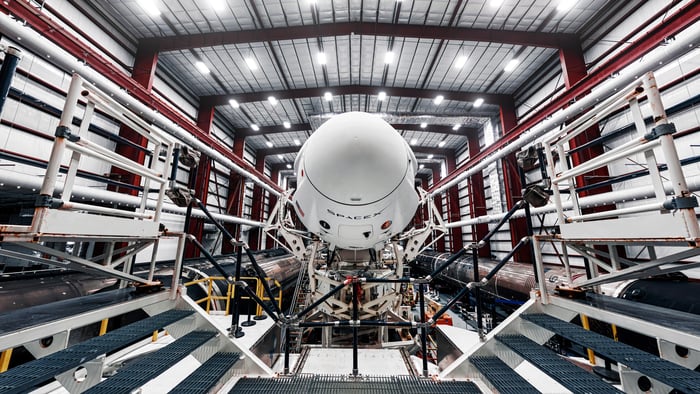
Image source: Getty Images.
Investors should keep in mind that an OpenAI IPO may not arrive for some time. "Am I excited to be a public company CEO? 0%. Am I excited for OpenAI to be a public company? In some ways, I am, and in some ways I think it'd be really annoying," Altman revealed last December. And while OpenAI did officially file for an IPO in early June, the company doesn't seem to be in a hurry to execute a public sale. "We have not decided on timing yet," Altman stressed.
Will OpenAI end up being a better bargain than SpaceX? We'll have minimal concrete details for making that distinction until a public prospectus is filed. That may not even happen this year. The New York Times recently reported that an OpenAI IPO may not occur until 2027.
I'm excited to see more AI giants go public, providing a better relative gauge for how highly SpaceX's AI division is being valued. But I won't be holding my breath for an OpenAI IPO this year.
Should you buy stock in Space Exploration Technologies right now?
Before you buy stock in Space Exploration Technologies, consider this:
The Motley Fool Stock Advisor analyst team just identified what they believe are the 10 best stocks for investors to buy now… and Space Exploration Technologies wasn’t one of them. The 10 stocks that made the cut could produce monster returns in the coming years.
Consider when Netflix made this list on December 17, 2004... if you invested $1,000 at the time of our recommendation, you’d have $418,761!* Or when Nvidia made this list on April 15, 2005... if you invested $1,000 at the time of our recommendation, you’d have $1,195,804!*
Now, it’s worth noting Stock Advisor’s total average return is 918% — a market-crushing outperformance compared to 208% for the S&P 500. Don't miss the latest top 10 list, available with Stock Advisor, and join an investing community built by individual investors for individual investors.
See the 10 stocks »
*Stock Advisor returns as of July 5, 2026.
Ryan Vanzo has no position in any of the stocks mentioned. The Motley Fool has no position in any of the stocks mentioned. The Motley Fool has a disclosure policy.
Recommended Articles


