


Micron Technology Has Fantastic News for This Artificial Intelligence (AI) Infrastructure Stock That Has More Than Doubled in 2026
Key Points
Micron Technology is on track to significantly raise its capex this year, followed by another substantial jump in the next fiscal year.
Lam Research derives a significant portion of its revenue from selling memory manufacturing equipment, which explains why its growth has been robust in recent quarters.
As the memory supply shortage could last until the end of the decade, Lam's growth trajectory could remain solid, sending the stock higher.
- 10 stocks we like better than Lam Research ›
Micron Technology (NASDAQ: MU) delivered fantastic results for the third quarter of fiscal 2026 (which ended on May 28) on June 24. The memory specialist not just crushed Wall Street's expectations by a mile, but its guidance made it clear that the red-hot demand for memory chips isn't going away any time soon.
Micron stock jumped nearly 16% after its blowout quarterly report. The company's performance lifted other memory stocks as well, and Lam Research (NASDAQ: LRCX) was one of them. Lam Research supplies semiconductor manufacturing equipment to chipmakers, foundries, and memory manufacturers. Its shares jumped over 7% following Micron's results. Let's see why that was the case.
Where to invest $1,000 right now? Our analyst team just revealed what they believe are the 10 best stocks to buy right now, when you join Stock Advisor. See the stocks »
Image source: Getty Images.
Booming memory chip demand is boosting Micron Technology's capex
Micron's fiscal Q3 revenue shot up by 346% year over year to $41.5 billion last quarter. However, its earnings per share grew by a whopping 1,215%. Micron management noted on the latest earnings call that demand for both dynamic random-access memory (DRAM) and NAND flash "continues to significantly exceed industry supply."
What's more, management added that the tight supply conditions will persist beyond 2027, primarily due to AI-fueled demand from data centers, high-end personal computers (PCs), smartphones, vehicles, and robots. Also, Micron notes that demand for high-performance, high-value memory chips is increasing to support AI workloads, which is why the company is on track to significantly ramp up the build-out of new capacity.
The addition of new capacity explains why Micron's capital expenditure in fiscal 2026 is going to land at $27 billion. That's nearly double Micron's capex in fiscal 2025. The company also notes that its quarterly capex in fiscal 2027 will be higher than in fiscal Q4. Micron is forecasting $10 billion in capital spending this quarter, indicating that its fiscal 2027 capex will exceed $40 billion.
Importantly, Micron isn't the only memory manufacturer adding new capacity. Korean memory giant SK Hynix intends to double its wafer capacity over the next five years. Samsung, meanwhile, is planning to spend an enormous $648 billion in South Korea over the next decade to shore up chip production, as reported by Reuters.
All this bodes well for Lam Research, which gets 39% of its revenue from selling memory manufacturing equipment. On the other hand, it derives 54% of its revenue from the sale of foundry equipment. So, Lam is in a solid position to sustain the impressive revenue and earnings growth it has been clocking in recent quarters.
Strong memory equipment spending should be a tailwind for Lam Research stock
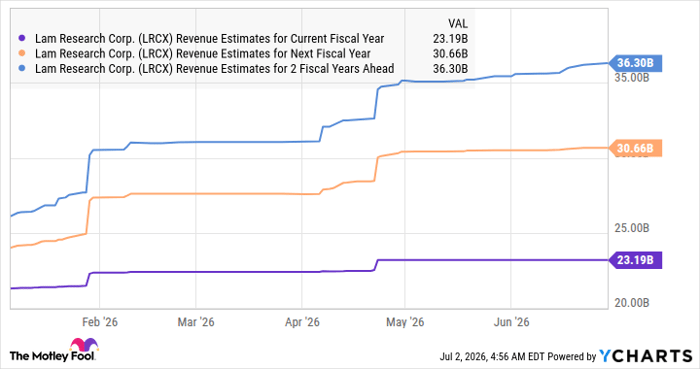
Lam Research's revenue has increased by 24.4% in the first nine months of fiscal 2026 to $16.5 billion. Its fiscal Q4 revenue guidance of $6.6 billion indicates that Lam's top line this year will land at $23.1 billion, an increase of 25% over last year. The strong memory spending environment explains why analysts are expecting a spike in Lam's revenue growth in fiscal 2027, followed by another solid increase in fiscal 2028.
Data by YCharts
However, Lam's growth rate could continue to accelerate beyond fiscal 2027, given that the memory shortage is not expected to ease until 2030. SK Hynix estimates that memory wafer supply will trail demand by 20% through 2030, suggesting that memory manufacturers will need to add more capacity. So, Lam's revenue and earnings growth can exceed Wall Street's expectations over the long run.
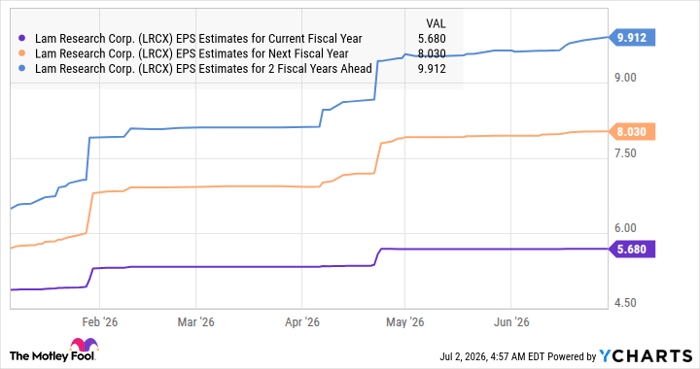
Lam's earnings are expected to increase to $9.91 per share in fiscal 2028, as evidenced by the following chart.
Data by YCharts
Assuming it can clock 20% annual bottom-line growth in fiscal years 2029 and 2030, its earnings per share could increase to $14.27 after four years. If this AI stock trades at 39.5 times earnings at that time (in line with the tech-focused Nasdaq Composite index's average earnings multiple), its price could reach $564. That represents a potential upside of 44% over the next four years, though stronger gains cannot be ruled out, given the solid memory demand and the ongoing supply shortage.
So, it isn't too late for investors to buy this growth stock that has appreciated 111% so far this year, as it is sitting on a terrific catalyst that could send it even higher.
Should you buy stock in Lam Research right now?
Before you buy stock in Lam Research, consider this:
The Motley Fool Stock Advisor analyst team just identified what they believe are the 10 best stocks for investors to buy now… and Lam Research wasn’t one of them. The 10 stocks that made the cut could produce monster returns in the coming years.
Consider when Netflix made this list on December 17, 2004... if you invested $1,000 at the time of our recommendation, you’d have $400,101!* Or when Nvidia made this list on April 15, 2005... if you invested $1,000 at the time of our recommendation, you’d have $1,212,683!*
Now, it’s worth noting Stock Advisor’s total average return is 911% — a market-crushing outperformance compared to 208% for the S&P 500. Don't miss the latest top 10 list, available with Stock Advisor, and join an investing community built by individual investors for individual investors.
See the 10 stocks »
*Stock Advisor returns as of July 2, 2026.
Harsh Chauhan has no position in any of the stocks mentioned. The Motley Fool has positions in and recommends Lam Research and Micron Technology. The Motley Fool has a disclosure policy.
Recommended Articles


