


Prediction: This Will Be the Next AI Stock to Split (Hint: It's Not Micron or Sandisk)
Key Points
Exploding demand for high-bandwidth memory (HBM) has pushed memory chip makers sharply higher, making the Roundhill Memory ETF one of the year's fastest-growing thematic funds.
Most of its assets are invested in a handful of companies, including SK Hynix, Samsung Electronics, and Micron.
The ETF's rapid rise makes a share split later this year a realistic possibility if momentum continues.
- 10 stocks we like better than Roundhill ETF Trust - Roundhill Memory ETF ›
It seems like everyone wants to talk about Nvidia when the conversation turns to artificial intelligence (AI) infrastructure. Fair enough. But there's a quieter, less glamorous part of the AI build-out that has been generating some of the most staggering returns of 2026, and it barely gets a mention in the headlines: memory.
When an AI model runs, it doesn't just need processing power. It requires a large amount of working memory to hold data while computations are performed. The chips doing that job are called high bandwidth memory, or HBM, and the companies that make it are drowning in demand that they can't keep up with.
Where to invest $1,000 right now? Our analyst team just revealed what they believe are the 10 best stocks to buy right now, when you join Stock Advisor. See the stocks »
That demand imbalance is exactly what the Roundhill Memory ETF (NYSEMKT: DRAM) is built around, and if the exchange-traded fund (ETF) keeps climbing the way it has, a stock split may not be far off.
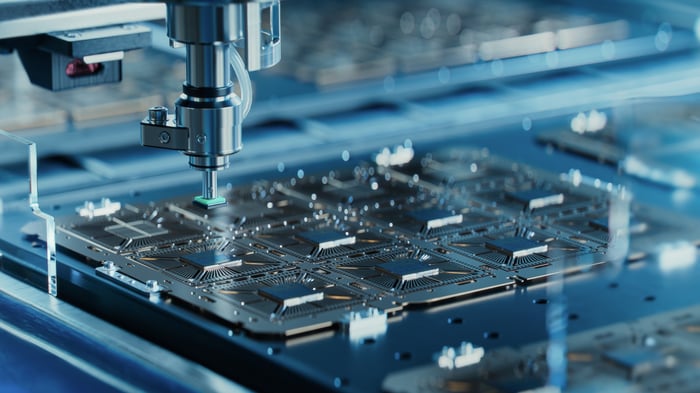
Image source: Getty Images.
A record-breaking launch
The Roundhill Memory ETF only started trading on April 2. In less than 45 days, it gathered nearly $10 billion in net assets, a record pace for ETF asset growth. The price went from around $26 at launch to more than $81 at its peak, a roughly 78% gain in under two months. As of late June, it has pulled back near the $70s, but the trajectory since inception has been hard to ignore.
When an ETF's share price runs this far this fast, fund managers often split the shares to bring the price back into a range that feels more accessible to everyday investors. Roundhill has done this before with other thematic funds. Given the DRAM ETF's trajectory, a split is not just plausible; it's likely. I think it's a reasonable prediction for later this year.
What's actually inside
The fund holds a concentrated group of the world's leading memory chip producers. SK Hynix and Samsung Electronics each account for roughly 24.5% of the portfolio, with Micron Technology at around 26% (including 10% in leveraged shares) and Sandisk rounding things out at 4.8%. That's nearly 80% of the entire fund sitting in four companies.
That concentration is worth understanding before jumping in. This is not a diversified tech fund. It's a direct bet on the memory supply chain, and if that supply chain runs into trouble, there's no cushion from other sectors.
That said, the underlying companies have been performing in a way that's hard to argue with. SK Hynix stock has climbed roughly 300% this year, while Samsung is up around 195%. The reason is straightforward: Demand for HBM chips used in AI accelerators is outpacing supply, and prices are rising as a result. Every time a hyperscaler builds out another cluster of AI servers, memory companies get a piece of that order.
The deeper case for memory
Here's the thing about DRAM and HBM that I think gets underappreciated. The shift toward larger AI models and more complex inference workloads means the memory requirements per chip are growing, not shrinking. Newer architectures stack more HBM on each accelerator than the previous generation. That's not a short-term trend. It's a structural feature of where AI is heading.
The Roundhill Memory ETF essentially packages that thesis into a single ticker. You get exposure to the Korean memory giants, which are difficult for most U.S. retail investors to access directly, alongside Micron and Sandisk. For someone who wants to bet on AI infrastructure without picking individual semiconductor stocks, this is a clean way to do it.
The concentration risk is real. If Micron, Samsung, or SK Hynix hits a rough patch, the ETF will feel it immediately. Memory is also a cyclical industry. Supply constraints have driven prices up sharply, but those same high prices eventually attract more supply, which can compress margins later. The current boom won't last forever.
Still, with a record-setting asset base, a price that has nearly tripled since April, and the structural tailwind of AI memory demand not slowing down, the Roundhill Memory ETF looks like exactly the kind of thematic fund that ends up needing a split before the year is out.
Should you buy stock in Roundhill ETF Trust - Roundhill Memory ETF right now?
Before you buy stock in Roundhill ETF Trust - Roundhill Memory ETF, consider this:
The Motley Fool Stock Advisor analyst team just identified what they believe are the 10 best stocks for investors to buy now… and Roundhill ETF Trust - Roundhill Memory ETF wasn’t one of them. The 10 stocks that made the cut could produce monster returns in the coming years.
Consider when Netflix made this list on December 17, 2004... if you invested $1,000 at the time of our recommendation, you’d have $400,101!* Or when Nvidia made this list on April 15, 2005... if you invested $1,000 at the time of our recommendation, you’d have $1,212,683!*
Now, it’s worth noting Stock Advisor’s total average return is 911% — a market-crushing outperformance compared to 208% for the S&P 500. Don't miss the latest top 10 list, available with Stock Advisor, and join an investing community built by individual investors for individual investors.
See the 10 stocks »
*Stock Advisor returns as of July 2, 2026.
Micah Zimmerman has no position in any of the stocks mentioned. The Motley Fool has positions in and recommends Micron Technology and Nvidia. The Motley Fool has a disclosure policy.
Recommended Articles


