


OpenAI Rumored to Offer 5% Stake to Trump Administration as SoftBank Completes $10 Billion Capital Injection Day Before Yesterday
TradingKey - On July 2, Eastern Time, the Financial Times reported that OpenAI is in talks with the U.S. government regarding a plan to sell a 5% stake. The artificial intelligence startup, valued at $852 billion, is seeking to clear political and regulatory hurdles by securing support from the Trump administration.
According to two people familiar with the matter, OpenAI Chief Executive Sam Altman believes that allowing the public to hold shares in the company is the best way to share the benefits of artificial intelligence, a proposal he raised in early talks with the government. Altman has already engaged with government officials, including President Trump, Commerce Secretary Lutnick, and Treasury Secretary Bessent, on this matter.
According to the report, the proposed plan could involve other U.S. artificial intelligence companies selling similar stakes. Altman and OpenAI executives have suggested that major U.S. AI developers could pool their respective 5% stakes into a public investment vehicle similar to the Alaska Permanent Fund.
However, it remains unclear whether other AI companies are willing to participate, with potential participants possibly including Anthropic, Google ( GOOG L) and Meta ( META ), among others. OpenAI's discussions with the U.S. government are still in the early and conceptual stages, and any transaction may require congressional legislation to implement.
The proposal comes against the backdrop of recent intensive regulatory oversight of the AI industry by the U.S. government. On June 12, the Department of Commerce imposed export controls on Anthropic's Fable 5 and Mythos 5, banning both models; the White House simultaneously intervened in OpenAI's GPT-5.6 release process, requiring a phased, limited roll-out, marking the first time an AI company was required to restrict the release of a new model.
On June 30, the Commerce Department lifted the controls on the Fable 5 and Mythos 5 models, restoring access on July 1. Behind the alternating tightening and loosening of regulation lies division within the Trump administration: one faction advocates for deregulation to maintain a competitive edge, while another pushes for stricter controls. Faced with an uncertain policy environment, OpenAI has opted to trade equity for regulatory certainty.
Just a day before the news emerged, on July 1, SoftBank Group completed its second follow-on investment of $10 billion in OpenAI through SoftBank Vision Fund 2. SoftBank announced in February this year that it would inject an additional $30 billion into OpenAI in three tranches of $10 billion each. The first tranche was received in April, the second was completed on July 1, and the third is scheduled for completion on October 1. Once all three tranches are completed, SoftBank's cumulative investment in OpenAI will reach approximately $64.6 billion, with its stake expected to rise to around 13%.
To raise funds, SoftBank borrowed $10 billion on July 1 under a bridge loan agreement signed on March 27. Meanwhile, SoftBank has resumed talks with a banking syndicate regarding a $10 billion margin loan, planning to pledge its OpenAI shares as collateral and promising for the first time a repayment guarantee by SoftBank itself. The banks involved in the negotiations are expected to include Goldman Sachs ( GS ), JPMorgan Chase ( JPM) and Mizuho Financial Group.
In terms of stock performance, as of the close on July 2, SoftBank Group closed up 3.25% at 6,195 yen, bringing its year-to-date gain to around 37%.
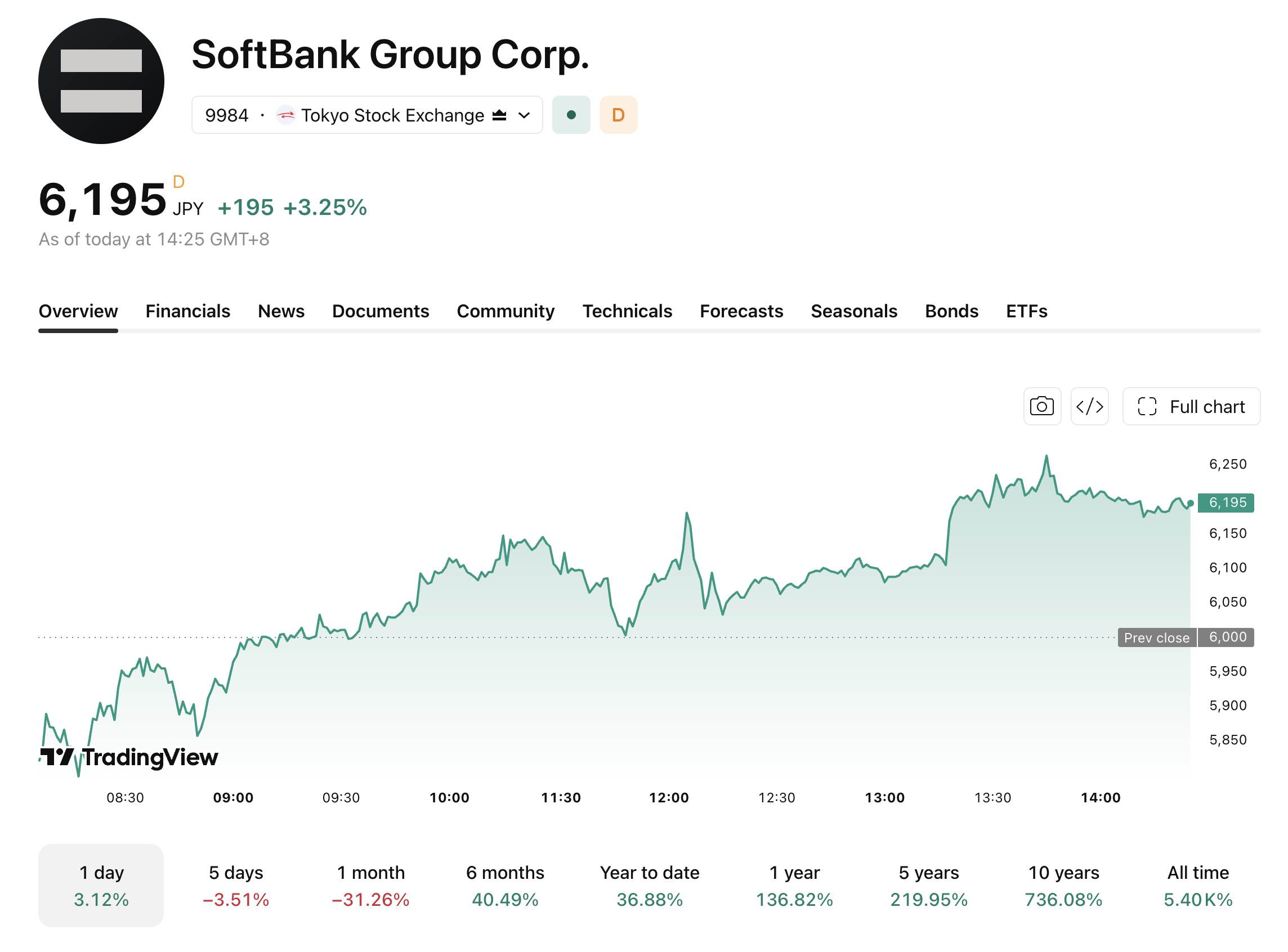
[Source: TradingView]
Analysts note that OpenAI's proposal to transfer equity to the government is essentially an attempt to trade equity for regulatory certainty. The 5% stake corresponds to a value of approximately $42.6 billion. For SoftBank, as one of OpenAI's largest external shareholders, OpenAI's regulatory fate and IPO timeline are directly linked to its investment returns. The market is currently focused on whether Altman's "equity-for-green-light" plan can be implemented and whether OpenAI's IPO process will be accelerated as a result.
Recommended Articles


