


NVIDIA Stock Outlook: Is the AI Trade Over or Is Money Simply Rotating Into Memory Stocks?
TradingKey - NVIDIA (NASDAQ: NVDA) trades at $198.58, having re-tested what was previously support and is now acting as resistance on the 4H chart after rallying on a green candle from the lows of the lower channel. Today marks the sixth straight trading session for NVDA underperforming the S&P 500, its longest streak of relative weakness since Sept. 2025, and still trades 23% lower from its all-time high close of $235.47 in mid-May.
In terms of sector performance, this week's relative underperformance stems from a rotation among institutions that appears to be exiting high-flying AI hardware stocks and into particular subsectors, specifically memory. That's the exact same Micron and Sandisk trade that has been the story of this week for most tech investors, as the Yahoo Finance AlphaSpace data reveals. The stock's current Relative Strength Index (RSI), at 49.54, is in neutral territory and has room to climb from here while also showing no evidence of bearish divergence.
Despite the recent weakness, there are 62 analysts issuing a Strong Buy consensus on the stock with an average price target of $298.93, or about a 53% gain from current levels.
Rotation, Not Retreat — Why Money Moving Into Memory Doesn’t Mean Money Leaving AI
It is arguably the most important thing for NVDA investors to understand about this current six-day period of underperformance relative to the S&P 500. As of this writing, what has been happening this week is a sector rotation. While money has been coming into NVDA, money has also been coming out of it. This is not money leaving the AI trade, but rather, capital reallocation in the AI trade, toward the part of the supply chain that is experiencing the highest demand/supply imbalance.
This week's price action in the sector has seen a rotation out of GPU compute and into memory. Micron’s 84.6% gross margin and Sandisk’s 857% year-to-date return reflect a memory market where demand is outstripping supply badly enough that suppliers are setting their own terms. GPU compute, while still growing robustly, faces a more competitive landscape and the B200 rental price softness covered in NVIDIA’s own recent coverage.
There is a distinction to make here: the fact that money is rotating into AI memory does not suggest that money is leaving AI infrastructure entirely. It just means that it's not just one big AI monolith; there's a market, a supply side, and a demand side. The second component of this rotation is Wall Street's growing impatience with the pace of Big Tech capex.
Wall Street expects Big Tech to spend upwards of $700 billion on AI infrastructure this year, a figure projected to balloon 70% to more than $700 billion this year across the hyperscalers. And while Nvidia may be the most visible beneficiary of that spending, it is by no means the only beneficiary of that growth. It's also worth noting that, with Nvidia being one of the biggest names in AI capex, the company will likely continue to be the biggest beneficiary of Big Tech capex growth.
Wall Street analysts are still calling the sector a "Strong Buy", despite a significant drop in price over the last six days. According to a survey, 62 analysts hold "Strong Buy" ratings on the stock with an average 12-month price target of $298.93. That means they continue to expect Nvidia to be a dominant player in the sector, despite the recent price drop. In short, this is not a sign that Nvidia's dominance will wane in the years to come. It's simply a sign that investors are becoming more impatient with Nvidia's pace of growth. But that doesn't necessarily mean Nvidia's dominance is waning.
Two New Deals Layered on Top of Vera Rubin — Palantir and Firmus Technologies
NVIDIA announced two new deals in addition to the Vera Rubin partnership that add new data points and are marginally positive, but does not change the thesis. Today, NVIDIA and Palantir announced a new plan to deploy the company's NVIDIA Nemotron models within Palantir as an intelligent engine to run NVIDIA AI models across Palantir's current enterprise and government customers and deployments.
Shares of PLTR were up 4% in premarket trades, extending the software ecosystem of Nvidia to Palantir's customers in the defense and intelligence space, an area where the GPU giant historically has had less of a direct footprint as far as software penetration goes, compared to its hyperscaler ties.
Separately today, Nvidia announced a partnership with Australian firm Firmus Technologies to help bring access to AI computing within the region and continue to expand its global footprint in the Asia-Pacific region for its data centers that is separate from restrictions tied to China.
Neither deal individually represents significant revenue numbers for the company in a given quarter, but are part of the breadth strategy the company has pursued as a result of the setbacks in China revenue: expanding the customer base to other verticals (Palantir in the defense and intelligence sector), and expanding it into more global markets (Australia/Firmus in the Asia-Pacific space) helps ensure that the company is not solely dependent on a single group to make up for any shortfall in another customer group.
This is the same story that is behind the RTX Spark consumer PC launch, the Vera Rubin ramp into OpenAI, Anthropic, xAI, Dell, Oracle, and CoreWeave mentioned in previous Nvidia updates: widening of the demand base. If one growth vector slows, others remain to continue the overall stock price gains for the business.
NVDA Technical Setup — Support-Turned-Resistance at $198–$205, RSI 49, Target $221.60
On the 4H time frame, shares of NVDA are testing $198 to $205 after rebounding off the support lows in a descending channel, and that level is serving as resistance, with green candles absorbing any downside selling pressure, the overall descending channel remains in play to $205.02 to $210.02 on lower highs, while RSI at 49.54 is in neutral territory with room to run and has no divergences with the price action that would signal weakness.
Further downside is projected via a breakdown through the current channel to $184.75 to $180.31. However, the descending channel can also project a move to $190.09 to $184.75 in the way of support levels should today's bounce not continue into a more sustainable move. Should NVDA clear $205.00, we can look for a move to $221.60 on the break of channel resistance.
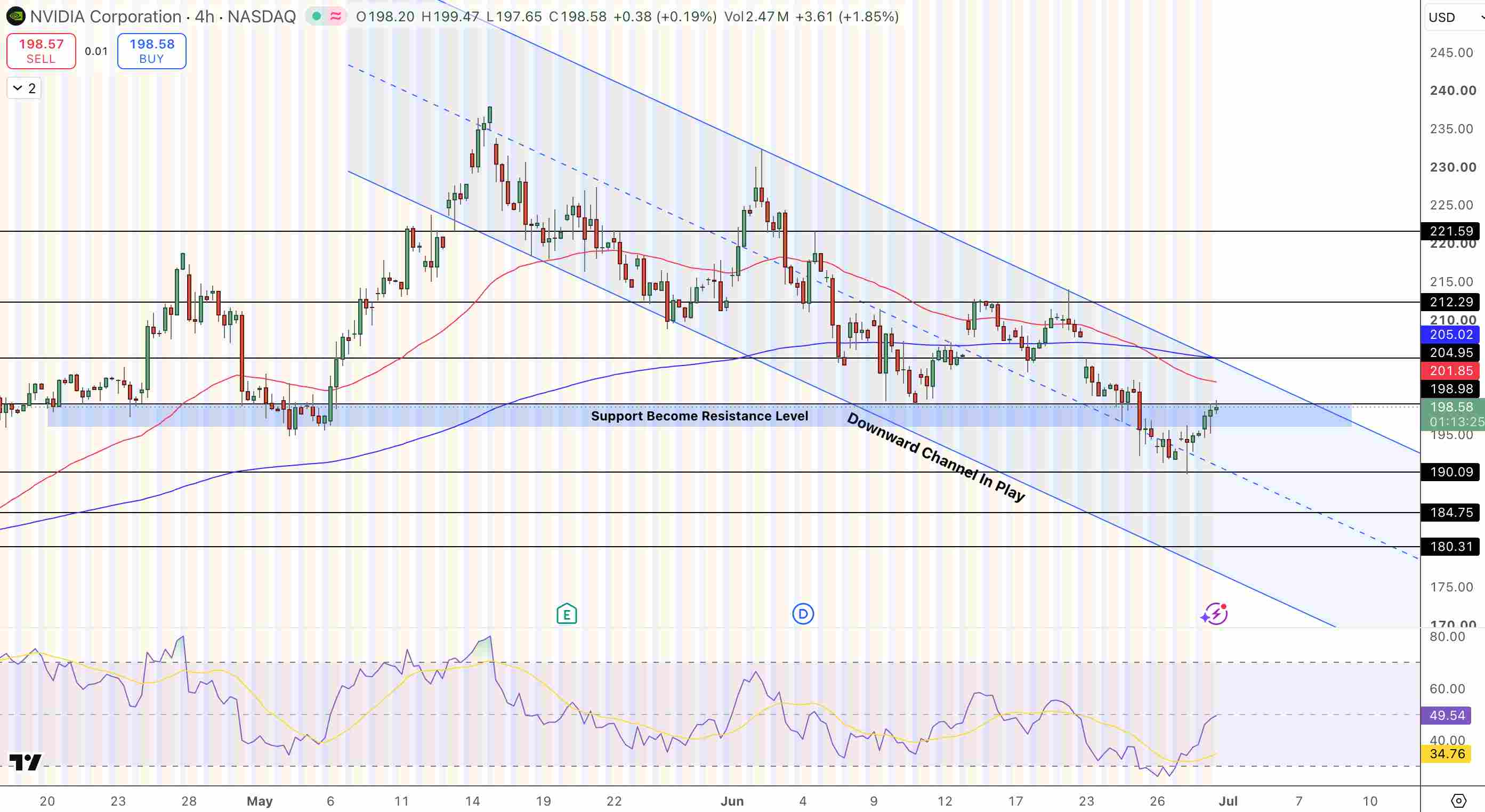
Entry: Long above $205.00 — support-turned-resistance cleared
Target: $221.60 — channel resistance breakout
Support: $190.09–$184.75 — next defence if bounce fails
Stop Loss: Close below $190.10 — support cluster fails
Analyst consensus: Strong Buy, 62 analysts, avg target $298.93 (+53% from current)
Underperformance streak: 6 consecutive days vs S&P 500 — longest since Sept 2025
Bottom Line
NVIDIA’s six-day underperformance streak versus the S&P 500, marking its longest since September 2025, was a sector rotation to memory chips, and not a change in investors’ expectations for the AI boom. Consensus ratings from 62 analysts remain at Strong Buy throughout that time and the average price target also hasn’t budged from $298.93.
The company recently added two new customers with Palantir Technologies and Firmus Technologies. Neither are likely to affect the stock in the near term.
At $198.58, shares of NVDA are testing support-turned-resistance at $198 to $205. The Relative Strength Index of 49.54 remains neutral, with a close above $205.00 in order for a move to $221.60. A stop order needs to be entered at $190.10 and below, with shares 23% below its all-time high from May. Data on Core PCE and further details from hyperscaler earnings commentary regarding capex will determine if the sector rotation is temporary.
Recommended Articles


