

TradingKey Daily Market Brief: AMD and Intel Lead Chip Stocks, Nike Under Pressure After-Hours, Market Focuses on Non-Farm Payrolls Data

Source Tradingkey

Track Market Trends

TradingKey - On June 30, Eastern Time, US stocks continued to march higher in end-of-quarter trading, with AI and chip stocks emerging once again as the core driving force behind the market's upward move. Although uncertainty remains over a Middle East ceasefire and investors continue to focus on the US nonfarm payrolls report due out this week, risk appetite did not recede significantly. The Dow Jones Industrial Average hit another record closing high, while the S&P 500 and Nasdaq Composite also posted strong gains, indicating that capital still prefers to seek opportunities within the tech and AI themes.

At the close, the Dow Jones Industrial Average rose 0.26% to 52,324.22; the S&P 500 Index climbed 0.79% to 7,499.36; and the Nasdaq Composite Index surged 1.52% to 26,213.72.

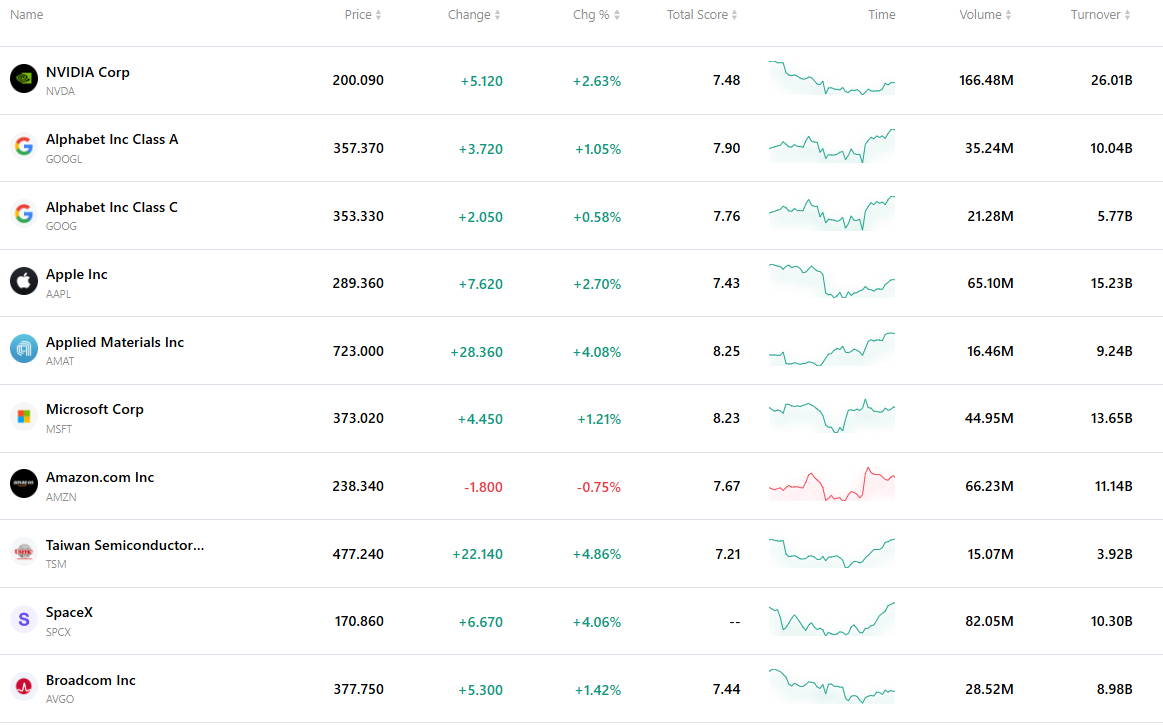
In sectors and individual stocks, chipmakers continued to lead the market higher. Nvidia ( NVDA) rose 2.63%, AMD ( AMD) jumped 7.68%, Micron Technology ( MU) ticked slightly higher, and Intel ( INTC) advanced 6.01%, indicating that market expectations for AI computing power, advanced nodes, and memory chip demand remain robust. Meanwhile, Alphabet ( GOOGL) rose 1.05%, SpaceX ( SPCX) gained 4.06%, and mega-cap tech and AI infrastructure-related stocks overall extended their recovery trend. Nike ( NKE) saw its shares come under pressure in after-hours trading following its earnings release, sliding 2.47%.

In commodity markets, crude oil prices remained weak at the end of the quarter. Brent crude settled down 0.22% at $73.42, while WTI ( USOIL) crude closed at $70.02. As transit through the Strait of Hormuz gradually resumed and previously stranded vessels re-entered the market, concerns over supply disruptions eased significantly. Brent crude fell about 29% for the quarter, and WTI crude lost about 31%, with both posting their largest quarterly declines since 2020.

In precious metals, spot gold ( XAUUSD) edged down 0.05% to around $4,005, with its overall performance in the second quarter remaining weak. Due to a strong US dollar and rising expectations of Fed rate hikes, gold fell about 14% this quarter, marking its worst quarterly performance since 2013.

Market News

The US labor market data has become the macroeconomic focus. JOLTS data released by the US Department of Labor showed that job openings rose to 7.594 million in May, a near two-year high, indicating that corporate hiring demand remains resilient. However, the number of hires fell slightly and the quit rate remained low, suggesting that the labor market is not overheating across the board. Following the release of the data, the market continued to bet that it would be difficult for the Federal Reserve to pivot to easing in the short term. The June non-farm payrolls report, scheduled for release this Thursday, will be a key variable influencing the trend of US stocks, the US dollar, and US Treasury yields.

The Japanese yen continues to hit new multi-year lows. The USD/JPY exchange rate once rose to around 162.66, with the yen falling to its lowest level since 1986. Although the Bank of Japan had previously entered a rate hike cycle, the interest rate differential between the US and Japan remains wide, and carry trades continue to weigh on the yen's performance. Japan's Ministry of Finance has once again signaled potential intervention in the foreign exchange market, but the yen is unlikely to shake off its short-term weakness before the strong dollar and hawkish Fed expectations cool down significantly.

The prospects for US-Iran negotiations are once again clouded. Iran stated that it would not meet directly with the US envoy arriving in Doha, casting further uncertainty over whether previous temporary peace arrangements can be transformed into a long-term agreement. Although the two sides have recently signed a ceasefire agreement, differences remain over rules of passage through the Strait of Hormuz, whether Iran will levy transit fees, and regional security arrangements. The market still needs to watch whether the two sides resume direct contact during the negotiation window, as this will affect energy supply expectations, inflation assessments, and global risk appetite.

Top 10 most active stocks

The table below lists the ten most actively traded stocks in the latest market. Supported by massive trading volume and excellent liquidity, these assets have become key benchmarks for tracking global market dynamics.
stock-1a117f2a95b7412f8254185d4bed97fa

Disclaimer: For information purposes only. Past performance is not indicative of future results.
placeholder
Bitcoin CME gaps at $35,000, $27,000 and $21,000, which one gets filled first?Prioritize filling the $27,000 gap and even try higher.
Author  FXStreet
Aug 22, 2023
Prioritize filling the $27,000 gap and even try higher.
placeholder
Pinduoduo Earnings Incoming: Morgan Stanley Sees Long-Term Profit Potential​Insights – On November 21, Chinese e-commerce giant Pinduoduo (PDD) will release its Q3 2024 earnings.
Author  Mitrade
Nov 20, 2024
​Insights – On November 21, Chinese e-commerce giant Pinduoduo (PDD) will release its Q3 2024 earnings.
placeholder
Elon Musk’s xAI and Neuralink Launch New Funding Rounds​Billionaire Elon Musk recently raised funds for his two high-profile tech companies, xAI and Neuralink.
Author  Insights
Jun 03, 2025
​Billionaire Elon Musk recently raised funds for his two high-profile tech companies, xAI and Neuralink.
placeholder
Bitcoin briefly loses 2025 gains as crypto plunges over the weekend.Bitcoin experienced a sharp decline this weekend, briefly erasing its 2025 gains and dipping below its year-opening value of $93,507. The cryptocurrency fell to a low of $93,029 on Sunday, representing a 25% drop from its all-time high in October. Although it has rebounded slightly to around $94,209, the pressures on the market remain significant. The downturn occurred despite the reopening of the U.S. government on Thursday, which many had hoped would provide essential support for crypto markets. This year initially appeared promising for cryptocurrencies, particularly after the inauguration of President Donald Trump, who has established the most pro-crypto administration thus far. However, ongoing political tensions—including Trump's tariff strategies and the recent government shutdown, lasting a historic 43 days—have contributed to several rapid price pullbacks for Bitcoin throughout the year. Market dynamics are also being influenced by Bitcoin whales—investors holding large amounts of Bitcoin—who have been offloading portions of their assets, consequently stalling price rallies even as positive regulatory developments emerge. Despite these sell-offs, analysts from Glassnode argue that this behavior aligns with typical patterns seen among long-term investors during the concluding stages of bull markets, suggesting it is not indicative of a mass exodus. Notably, Bitcoin is not alone in its struggles, as Ethereum and Solana have also recorded declines of 7.95% and 28.3%, respectively, since the start of the year, while numerous altcoins have faced even steeper losses. Looking ahead, questions linger regarding the viability of the four-year cycle thesis, particularly given the increasing institutional support and regulatory frameworks now in place in the crypto landscape. Matt Hougan, chief investment officer at Bitwise, remains optimistic, suggesting a potential Bitcoin resurgence in 2026 driven by the “debasement trade” thesis and a broader trend toward increased adoption of stablecoins, tokenization, and decentralized finance. Hougan emphasized the soundness of the underlying fundamentals, pointing to a positive outlook for the sector in the longer term.
Author  Mitrade
Nov 17, 2025
Bitcoin experienced a sharp decline this weekend, briefly erasing its 2025 gains and dipping below its year-opening value of $93,507. The cryptocurrency fell to a low of $93,029 on Sunday, representing a 25% drop from its all-time high in October. Although it has rebounded slightly to around $94,209, the pressures on the market remain significant. The downturn occurred despite the reopening of the U.S. government on Thursday, which many had hoped would provide essential support for crypto markets. This year initially appeared promising for cryptocurrencies, particularly after the inauguration of President Donald Trump, who has established the most pro-crypto administration thus far. However, ongoing political tensions—including Trump's tariff strategies and the recent government shutdown, lasting a historic 43 days—have contributed to several rapid price pullbacks for Bitcoin throughout the year. Market dynamics are also being influenced by Bitcoin whales—investors holding large amounts of Bitcoin—who have been offloading portions of their assets, consequently stalling price rallies even as positive regulatory developments emerge. Despite these sell-offs, analysts from Glassnode argue that this behavior aligns with typical patterns seen among long-term investors during the concluding stages of bull markets, suggesting it is not indicative of a mass exodus. Notably, Bitcoin is not alone in its struggles, as Ethereum and Solana have also recorded declines of 7.95% and 28.3%, respectively, since the start of the year, while numerous altcoins have faced even steeper losses. Looking ahead, questions linger regarding the viability of the four-year cycle thesis, particularly given the increasing institutional support and regulatory frameworks now in place in the crypto landscape. Matt Hougan, chief investment officer at Bitwise, remains optimistic, suggesting a potential Bitcoin resurgence in 2026 driven by the “debasement trade” thesis and a broader trend toward increased adoption of stablecoins, tokenization, and decentralized finance. Hougan emphasized the soundness of the underlying fundamentals, pointing to a positive outlook for the sector in the longer term.
placeholder
Gold Price Forecast: Does Gold Falling Below $4,000 Mean the Bull Market Is Over? Will It Still Rise in the Second Half of 2026?Heading into the second half of 2026, the gold market has transitioned from a strong-performing asset at the start of the year into one pulling back from its highs. Recently, gold prices
Author  TradingKey
Jun 29, Mon
Heading into the second half of 2026, the gold market has transitioned from a strong-performing asset at the start of the year into one pulling back from its highs. Recently, gold prices
goTop
quote