


The Buffett Indicator Just Hit an All-Time High. Here's What History Says Comes Next.
Key Points
The total value of U.S. stocks has climbed to about 2.3 times the size of the economy, a record.
The 10 largest companies now make up roughly a third of the S&P 500, most of them tied to artificial intelligence.
Stretched starting valuations have historically meant weaker long-term returns, not an immediate crash.
- 10 stocks we like better than S&P 500 Index ›
There's a stock market gauge that famed investor Warren Buffett once called "probably the best single measure of where valuations stand at any given moment." Recently, it sat higher than at any point in records going back more than half a century.
The measure is simple: the total value of the U.S. stock market divided by the size of the economy, as measured by gross domestic product. It recently climbed past 230%, meaning American stocks are worth about 2.3 times the country's annual economic output. That's a record. For perspective, the same gauge peaked near 140% just before the dot-com bubble burst in 2000.
Where to invest $1,000 right now? Our analyst team just revealed what they believe are the 10 best stocks to buy right now, when you join Stock Advisor. See the stocks »
Warren Buffett himself flagged the risk years ago. When the ratio "approaches 200%," he wrote in a 2001 Fortune essay, "you are playing with fire."
But the market left that mark behind long ago.
So what does history say comes next? And how much of the danger is a genuinely overpriced market versus a handful of enormous artificial intelligence (AI) stocks pulling the average higher?
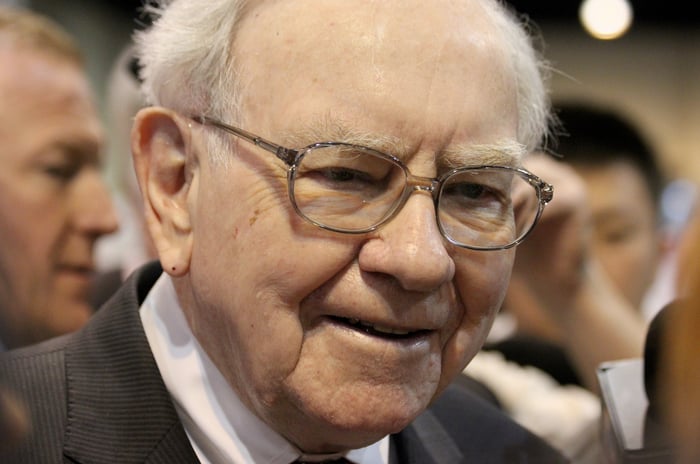
Warren Buffett. Image source: The Motley Fool.
Expensive by almost any measure
The Buffett indicator isn't the only gauge pointing this way. The Shiller cyclically adjusted price-to-earnings ratio, which compares prices to 10 years of inflation-adjusted earnings to smooth out the booms and busts, sits around 41. That's the highest it has been since the 2000 dot-com peak, when it briefly topped 44.
Put those two readings together, and today's market ranks among the most expensive in U.S. history by either gauge. That doesn't guarantee a decline is near. But it does mean anyone buying the broad market today is paying an unusually steep price for each dollar of underlying earnings.
How much is just a few AI stocks?
A lot of how worried you should be comes down to a single word: concentration. The 10 largest companies in the S&P 500 (SNPINDEX: ^GSPC) now make up roughly 35% of the entire index, not far from the record of about 41% set in 2025, and well above the roughly 20% they represented a decade ago.
AI has certainly been a catalyst for some of them. Nvidia, of course, has been a major beneficiary of AI. And Alphabet's soaring stock price over the last 12 months has also been driven by AI.
Whatever the catalyst for this group's strong performance, the biggest companies in the S&P 500 index have been massive drivers for the overall market. In 2025, those 10 names accounted for about 41% of the index's value but only about 32% of its earnings.
Investors, in other words, are paying the steepest premiums for the very stocks driving the market's record valuation.
Part of the reason the Buffett indicator looks so extreme, therefore, is that a small cluster of megacaps has grown to gigantic proportions. But it would be a mistake to dismiss the whole reading as a top-heavy quirk. The Shiller ratio measures the S&P 500, and it's near a record, too.
So, what comes next? History offers a caution rather than a countdown. The last time valuations looked like this, in March 2000, the S&P 500 went on to fall about 49% over the following two and a half years and didn't reclaim its high until 2007. But the same gauge that looks so stretched today has been elevated for years while stocks kept climbing, which is exactly why it works poorly as a market-timing tool.
While there's no way to predict the future, I feel comfortable saying this: A rich starting valuation likely tells you a lot more about the next decade of returns and almost nothing about the next quarter.
What should investors do?
I think keeping expectations modest makes sense, and refraining from investing in stocks that look blatantly overvalued could be wise. What am I personally doing? In addition to remaining invested in equities, I'm holding onto some cash as I wait for more attractive opportunities.
What would change my mind? If valuations cooled off in a meaningful way, or if those megacaps' earnings caught up to their prices, I'd be glad to put that cash to work.
Should you buy stock in S&P 500 Index right now?
Before you buy stock in S&P 500 Index, consider this:
The Motley Fool Stock Advisor analyst team just identified what they believe are the 10 best stocks for investors to buy now… and S&P 500 Index wasn’t one of them. The 10 stocks that made the cut could produce monster returns in the coming years.
Consider when Netflix made this list on December 17, 2004... if you invested $1,000 at the time of our recommendation, you’d have $397,890!* Or when Nvidia made this list on April 15, 2005... if you invested $1,000 at the time of our recommendation, you’d have $1,196,664!*
Now, it’s worth noting Stock Advisor’s total average return is 902% — a market-crushing outperformance compared to 207% for the S&P 500. Don't miss the latest top 10 list, available with Stock Advisor, and join an investing community built by individual investors for individual investors.
See the 10 stocks »
*Stock Advisor returns as of June 30, 2026.
Daniel Sparks and his clients have no position in any of the stocks mentioned. The Motley Fool has positions in and recommends Alphabet and Nvidia. The Motley Fool has a disclosure policy.
Recommended Articles


