


NZD/USD Price Forecast: Recovery faces resistance at 0.5700
- New Zealand Dollar edges higher as ANZ Business Confidence hits a four-month high.
- NZD/USD recovery faces resistance near 0.5700 as the broader downtrend remains intact.
- RSI recovers from oversold territory while the MACD points to easing bearish momentum.
The New Zealand Dollar (NZD) edges higher against the US Dollar (USD) on Tuesday, supported by upbeat New Zealand business confidence data and a modest pullback in the Greenback. At the time of writing, NZD/USD trades around 0.5677, up 0.5% on the day.
The US Dollar Index (DXY), which tracks the Greenback against a basket of six major currencies, trades around 101.23 after hitting an intraday high of 101.43 and remains on track for a second consecutive monthly gain.
ANZ Business Confidence surged to 36.6 in June from 10.0 in the previous month, marking the highest reading since February.
Despite the intraday uptick, NZD/USD remains on track to close the month in negative territory, with losses of around 5.20%. The downside came as the US Dollar strengthened across the board amid rising expectations that the Federal Reserve (Fed) could raise interest rates later this year.
Meanwhile, the lack of progress toward a final US-Iran deal keeps geopolitical risks alive, supporting safe-haven demand for the US Dollar while weighing on risk-sensitive currencies such as the Kiwi.
Traders now turn their attention to this week's US labor market data, including the ADP Employment Change and Nonfarm Payrolls (NFP) reports, which could shape Fed interest rate expectations and drive the next move in NZD/USD.
Technical Analysis:
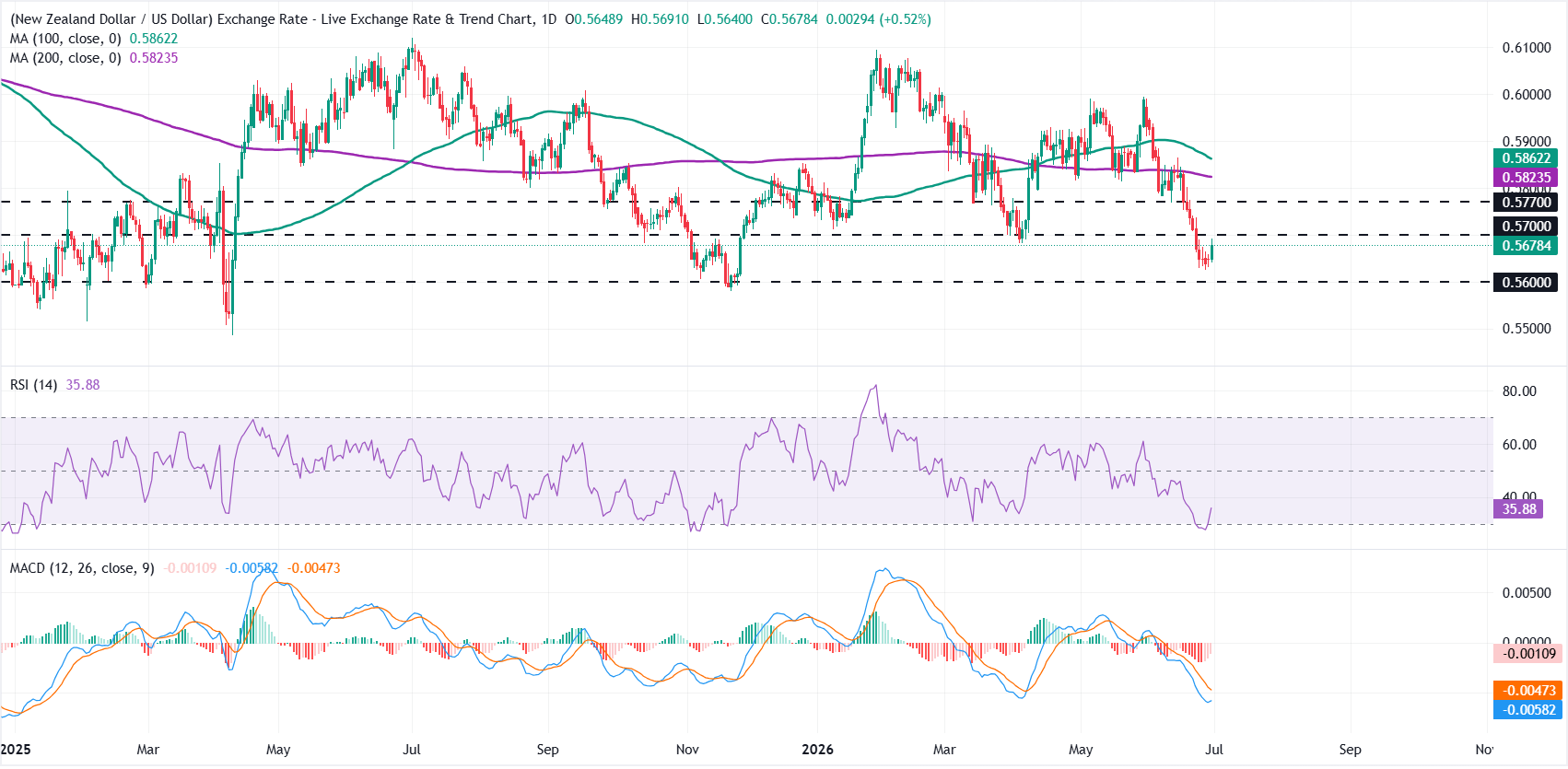
On the daily chart, NZD/USD keeps a bearish near-term tone as it holds below both the 200-day Simple Moving Average (SMA) at 0.5824 and the 100-day SMA at 0.5862.
The pair is pressing against nearby overhead resistance at 0.5700, while the Relative Strength Index (RSI) at 35.5 is recovering from oversold territory and the Moving Average Convergence Divergence (MACD) indicator remains negative with fading red histogram bars, which together hint that downside pressure persists even as selling momentum shows signs of moderating.
On the topside, initial resistance is seen at the horizontal barrier of 0.5700, followed by 0.5770, before the longer-term 200-day SMA at 0.5824 and the 100-day SMA at 0.5862 reinforce a broader caps zone.
On the downside, the next notable support comes at 0.5600, where a break would likely extend the current bearish phase, while holding above this floor would keep the pair consolidating beneath the cluster of daily moving averages.
(The technical analysis of this story was written with the help of an AI tool.)
Nonfarm Payrolls FAQs
Nonfarm Payrolls (NFP) are part of the US Bureau of Labor Statistics monthly jobs report. The Nonfarm Payrolls component specifically measures the change in the number of people employed in the US during the previous month, excluding the farming industry.
The Nonfarm Payrolls figure can influence the decisions of the Federal Reserve by providing a measure of how successfully the Fed is meeting its mandate of fostering full employment and 2% inflation. A relatively high NFP figure means more people are in employment, earning more money and therefore probably spending more. A relatively low Nonfarm Payrolls’ result, on the either hand, could mean people are struggling to find work. The Fed will typically raise interest rates to combat high inflation triggered by low unemployment, and lower them to stimulate a stagnant labor market.
Nonfarm Payrolls generally have a positive correlation with the US Dollar. This means when payrolls’ figures come out higher-than-expected the USD tends to rally and vice versa when they are lower. NFPs influence the US Dollar by virtue of their impact on inflation, monetary policy expectations and interest rates. A higher NFP usually means the Federal Reserve will be more tight in its monetary policy, supporting the USD.
Nonfarm Payrolls are generally negatively-correlated with the price of Gold. This means a higher-than-expected payrolls’ figure will have a depressing effect on the Gold price and vice versa. Higher NFP generally has a positive effect on the value of the USD, and like most major commodities Gold is priced in US Dollars. If the USD gains in value, therefore, it requires less Dollars to buy an ounce of Gold. Also, higher interest rates (typically helped higher NFPs) also lessen the attractiveness of Gold as an investment compared to staying in cash, where the money will at least earn interest.
Nonfarm Payrolls is only one component within a bigger jobs report and it can be overshadowed by the other components. At times, when NFP come out higher-than-forecast, but the Average Weekly Earnings is lower than expected, the market has ignored the potentially inflationary effect of the headline result and interpreted the fall in earnings as deflationary. The Participation Rate and the Average Weekly Hours components can also influence the market reaction, but only in seldom events like the “Great Resignation” or the Global Financial Crisis.
Recommended Articles


