


If a Stock Market Crash Is Coming, History Shows This Stock Will Be a Brilliant Buy
Key Points
This company tends to outperform the market during recessions.
It has a highly resilient and reliable business and a rock-solid balance sheet.
The dividend program is another great reason to consider buying this stock.
- 10 stocks we like better than Johnson & Johnson ›
Although geopolitical tensions have eased and oil prices have fallen, there is still the very real possibility that the U.S. could be headed toward a recession, as some economists have been warning. After all, inflation remains elevated, and that could trigger a slowdown in consumer activity, with a domino effect across much of our economy. We don't know for sure whether that will happen, but it's always a good idea for investors to prepare for such a scenario. Purchasing shares of companies that can perform better than most during recessions and market downturns is a great idea. Johnson & Johnson (NYSE: JNJ) is an excellent choice in that regard. Here is why.

Image source: The Motley Fool.
Where to invest $1,000 right now? Our analyst team just revealed what they believe are the 10 best stocks to buy right now, when you join Stock Advisor. See the stocks »
A recession-resistant company
Johnson & Johnson tends to outperform broader equities during recessions and market downturns. Let's take two examples. First, the 2008 financial crisis, triggered by the collapse of the housing market, impacted the entire economy, including the stock market. That recession lasted about 18 months, from December 2007 to June 2009. Here is how Johnson & Johnson performed throughout it all compared to the S&P 500.
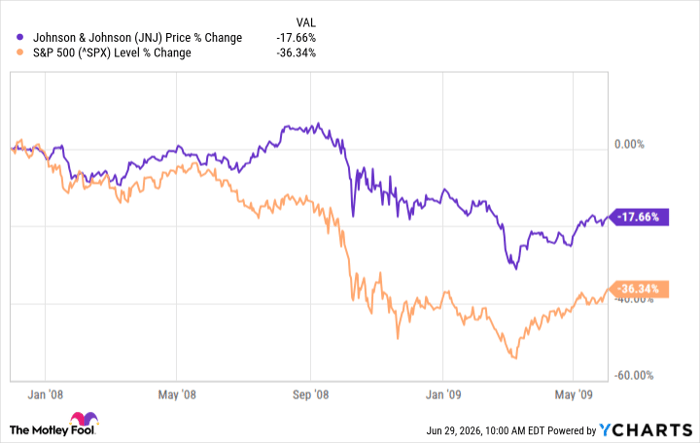
JNJ data by YCharts
Next, the 2020 recession and associated market crash, which resulted from the coronavirus pandemic. This one was short, lasting only about two months. And once again, Johnson & Johnson outperformed the average.
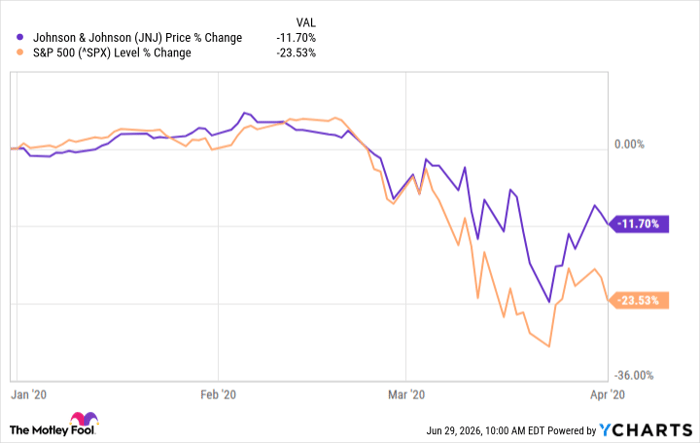
JNJ data by YCharts
Are these just flukes? Not at all. Johnson & Johnson's business is equipped to perform well throughout the economic cycle. The company operates in a defensive sector: healthcare. Medical goods and services aren't among the first things patients want to cut, even when their purse strings tighten. That's especially the case with lifesaving drugs. Johnson & Johnson has a vast portfolio of pharmaceutical products across many areas. The company also has a deep pipeline that allows it to earn brand-new approvals fairly regularly.
Then there is Johnson & Johnson's medical device business, which offers products that help physicians treat a range of serious conditions across cardiovascular health, surgery, and other areas. Johnson & Johnson's medtech unit is also recession-resistant. The company's diversified healthcare business is an important reason it performs relatively well even when the going gets rough. Further, Johnson & Johnson has a strong balance sheet, as evidenced by its AAA credit rating from S&P Global (the highest possible). This means investors don't have to worry about Johnson & Johnson failing to meet its obligations, even in a recession.
There is more where that came from
The bears might argue that the past is no guarantee of future performance. Additionally, Johnson & Johnson has faced challenges in recent years. The company has dealt with patent cliffs, most recently for Stelara, an immunology medicine that was a meaningful growth driver. Johnson & Johnson is also navigating government-led drug price negotiations in the U.S. Several of the company's medicines have already been targeted, and things could get even worse for the healthcare leader over the long run.
Also, Johnson & Johnson has yet to shake off the lawsuits that allege that its talc-based products caused cancer. Could these problems eventually catch up to the company and sink its stock price? My view is that Johnson & Johnson will be fine -- and remains a top recession pick -- despite these obstacles. The company has navigated the loss of patent exclusivity for Stelara very well. Sales and earnings continue to grow at a good clip for the company. That also goes for drug price negotiations. Johnson & Johnson's guidance implies healthy top-line growth in 2026 despite that.
And it's worth noting that in its more than 100-year history, the pharmaceutical giant has survived -- and thrived -- despite significant legal and regulatory changes in the U.S. healthcare system, including the introduction of Medicare and Medicaid in the 60s. Further, Johnson & Johnson's robust balance sheet and credit rating show that it isn't at risk of financial ruin despite the talc-related lawsuits. Lastly, the company is a fantastic income stock. Johnson & Johnson is a Dividend King, or a company with at least 50 consecutive annual payout increases. Johnson & Johnson's current streak is at 64. That means the company has raised its dividends through many recessions, and investors can expect more of the same moving forward. That's why the stock remains a top pick to prepare for an economic downturn.
Should you buy stock in Johnson & Johnson right now?
Before you buy stock in Johnson & Johnson, consider this:
The Motley Fool Stock Advisor analyst team just identified what they believe are the 10 best stocks for investors to buy now… and Johnson & Johnson wasn’t one of them. The 10 stocks that made the cut could produce monster returns in the coming years.
Consider when Netflix made this list on December 17, 2004... if you invested $1,000 at the time of our recommendation, you’d have $397,890!* Or when Nvidia made this list on April 15, 2005... if you invested $1,000 at the time of our recommendation, you’d have $1,196,664!*
Now, it’s worth noting Stock Advisor’s total average return is 902% — a market-crushing outperformance compared to 207% for the S&P 500. Don't miss the latest top 10 list, available with Stock Advisor, and join an investing community built by individual investors for individual investors.
See the 10 stocks »
*Stock Advisor returns as of June 30, 2026.
Prosper Junior Bakiny has positions in Johnson & Johnson. The Motley Fool recommends Johnson & Johnson. The Motley Fool has a disclosure policy.
Recommended Articles


