

The Dividend ETF That Belongs in Almost Every Long-Term Portfolio

Source The Motley Fool

Key Points

  • The Schwab U.S. Dividend Equity ETF holds 100 top-quality dividend stocks.

  • Its holdings have above-average yields and strong five-year dividend growth rates.

  • The ETF should provide investors with a growing income stream and robust total return potential.

  • 10 stocks we like better than Schwab U.S. Dividend Equity ETF ›

Dividend stocks make ideal long-term investments. Ned Davis Research and Hartford Funds have found that since 1973, dividend stocks in the S&P 500 have delivered an average annual return of 9.2%, more than double the return of non-dividend-paying stocks (4.2%).

One of the easiest ways to invest in dividend stocks is through an exchange-traded fund (ETF). Here's why the Schwab U.S. Dividend Equity ETF (NYSEMKT: SCHD) belongs in almost any investor's long-term portfolio.

Where to invest $1,000 right now? Our analyst team just revealed what they believe are the 10 best stocks to buy right now, when you join Stock Advisor. See the stocks »
Blocks spelling out ETF with the words exchange-traded funds next to them.

Image source: Getty Images.

Focused on the top dividend stocks

The Schwab U.S. Dividend Equity ETF's goal is to track the Dow Jones U.S. Dividend 100 Index. That index measures the performance of about 100 high-yielding U.S. stocks with a consistent dividend record. It selects them based on several quality characteristics, including dividend yield, five-year dividend growth rate, and strong financial metrics.

The index reconstitutes its holdings once a year to emphasize higher quality holdings. It will add companies that stand out in its screening process while deleting those that have cut their payouts or have lower dividend qualities. That helps ensure it focuses on holding the highest-quality dividend stocks.

As a result, the fund holds companies that pay higher-yielding dividends that steadily grow. For example, at the index's last annual reconstitution, its holdings had an average dividend yield of 3.4% (about three times the S&P 500's current 1.1% yield) while delivering an average annual dividend growth rate of 9.4%.

Why dividend growth matters

The Schwab U.S. Dividend Equity ETF's dual focus on yield and growth is noteworthy. While data from Ned Davis Research and Hartford Funds show that dividend stocks generally outperform non-payers, dividend growers delivered much higher returns (10.2%) than companies with no change in their policy (6.9%) and dividend cutters and eliminators (-1%).

By screening for stocks with high dividend yields and strong growth, the Schwab U.S. Dividend Equity ETF has historically provided investors with a growing stream of dividend income and strong total returns.

Here's a look at the fund's quarterly dividend payment throughout its history:
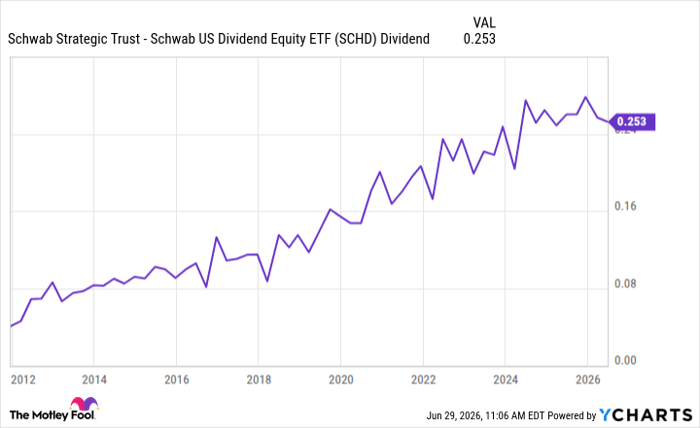
SCHD Dividend Chart

SCHD Dividend data by YCharts

The ETF should continue to provide investors with an above-average, steadily growing income stream.

The main driver of long-term dividend growth is earnings growth. That also supports long-term stock price appreciation. As a result, the fund's holdings tend to appreciate, boosting its total return. Here's a look at its annualized return performance over the years:

Fund

1-Year

3-Year

5-Year

10-Year

Since inception (10/20/2011)

SCHD

29%

16.2%

8.7%

12.9%

13.3%

Data source: Schwab Asset Management.

A no-brainer dividend ETF to hold for the long haul

The Schwab U.S. Dividend Equity ETF focuses on high-yielding dividend-growth stocks. As a result, it provides investors with an above-average income stream and strong total return potential. That combination should earn it a place in almost any investor's portfolio.

Should you buy stock in Schwab U.S. Dividend Equity ETF right now?

Before you buy stock in Schwab U.S. Dividend Equity ETF, consider this:

The Motley Fool Stock Advisor analyst team just identified what they believe are the 10 best stocks for investors to buy now… and Schwab U.S. Dividend Equity ETF wasn’t one of them. The 10 stocks that made the cut could produce monster returns in the coming years.

Consider when Netflix made this list on December 17, 2004... if you invested $1,000 at the time of our recommendation, you’d have $397,890!* Or when Nvidia made this list on April 15, 2005... if you invested $1,000 at the time of our recommendation, you’d have $1,196,664!*

Now, it’s worth noting Stock Advisor’s total average return is 902% — a market-crushing outperformance compared to 207% for the S&P 500. Don't miss the latest top 10 list, available with Stock Advisor, and join an investing community built by individual investors for individual investors.

See the 10 stocks »

*Stock Advisor returns as of June 30, 2026.

Matt DiLallo has positions in Schwab U.S. Dividend Equity ETF. The Motley Fool has no position in any of the stocks mentioned. The Motley Fool has a disclosure policy.

Disclaimer: For information purposes only. Past performance is not indicative of future results.
placeholder
Bitcoin CME gaps at $35,000, $27,000 and $21,000, which one gets filled first?Prioritize filling the $27,000 gap and even try higher.
Author  FXStreet
Aug 22, 2023
Prioritize filling the $27,000 gap and even try higher.
placeholder
Pinduoduo Earnings Incoming: Morgan Stanley Sees Long-Term Profit Potential​Insights – On November 21, Chinese e-commerce giant Pinduoduo (PDD) will release its Q3 2024 earnings.
Author  Mitrade
Nov 20, 2024
​Insights – On November 21, Chinese e-commerce giant Pinduoduo (PDD) will release its Q3 2024 earnings.
placeholder
Elon Musk’s xAI and Neuralink Launch New Funding Rounds​Billionaire Elon Musk recently raised funds for his two high-profile tech companies, xAI and Neuralink.
Author  Insights
Jun 03, 2025
​Billionaire Elon Musk recently raised funds for his two high-profile tech companies, xAI and Neuralink.
placeholder
Bitcoin briefly loses 2025 gains as crypto plunges over the weekend.Bitcoin experienced a sharp decline this weekend, briefly erasing its 2025 gains and dipping below its year-opening value of $93,507. The cryptocurrency fell to a low of $93,029 on Sunday, representing a 25% drop from its all-time high in October. Although it has rebounded slightly to around $94,209, the pressures on the market remain significant. The downturn occurred despite the reopening of the U.S. government on Thursday, which many had hoped would provide essential support for crypto markets. This year initially appeared promising for cryptocurrencies, particularly after the inauguration of President Donald Trump, who has established the most pro-crypto administration thus far. However, ongoing political tensions—including Trump's tariff strategies and the recent government shutdown, lasting a historic 43 days—have contributed to several rapid price pullbacks for Bitcoin throughout the year. Market dynamics are also being influenced by Bitcoin whales—investors holding large amounts of Bitcoin—who have been offloading portions of their assets, consequently stalling price rallies even as positive regulatory developments emerge. Despite these sell-offs, analysts from Glassnode argue that this behavior aligns with typical patterns seen among long-term investors during the concluding stages of bull markets, suggesting it is not indicative of a mass exodus. Notably, Bitcoin is not alone in its struggles, as Ethereum and Solana have also recorded declines of 7.95% and 28.3%, respectively, since the start of the year, while numerous altcoins have faced even steeper losses. Looking ahead, questions linger regarding the viability of the four-year cycle thesis, particularly given the increasing institutional support and regulatory frameworks now in place in the crypto landscape. Matt Hougan, chief investment officer at Bitwise, remains optimistic, suggesting a potential Bitcoin resurgence in 2026 driven by the “debasement trade” thesis and a broader trend toward increased adoption of stablecoins, tokenization, and decentralized finance. Hougan emphasized the soundness of the underlying fundamentals, pointing to a positive outlook for the sector in the longer term.
Author  Mitrade
Nov 17, 2025
Bitcoin experienced a sharp decline this weekend, briefly erasing its 2025 gains and dipping below its year-opening value of $93,507. The cryptocurrency fell to a low of $93,029 on Sunday, representing a 25% drop from its all-time high in October. Although it has rebounded slightly to around $94,209, the pressures on the market remain significant. The downturn occurred despite the reopening of the U.S. government on Thursday, which many had hoped would provide essential support for crypto markets. This year initially appeared promising for cryptocurrencies, particularly after the inauguration of President Donald Trump, who has established the most pro-crypto administration thus far. However, ongoing political tensions—including Trump's tariff strategies and the recent government shutdown, lasting a historic 43 days—have contributed to several rapid price pullbacks for Bitcoin throughout the year. Market dynamics are also being influenced by Bitcoin whales—investors holding large amounts of Bitcoin—who have been offloading portions of their assets, consequently stalling price rallies even as positive regulatory developments emerge. Despite these sell-offs, analysts from Glassnode argue that this behavior aligns with typical patterns seen among long-term investors during the concluding stages of bull markets, suggesting it is not indicative of a mass exodus. Notably, Bitcoin is not alone in its struggles, as Ethereum and Solana have also recorded declines of 7.95% and 28.3%, respectively, since the start of the year, while numerous altcoins have faced even steeper losses. Looking ahead, questions linger regarding the viability of the four-year cycle thesis, particularly given the increasing institutional support and regulatory frameworks now in place in the crypto landscape. Matt Hougan, chief investment officer at Bitwise, remains optimistic, suggesting a potential Bitcoin resurgence in 2026 driven by the “debasement trade” thesis and a broader trend toward increased adoption of stablecoins, tokenization, and decentralized finance. Hougan emphasized the soundness of the underlying fundamentals, pointing to a positive outlook for the sector in the longer term.
placeholder
Ethereum smart contract deployments reach new 8.7M high in Q4Token Terminal data revealed that smart contracts deployed on the Ethereum network hit an all-time high of 8.7 million in the fourth quarter of 2025.
Author  Cryptopolitan
Dec 29, 2025
Token Terminal data revealed that smart contracts deployed on the Ethereum network hit an all-time high of 8.7 million in the fourth quarter of 2025.
goTop
quote